



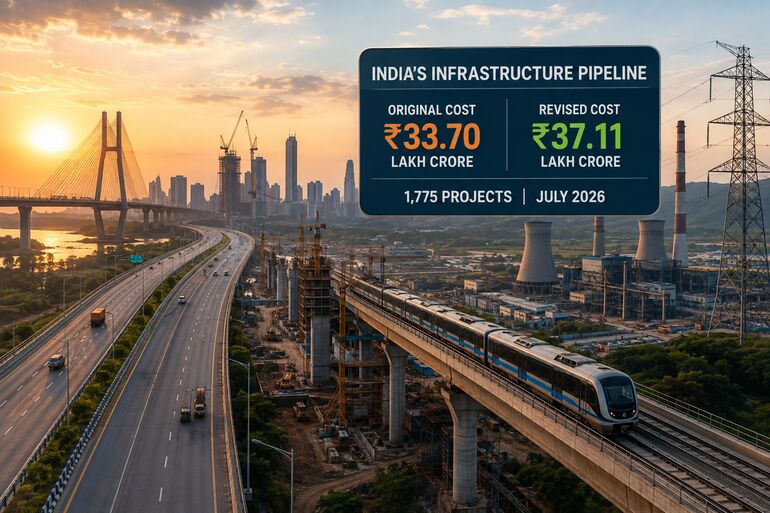
India’s infrastructure pipeline is getting larger, but so is the estimated bill attached to it. The combined revized cost of 1,775 ongoing Central Sector infrastructure projects monitored by the Ministry of Statistics and Programme Implementation (MoSPI) has reached ₹37.11 lakh crore as of July 2026, compared with an original estimated cost of ₹33.70 lakh crore.
The difference works out to roughly ₹3.40 lakh crore, highlighting the scale of cost escalation across India’s major infrastructure pipeline. The figures were released by MoSPI in its July 2026 Flash Report on Central Sector Infrastructure Projects costing ₹150 crore and above.
1,775 Projects Under Monitoring
According to the government data, MoSPI is monitoring 1,775 ongoing infrastructure projects across 17 Central Ministries and Departments through its PAIMANA project-monitoring platform. The projects had an aggregate original cost of ₹33.70 lakh crore. Their combined revized cost has since increased to ₹37.11 lakh crore.
The government also reported that cumulative expenditure on these projects had reached ₹19.26 lakh crore, equivalent to around 51.91% of the revized project cost. The figures indicate the enormous scale of infrastructure spending currently under implementation across the country.
What Does The ₹3.40 lakh Crore Increase Mean?
The ₹3.40 lakh crore figure represents the difference between the aggregate original and revized costs of the projects being monitored. It is important, however, not to interpret this as meaning that all 1,775 projects individually recorded cost overruns.
The MoSPI release does not specify the exact number of individual projects that experienced a cost increase. Instead, the figure reflects the change in the combined estimated cost of the monitored project portfolio. That distinction is important when assessing the latest infrastructure data.
Roads And Highways Account For The Largest Project Count
The Ministry of Road Transport and Highways has the largest number of projects among the ministries covered by the monitoring exercise. It accounts for 993 projects or around 56% of the total number being monitored. Their combined revized cost stands at approximately ₹9.62 lakh crore.
The Ministry of Railways follows with 190 projects, carrying a revized cost of about ₹6.38 lakh crore. The Ministry of Coal accounts for another 121 projects, with a revized cost of approximately ₹2.22 lakh crore.
Other major ministries and departments covered by the monitoring exercise include Petroleum and Natural Gas, Power, Housing and Urban Affairs, and the Department of Water Resources, River Development and Ganga Rejuvenation.
Transport and Logistics Dominate India’s Infrastructure Pipeline
The sector-wise numbers underline the importance of connectivity-related investment in India’s infrastructure programme. The Transport and Logistics sector accounts for the largest share, with 1,246 projects and a combined revized cost of around ₹19.81 lakh crore. That represents approximately 70% of the projects and 53% of the total revized project cost covered in the report. The category includes major infrastructure areas such as roads and highways, railways, aviation, urban public transport, shipping and inland waterways.
The Energy sector is the second-largest category, accounting for 205 projects with a revized cost of around ₹10.66 lakh crore. Energy projects include investments in areas such as oil and gas infrastructure, electricity generation, transmission and distribution, and energy storage.
More Than 675 Projects Have Crossed 80% Physical Progress
The MoSPI data also provides a picture of how far the projects have progressed. As many as 675 projects or around 38% of the monitored portfolio have achieved more than 80% physical progress. Another 305 projects or approximately 17% have crossed the 80% mark in financial completion. The distribution suggests that the infrastructure pipeline contains projects at very different stages from recently launched projects to those approaching completion.
MoSPI said physical and financial progress broadly move together, although the relationship varies across different stages of implementation.
735 Mega Projects Form A Major Part Of The Investment Pipeline
Of the 1,775 projects being monitored, 735 are classified as mega projects with a project cost of ₹1,000 crore or more. These projects had an original aggregate cost of approximately ₹28.77 lakh crore. The remaining 1,040 projects fall into the major-project category, covering projects costing below ₹1,000 crore and up to ₹150 crore.
Their combined original cost was around ₹4.93 lakh crore. The numbers demonstrate how heavily the overall infrastructure investment pipeline is weighted towards large-scale projects.
36 New Projects Added To The Monitoring System
The infrastructure pipeline also expanded during July. MoSPI said 36 additional projects were brought under PAIMANA monitoring during the month. Among them were 16 projects from the Department of Telecommunications, nine from the Ministry of Steel, six from the Ministry of Road Transport and Highways, three from the Department for Promotion of Industry and Internal Trade, and projects from the Ministry of Housing and Urban Affairs and the Ministry of Power.
Some of the newly monitored projects carry particularly large investment requirements. These include the Meja Thermal Power Project, Stage-II, involving three 800 MW units, with a reported project cost of around ₹38,358 crore and Jaipur Metro Rail Project Phase 2 estimated at approximately ₹13,037.66 crore.
Several Major Projects Commissioned In July
The government’s July update also recorded the commissioning of several infrastructure projects. Among them were the Srikakulam-Angul Gas Pipeline Project estimated at ₹2,810 crore and road projects including the Aligarh-Kanpur Package I and Dwarka Expressway Package III.
A transmission project for evacuation of power from the potential renewable energy zone in Gujarat’s Khavda area was also listed among the projects commissioned during the month.
What the Latest Cost Data Reveals
The latest MoSPI data offers a snapshot of both the scale and complexity of India’s infrastructure build-out. A revized project cost can reflect several factors during the life of a project, including changes in scope, implementation conditions, input costs, delays and other factors. Therefore, the ₹3.40 lakh crore increase should not automatically be treated as a single measure of inefficiency. At the same time, the gap between original and revized estimates is significant enough to highlight why close monitoring of large infrastructure projects matters.
With thousands of crores committed across roads, railways, energy, telecommunications, water and other sectors, changes in project estimates can have a substantial impact on overall public investment requirements.
The Bigger Picture
India’s infrastructure programme continues to be dominated by transportation and energy, with these two sectors accounting for the overwhelming majority of the revized project cost tracked by MoSPI. The July data also shows a mixed project pipeline: hundreds of projects are nearing completion, while dozens of new projects are entering the monitoring system.
The next update is already on the calendar. MoSPI is scheduled to release its August 2026 Flash Report on September 25, providing a fresh look at project progress, expenditure and revized costs.
Source: Ministry of Statistics and Programme Implementation (MoSPI), Flash Report on Central Sector Infrastructure Projects worth ₹150 crore and above – July 2026, released through the Press Information Bureau (PIB).

1 Comment
Pingback: Yash Highvoltage Expands US Presence with ENSALES