



India’s private space industry is entering a more mature phase, with the country’s startup base expanding, private rocket launches moving closer to regular commercial activity and the government looking at ways to simplify the regulatory process for companies operating across the space sector.
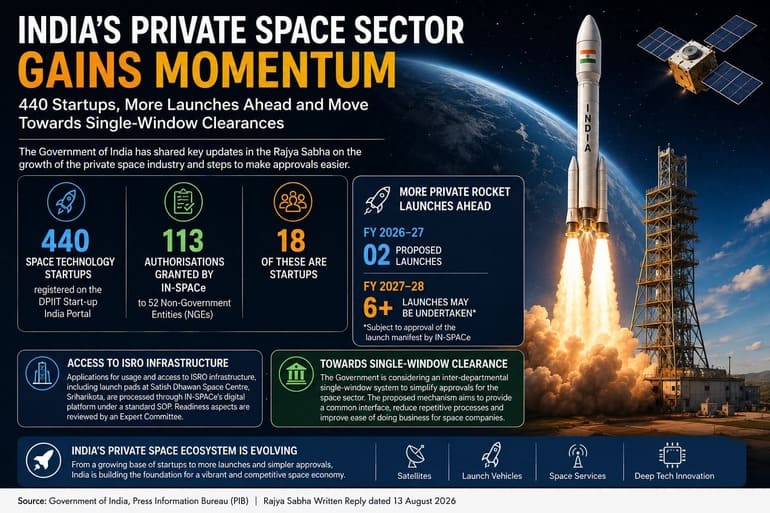
According to the latest information provided by the Government of India in the Rajya Sabha, around 440 space technology startups are registered on the DPIIT Start-up India Portal.
At the same time, the Indian National Space Promotion and Authorisation Centre (IN-SPACe) has granted 113 authorizations to 52 Non-Government Entities (NGEs) for carrying out various space activities. Of these authorized entities, 18 are startups.
The figures were provided by Union Minister of State for Prime Minister’s Office, Personnel, Public Grievances and Pensions, Atomic Energy and Space, Dr Jitendra Singh in a written reply in the Rajya Sabha on 13th August, 2026.
From Space Startups To Commercial Missions
The growing startup numbers are increasingly being accompanied by activity closer to the operational end of the space value chain. The government says two commercial rockets are proposed to be launched by Indian private companies in FY 2026-27. For FY 2027-28, the launch manifest has not yet been approved by IN-SPACe. However, the government expects that more than six launches may be undertaken by Indian private companies during that financial year.
The wording is significant. While two launches are proposed for FY 2026-27, the figure for FY 2027-28 remains an expectation until IN-SPACe approves the launch manifest. It would therefore be premature to treat the potential six-plus launches as a confirmed schedule. Nevertheless, the projection indicates how India’s private space ecosystem is beginning to move from startup formation and technology development towards repeated commercial launch activity.
Also Read: PM Modi’s 2047 Vision Puts Chips, Energy and Critical Minerals in Focus
Who Are The Authorized Startups?
The government has identified 18 startups among the authorized NGEs. They include Agnikul Cosmos, Akshath Aerospace, Azista BST, Bellatrix Aerospace, Cosmoserv Space India, Dhruva Space, Digantara Research and Technologies, GalaxEye Space Solutions, HEX20Labs India, Inorbit Space Telecommunications, Manastu Space Technologies, NSpace Tech India, OrbitAID Aerospace, PierSight Space, PixxelSpace India, Skyroot Aerospace, Space Kidz India and TakeMe2Space Technologies. These companies represent different segments of the emerging private space ecosystem, spanning launch technologies, satellites, space situational awareness, communications and other space-related applications.
The presence of startups across multiple parts of the value chain is important because the development of a private space economy depends on more than launch vehicles alone.
Access To ISRO Infrastructure Remains Important
For private launch companies, one of the major advantages of India’s space ecosystem is access to established national infrastructure. The government says applications for the use and access of ISRO infrastructure, including launch pads at the Satish Dhawan Space Centre in Sriharikota are processed through IN-SPACe’s digital platform under a standard operating procedure.
An Expert Committee of IN-SPACe reviews readiness-related aspects of the applications. This infrastructure-sharing framework can be particularly important for private companies developing launch vehicles and other space systems because building an entirely independent launch and testing infrastructure can require substantial time and investment.
But What About Regulatory Approvals?
As the number of private space companies grows, another issue becomes increasingly important: how easily can a company navigate approvals involving different government authorities? This is where the discussion around a broader single-window clearance mechanism for the space sector becomes relevant.
IN-SPACe itself was created as an autonomous, single-window nodal agency to promote, enable, authorize and supervise space activities by non-government entities. It also facilitates access to ISRO infrastructure and acts as an interface between the private sector and the government. The proposed broader approach goes a step further by looking at how approvals that involve multiple government departments or ministries can be co-ordinated through a common interface. The objective is straightforward: instead of a space company having to navigate separate processes with different authorities, a more integrated system could make applications easier to submit, track and process.
Also Read: “Made in India” Isn’t Enough: From Wheels to Code, Priyank Rakholiya on Building the Indian EV
Why A Single-Window System Could Matter
A private space company does not necessarily deal with only one regulatory requirement. Depending on its business model, a company may need to interact with different authorities for matters connected with space activity, telecommunications, satellite communications, spectrum, broadcasting or other regulatory requirements.
A fragmented approval process can increase administrative work and extend the time required to bring a project from development to commercial operation. A co-ordinated single-window system could potentially reduce this friction by creating a common interface while allowing the relevant departments to carry out their respective statutory reviews.
The concept is also consistent with the broader objective behind India’s space-sector reforms: creating a more predictable environment for private participation and improving ease of doing business. IN-SPACe’s mandate already includes inter-departmental coordination and facilitating regulatory approvals.
This is not the same as saying all approvals will come from one agency There is an important distinction here.
IN-SPACe is already the single-window agency for authorization of space activities. A broader inter-departmental single-window mechanism would be aimed at improving coordination where a company’s activities require interaction with authorities beyond IN-SPACe. In other words, the objective would not necessarily be to remove the role of individual ministries or regulators. Instead, the emphasis would be on creating a smoother interface between the applicant and the different government authorities involved. That distinction matters as the proposal develops.
A Private Space Ecosystem Taking Shape
Taken together, the latest developments show that India’s private space story is no longer limited to the number of startups entering the sector. The country now has around 440 registered space technology startups, while 52 non-government entities have received 113 IN-SPACe authorizations, including 18 startups. Private companies are also preparing for more commercial rocket launches, with two proposed in FY 2026-27 and more than six potentially possible in FY 2027-28, subject to approval of the launch manifest.
At the same time, efforts to improve coordination between government authorities could become increasingly important as the sector expands. The combination of companies, capital, technology, launch infrastructure and regulatory access will ultimately determine how quickly India’s private space ecosystem can scale.
For startups, the next challenge is therefore not simply entering the space sector. It is getting from an approved project to a commercially viable mission and doing so in a regulatory environment that is predictable, coordinated and efficient. India’s private space sector is consequently moving into a phase where the quality of the ecosystem may matter as much as its size.
The coming years will show whether the growing number of startups and planned private launches can translate into a sustained commercial space industry with Indian companies competing across the global value chain.
Source: Government of India, Press Information Bureau, Department of Space, Rajya Sabha written reply on private companies in the space sector, August 13, 2026.
