



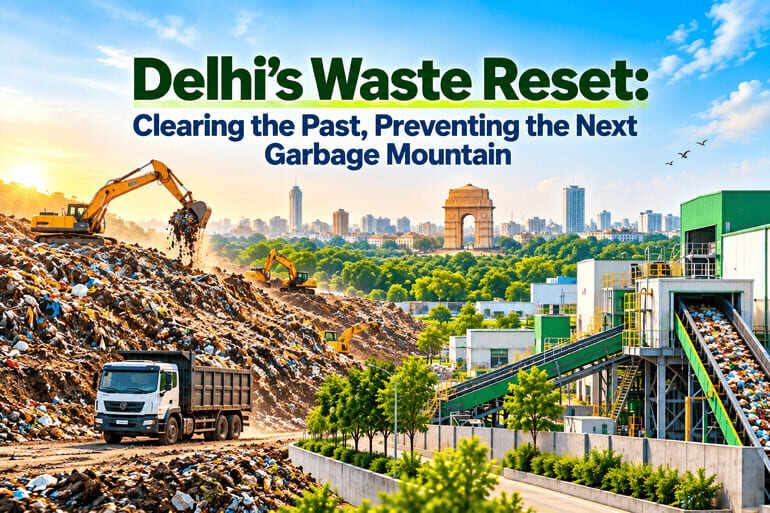
Delhi is taking a two-front approach to its long-running waste problem: clearing the legacy waste accumulated at its major landfill sites while ensuring that fresh waste does not create new garbage mountains.
The strategy was highlighted by Hon’ble Delhi Chief Minister Smt. Rekha Gupta during her inspection of the Okhla landfill site on 03rd October, where she reviewed ongoing waste disposal work and laid the foundation stone for new fresh-waste processing facilities at Okhla, Ghazipur and Singhola.
The Chief Minister said the Delhi government has reclaimed around 100 acres of land across the city’s three major landfill sites: Okhla, Bhalswa and Ghazipur over the past one-and-a-half years. According to the government, around 217.17 lakh metric tonnes of waste has been disposed of from these sites during this period.
Clearing Old Waste while Managing New Waste
The key point behind the government’s latest approach is that clearing existing landfill waste is only one part of the challenge. Fresh waste continues to arrive every day, creating the risk of new accumulations if it is not processed quickly.
The Chief Minister said around 3,000-4,000 metric tonnes of fresh waste reaches the sites daily and stressed that it needs to be processed continuously to prevent new garbage mountains from forming. She said almost all the waste at Okhla that existed before January 2025 had been processed, while the newer waste is now being handled through ongoing processing operations.
This explains why the government is combining legacy-waste remediation with new processing capacity.
New Waste Processing Plants Planned
The three facilities announced on 03rd October are intended to increase Delhi’s ability to handle fresh waste. The Okhla plant will have a reported capacity of 1,400 tonnes per day and is being developed at a cost of ₹103 crores. The Singhola facility will have a capacity of 800 tonnes per day, with a reported cost of ₹42 crores, while the Ghazipur plant will have a capacity of 700 tonnes per day. A separate biogas facility is also being developed at Ghazipur.
Together, the three processing plants represent around 2,900 tonnes per day of planned processing capacity. The government says the facilities will process fresh waste as well as construction and demolition waste, with useful outputs such as biogas, green energy and manure forming part of the wider waste-to-resource approach.
The Rules Driving Delhi’s Waste Reset
The development also comes as Delhi implements the Solid Waste Management Rules, 2026, which came into force nationally on 01st April. The rules require waste to be segregated into wet, dry, sanitary and special-care waste at source and establish responsibilities for waste generators and bulk waste generators. They also provide for stronger monitoring, environmental compensation for specified violations and time-bound management of legacy waste.
The new approach is designed to manage waste from the moment it is segregated at source through collection and transportation, followed by processing and recovery with only the remaining waste moving towards final disposal.
The success of this system will therefore depend not only on how quickly old garbage is removed or how many new plants are constructed, but also on whether waste remains properly segregated throughout collection and transportation.
Delhi’s Two-Front Waste Strategy
The government’s current strategy can be summed up simply: deal with yesterday’s waste while preventing today’s waste from becoming tomorrow’s garbage mountain. The progress at Okhla, Bhalswa and Ghazipur will determine how much old landfill land can be reclaimed, while the new processing facilities are intended to reduce the flow of fresh waste towards landfill sites.
The next indicators to watch will be the quantity of legacy waste actually processed, land reclaimed, fresh waste handled by the new facilities and the amount ultimately requiring landfill disposal. The new system also places an important responsibility on Delhi residents, who need to segregate waste correctly before handing it over for collection.
The Chief Minister’s 03rd October visit therefore represents more than another landfill inspection. It highlights a broader shift in Delhi’s waste strategy: clearing the garbage mountains that already exist while building a system designed to prevent new ones from taking their place.

1 Comment
Pingback: Delhi Landfills: Where Does Old Waste Go?