



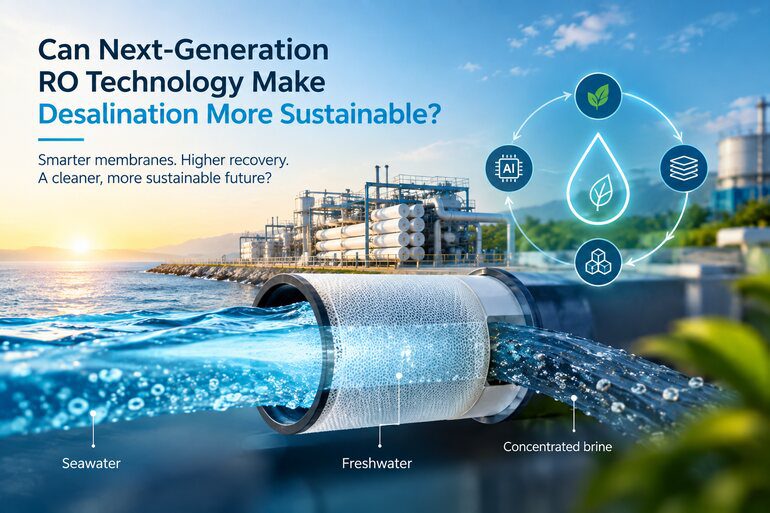
Imagine a city where every drop of seawater is squeezed so efficiently that almost nothing goes to waste. That’s the promise of the next wave of reverse osmosis (RO) technology, and it could change how the world thinks about freshwater forever.
Reverse osmosis has already transformed desalination. It’s the workhorse behind most of the world’s seawater and brackish water plants, thanks to its high salt rejection, scalability and relatively low energy use. However, the industry’s next challenge isn’t just making more freshwater. It’s making that water with less energy, higher recovery, fewer chemicals and a much smaller brine footprint.
That’s where things are getting interesting.
The Real Problem Isn’t Salt; It’s What’s Left Behind
Conventional seawater RO is excellent at removing salt. The tougher question: what happens to everything the membrane rejects?
RO produces a concentrated brine stream. As plants push for higher water recovery, that brine gets saltier. Eventually, osmotic pressure, scaling, fouling and membrane durability hit hard limits. As energy experts note, saltier water demands higher pressure, and membrane strength ultimately caps how concentrated the feed can be.
In short: the race is no longer about better salt removal. It’s about what comes after.
High-Recovery RO: Getting More Water, Less Brine
One of the most promising shifts is towards high-recovery configurations like closed-circuit reverse osmosis (CCRO).
Instead of running continuously like a traditional multi-stage RO system, CCRO circulates water through the membranes while progressively concentrating the brine. This can boost recovery while keeping scaling and fouling in check. Real-world results are catching attention.
A municipal water-reuse application using CCRO reported 95% overall recovery, compared with around 85% for the highest-recovery multi-stage reuse RO plant cited by the operator. That difference matters. Every extra percentage point of recovery means less water lost to concentrate and less brine to manage.
But high recovery isn’t a magic fix. As recovery climbs, systems move closer to physical limits set by osmotic pressure and mineral precipitation. That’s why the latest research focuses on combining RO with additional concentration technologies rather than expecting one membrane to do everything.
The Next Frontier: Concentrating Brine Without Burning More Energy
This may be the most important development in the sector. New approaches, including high-pressure RO (HPRO), low-salt-rejection RO (LSRRO), osmotically assisted RO (OARO) and cascading osmotically mediated RO (COMRO) are being tested to treat increasingly concentrated brines.
A 2026 assessment found that OARO and COMRO can maintain useful performance at brine concentrations where conventional methods struggle, while HPRO and LSRRO offer other pathways to extend membrane-based concentration.
This matters because conventional thermal concentration and crystallization can be highly energy-intensive, so the opportunity lies in using membranes for as much of the concentration as possible and reserving thermal processes only for the final, most difficult fraction.
Recent research describes this as a potential route to minimal liquid discharge (MLD) and zero liquid discharge (ZLD) systems. But economics remain critical: emerging technologies haven’t yet displaced established thermal crystallization across the market.
Also Read: Aimtron Electronics Enters New Global Engagement with Curtiss-Wright
Smarter Membranes: From Lab Breakthroughs to Real-World Durability
The other major innovation front is the membrane itself. Researchers are exploring graphene-based materials, graphene oxide nanocomposites, biomimetic structures and other engineered surfaces to improve the classic permeability-versus-selectivity trade-off.
The appeal is clear: if a membrane lets more water pass while maintaining high salt rejection, plants could achieve the same output at lower pressure.
Recent work on porous graphene oxide, for example, has reported improved separation performance alongside anti-fouling and long-term stability in experimental thin-film composite membranes.
Nanoporous graphene membranes are also drawing interest because their ultra-thin structures could theoretically deliver much higher water permeability while maintaining salt rejection. But there’s a crucial gap between lab performance and commercial-scale deployment. Manufacturing consistency, durability, fouling resistance, defect control and cost must all be solved before these materials can compete with mature polyamide RO membranes at industrial scale.
The future of RO won’t be decided by whichever membrane achieves the highest lab flux. It will be decided by whichever technology delivers reliable performance for years at commercially acceptable cost.
AI Could Become as Important as Membrane Chemistry
Another emerging shift: Intelligent Desalination Plants. Fouling and scaling are expensive because operators must balance water production, membrane performance, chemical dosing, cleaning cycles and energy use. Artificial Intelligence and Machine Learning models are increasingly being tested for predictive fouling control, process optimization and digital-twin applications. A 2026 review highlights AI/ML-enabled digital twins as an emerging route for predictive fouling management and process optimization.
This could prove more valuable than it sounds. A membrane doesn’t have to become dramatically better if software can help an operator consistently run an existing system closer to its optimum operating point. The real opportunity, then is the combination of better membranes + better process design + better monitoring + better control.
Also Read: Maharashtra’s Nuclear Moment: What JSW Energy and Torrent Power Are Planning
Brine as a Resource, Not Waste
This is where the industry’s sustainability narrative is changing most significantly. Instead of viewing brine solely as a disposal problem, developers are increasingly looking at resource recovery. Magnesium, calcium, sodium chloride and other valuable materials can potentially be recovered from concentrated streams.
Recent research describes the shift from brine disposal towards integrated resource recovery, while emerging systems combine membrane concentration with crystallization and other recovery processes.
Commercial developments are moving in the same direction. In 2026, new high-pressure RO elements entered the market, designed for higher brine concentration and improved water recovery in MLD and ZLD applications. These membranes can concentrate brine to levels of up to 220 g/L NaCl, extending membrane treatment into applications that have traditionally relied on more energy-intensive thermal processes.
The important point to note here is higher concentration doesn’t automatically equal sustainability. The additional pressure, equipment, pre-treatment and downstream processing must all be considered.
So, Can RO Become More Sustainable?
Yes, but probably not through one breakthrough membrane. The most convincing future for RO is an integrated one.
Instead of viewing desalination as:
Seawater → RO → freshwater + waste brine
The industry is moving towards:
Seawater → pretreatment → high-efficiency RO → high-recovery concentration → resource recovery → minimal discharge
That’s a more complicated system, but potentially a much more sustainable one. The numbers already show where the industry is heading. Conventional RO remains highly competitive, but new research is pushing recovery higher, advanced membranes are targeting permeability and fouling limitations, and high-pressure and osmotic-assisted processes are extending membrane treatment into increasingly concentrated brines.
The Real Test: Commercial Scale
A technology that delivers impressive results in a lab is interesting. A technology that can operate reliably for years, withstand fouling and scaling, reduce energy consumption, minimize brine, survive real-world feedwater variability and compete on the cost of water is transformative.
That’s where the next phase of reverse osmosis will be decided. The future of desalination may not be about replacing RO. It may be about making RO smarter, pushing it further and integrating it with technologies that can solve the problems RO cannot solve alone.

1 Comment
Pingback: Seco X Tip Drill Simplifies Holemaking