



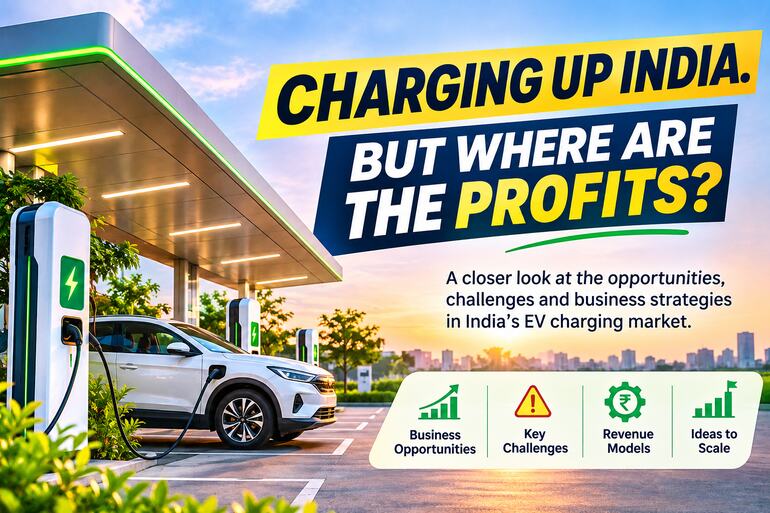
India’s electric vehicle transition is creating a growing market for charging infrastructure, but the EV charging business is not yet a guaranteed money-maker. While the number of charging stations is increasing, many operators are struggling to attract enough customers to recover their investment. For entrepreneurs considering setting up an EV charging station, the real opportunity lies not simply in installing chargers, but in identifying the right customers, choosing a commercially viable location and building a business model that can generate consistent revenue.
The market is expanding and the government is encouraging private participation. However, investors need to look beyond the headline growth figures and understand the economics of running a charging network before committing capital.
India’s EV Charging Network Is Growing, but Is Demand Keeping Pace?
India’s public EV charging infrastructure has expanded considerably. A report by Rubix Data Sciences, Rubix Sectoral Insights: India’s Charge Point Operator (CPO) Landscape estimates that the country had 29,151 public EV charging stations in December 2025, almost six times the number recorded in 2022. The increase reflects the growing focus on building the supporting infrastructure required for electric mobility.
The expansion has continued into 2026. Data from the Ministry of Heavy Industries indicates that India had 67,657 EV chargers installed as of 07th August, 2026, including infrastructure associated with battery-swapping facilities. While the figures point to a rapidly developing charging ecosystem, they also highlight the importance of distinguishing between the number of charging stations and the total number of individual chargers installed across the country.
This is one of the biggest challenges facing investors. A charging station can have modern equipment, multiple charging points and a prominent location, but if vehicles rarely use it, the operator still has to pay for electricity infrastructure, rent, maintenance, software, staff and other operating expenses.
The lesson is straightforward: the number of chargers installed is not the same as the number of profitable charging sessions delivered.
Also Read: E100 Fuel Takes the Spotlight as India Changes Motor Vehicle Rules
Where Are the Business Opportunities for New EV Charging Operators?
The market offers several opportunities, but entrepreneurs should select a business model based on the vehicles and customers they intend to serve.
-
Fleet and Commercial Vehicle Charging
One of the more promising opportunities is to serve electric vehicle fleets. Electric three-wheelers, taxis, delivery vehicles, buses and commercial fleets require regular charging to remain operational.
Unlike occasional public users, fleet operators can offer a more predictable pattern of electricity consumption. A charging business could enter into agreements with logistics companies, e-commerce delivery operators, taxi services, bus operators or electric three-wheeler fleet owners.
For example, an operator could develop a dedicated charging facility near a logistics hub or establish a depot-based charging arrangement for a fleet that returns to the same location every day.
The advantage is the potential for repeat business and planned charging schedules. However, investors must secure customer commitments and understand the fleet’s daily energy requirements before investing in chargers.
-
Highway and Intercity Charging Stations
As electric passenger vehicles become more common, demand for charging along highways and intercity routes is expected to develop further.
Highway charging locations can attract travellers who need faster charging and convenient access to food, restrooms, parking and other facilities. Partnerships with highway restaurants, hotels, fuel stations and commercial property owners can help operators access established locations without necessarily purchasing land.
However, highway charging requires careful planning. Investors must assess traffic volume, EV movement along the route, nearby competing chargers, electricity availability and the time customers are likely to spend at the site.
A location with heavy conventional vehicle traffic may not necessarily have enough electric vehicle demand to support a charging station.
-
Charging at Malls, Offices and Commercial Properties
Shopping malls, office complexes, hotels, hospitals and residential communities can offer opportunities for destination charging.
Customers may be willing to charge their vehicles while shopping, working, attending appointments or staying at a hotel. This can make better use of parking time and provide an additional service to property owners.
Instead of purchasing land, entrepreneurs could partner with property developers, parking operators and commercial establishments. The charging operator provides the equipment and manages the service, while the property owner contributes parking space and access to customers.
The commercial arrangement must clearly establish who pays for electricity, who manages the connection, how revenue is shared and who is responsible for maintenance.
-
Battery Swapping and Charging for Two- and Three-Wheelers
Battery swapping can offer another business opportunity, particularly in segments where vehicles operate for long hours and cannot afford extended charging breaks.
Electric two-wheelers, three-wheelers and delivery fleets may benefit from swapping networks where compatible batteries can be exchanged quickly. Entrepreneurs could explore partnerships with battery-swapping companies, vehicle manufacturers and fleet operators.
However, battery swapping is not a universal solution. Battery compatibility, standardization, inventory costs and the ability to attract enough regular users must be evaluated before setting up a swapping facility.
Also Read: EIM Launches Electric Heavy-Duty Vehicle Complex with 5,000-Vehicle Capacity
What Can Make an EV Charging Business More Profitable?
A sustainable charging business may need more than one source of income. Depending on the location and customer segment, operators can explore:
Charging fees: Revenue from electricity sold to individual EV owners and fleet customers.
Fleet contracts: Monthly agreements or minimum consumption commitments with commercial vehicle operators.
Property partnerships: Revenue-sharing arrangements with malls, hotels, offices and parking operators.
Advertising and retail partnerships: Additional income from advertising displays, food outlets, convenience stores and other services at suitable locations.
Charging management services: Operating and maintaining chargers for property owners, fleet companies or other infrastructure investors.
Energy management: Integrating solar power, battery energy storage systems (BESS) and smart charging where the economics justify the additional investment.
Battery storage deserves particular attention. A battery energy storage system can store electricity when it is available and release it during periods of higher demand. At suitable sites, this may help manage peak loads, reduce pressure on grid connections and improve energy management.
However, solar panels and storage systems also require capital investment. Their financial benefits depend on electricity tariffs, demand patterns, equipment costs and the site’s operating requirements. They should be assessed through a project-specific financial model rather than treated as automatic cost-saving solutions.
Government Support: What Should Investors Know?
The government has taken steps to encourage charging infrastructure development. Setting up EV charging stations has been notified as an unlicensed activity, allowing private entities to participate in the sector under the applicable Ministry of Power guidelines.
The PM E-DRIVE scheme has allocated ₹2,000 crore for public EV charging infrastructure, including public charging stations, battery-swapping stations and battery-charging stations. Its operational guidelines provide for capital subsidies for eligible infrastructure, with support levels varying according to the location category.
However, entrepreneurs should understand an important distinction: the scheme does not mean that every individual setting up a private charging station automatically receives a subsidy. Eligible government entities, public-sector organizations and state-level agencies submit proposals through designated nodal agencies, and private charge point operators may participate in implementation.
Investors should therefore check the latest scheme guidelines, state EV policies, eligibility conditions and available tenders before including subsidy support in their financial projections.
The Challenges That Can Turn an Investment into a Loss
The biggest risk is investing before establishing demand. A charging station may take time to attract customers and low utilization can make it difficult to recover fixed expenses.
Several factors deserve attention before the project begins:
- Incorrect site selection: A high-rent location with limited EV movement can become a financial burden. Assess actual EV traffic, nearby fleets, parking patterns and competing charging facilities.
- High electricity and infrastructure costs: Electricity tariffs, demand charges, connection expenses and grid upgrades can significantly affect operating margins. Obtain a clear estimate from the local distribution company before finalizing the project.
- Expensive land and rentals: Avoid committing to long-term, high-cost leases without evidence of sufficient charging demand. Revenue-sharing or partnership arrangements may reduce upfront exposure.
- Low charger utilization: A station needs regular charging sessions to cover its operating costs. Build a customer base through fleet agreements, property partnerships and local business tie-ups rather than depending entirely on walk-in users.
- Maintenance and downtime: Chargers that are frequently unavailable can damage customer confidence and reduce revenue. Budget for preventive maintenance, repair support, software, payment systems and reliable customer service.
- Technology and compatibility: Select equipment suited to the vehicles expected to use the station. Consider connector compatibility, charging speeds, software interoperability, payment convenience and the ability to upgrade equipment as demand changes.
A Smarter Way to Enter the EV Charging Market
For first-time investors, starting with a smaller, demand-backed project may be more prudent than immediately developing a large public charging hub.
Begin by identifying the customer segment: private EV owners, delivery fleets, taxis, buses or commercial vehicles. Study the charging requirements of that segment, map competing stations and assess the availability and cost of electricity at potential locations.
Next, prepare a financial model that includes land or rental expenses, chargers, civil and electrical work, grid connection, software, maintenance, staff, electricity costs, financing and taxes. Calculate how many charging sessions or units of electricity must be sold each month to cover expenses.
Run different scenarios rather than relying on an optimistic utilization estimate. What happens if customer numbers take twice as long to build? Can the business survive if electricity costs increase? What if a major fleet customer leaves? Maintaining sufficient working capital and negotiating flexible site agreements can provide a buffer against these risks.
The Opportunity Is in Building a Charging Business, Not Just a Charging Station
India’s EV charging market has room for new participants, but long-term success will depend on how well operators match infrastructure with actual demand.
Fleet charging, highway networks, destination charging, battery swapping and energy management offer different routes to growth. The strongest opportunities are likely to emerge where operators can secure repeat customers, control fixed costs and deliver reliable service.
For entrepreneurs, the key is to resist the temptation to build first and search for customers later. A carefully selected location, a clear revenue model, committed demand and realistic financial planning can make the difference between an underused charging asset and a scalable EV infrastructure business.
References:
1. Rubix Data Sciences – Rubix Sectoral Insights: India’s Charge Point Operator (CPO) Landscape
2. Ministry of Heavy Industries, Government of India – EV Charging Stations
3. Ministry of Heavy Industries – EV charger installation figures as of August 7, 2026
*Disclaimer: This article is intended for informational purposes only. Readers should conduct independent research and seek professional advice before making investment or business decisions.
