



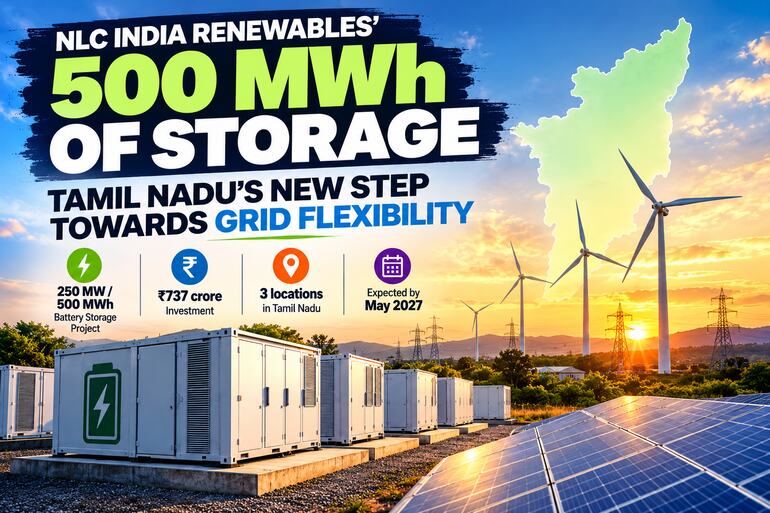
Tamil Nadu is taking another step towards a more flexible power system with a 250 MW / 500 MWh Battery Energy Storage System (BESS) project being developed by NLC India Renewables Limited (NIRL), a wholly owned subsidiary of NLC India Limited. Hon’ble Prime Minister of India, Shri Narendra Modi laid the foundation stone for the project on October 11, 2026.
With an investment of ₹737 crores and commissioning expected by May 2027, the project will distribute battery storage capacity across Anuppankulam, Ottapidaram and Kayathar. It is designed to support electricity demand during morning and evening peaks while enabling more effective integration of renewable energy into the grid.
Where Will Tamil Nadu’s 500 MWh Battery Storage Capacity Be Installed?
The project’s total capacity will be distributed across three locations in Tamil Nadu, with each site contributing to the overall storage capacity.
The project comprises three standalone battery storage installations associated with substations at Anuppankulam, Ottapidaram and Kayathar. The facilities are intended to strengthen the state’s ability to manage electricity supply and demand across different periods of the day.
The installations are designed for two full charging and discharging cycles daily. This operating approach is intended to make stored electricity available during periods when demand is high, helping the power system manage variations in consumption and renewable generation.
How Will the Battery Project Support the Power Grid?
Solar and wind power generation can fluctuate with weather conditions and the time of day, while electricity demand follows its own daily pattern. Battery storage can help bridge this gap by storing electricity when it is available and releasing it when the system needs additional power.
The Tamil Nadu project is designed to provide storage support during critical morning and evening peak-demand periods. By shifting the availability of electricity across different hours, the system could help improve the utilization of renewable energy and provide greater flexibility to grid operators.
Its 250 MW power rating indicates how much power the system can deliver at a given time, while its 500 MWh energy capacity represents the amount of electricity it can store. At full rated output, 500 MWh would theoretically support 250 MW of discharge for two hours, although actual performance will depend on usable battery capacity, operating conditions and system losses.
The project’s intended benefits will become clearer once the installations are commissioned and their operational performance can be assessed.
Also Read: The Next Defence Breakthrough Could Be Made in India: Is This the Start of a Bigger Shift?
NLC India’s First Large-Scale Energy Storage Initiative
The project marks NLC India Limited’s first large-scale energy storage initiative, extending its activities beyond conventional power generation and renewable energy development.
The project followed a tender issued by Tamil Nadu Green Energy Corporation Limited (TNGECL) in June 2025. NIRL was selected through a tariff-based competitive bidding process to develop the standalone battery storage facilities.
The project is being implemented under the Build-Own-Operate (BOO) model, under which the developer builds and owns the facilities and operates them in accordance with the applicable contractual arrangements.
The project is also supported by financial assistance under the state component of the Viability Gap Funding (VGF) scheme. Such assistance is intended to improve the financial viability of infrastructure projects that deliver wider system benefits but may face commercial challenges in their initial stages.
The combination of competitive bidding, public-sector participation and viability support reflects the policy effort to expand battery storage capacity as part of India’s evolving electricity infrastructure.
A 12-Year Agreement to Supply Energy Storage Services
Tamil Nadu Power Distribution Corporation Limited (TNPDCL) is expected to procure energy storage services from NIRL under a Battery Energy Storage Purchase Agreement (BESPA) for a period of 12 years.
The agreement provides a contractual framework for the procurement of storage services. Rather than treating batteries simply as equipment for storing electricity, this model recognizes energy storage as a service that can help meet the power system’s operational requirements.
The project’s effectiveness will depend on how efficiently the facilities are operated, how they are charged and discharged, and how well their availability aligns with peak demand and renewable energy generation.
VOC Port Adds a Separate Green Energy Development
Battery storage was not the only energy-related initiative announced during the Prime Minister’s Tamil Nadu visit. At V.O. Chidambaranar (VOC) Port in Thoothukudi, the government advanced a separate set of projects aimed at developing the port into a major container-handling and green energy hub.
The Prime Minister inaugurated three facilities: a 2 MW solar power plant, a green methanol bunkering and refuelling facility, and four electric bus services. He also laid the foundation stone for a 3 MW green hydrogen manufacturing and refuelling station.
The broader plan to develop VOC Port into a world-class mega container and green energy hub involves an investment of approximately ₹17,000 crores, according to the announcement.
These initiatives address different parts of the energy transition. Battery storage is intended to improve the flexibility of the electricity system, while the port projects focus on renewable power, alternative fuels, cleaner transport and maritime infrastructure.
Tamil Nadu’s Wider Infrastructure Push
The energy projects formed part of a broader development programme worth more than ₹13,000 crores launched by the Prime Minister in Chennai. The programme also covered transport infrastructure, including the inauguration of the Poonamallee-Vadapalani stretch of Chennai Metro Phase II, built at a cost of approximately ₹4,900 crores. The stretch includes a 3.7-kilometre double-decker structure and advanced signalling designed to support driverless operations.
National Highway projects worth around ₹3,700 crores were also included. These covered the Vadugapatti-Therkuvenganallur section of NH-744, a section of Madurai Ring Road on NH-744A, and the foundation stone for the four-lane Thiruvarur Bypass on NH-83.
Railway works worth more than ₹750 crore included the Karaikal-Peralam railway line, three rail flyovers in Coimbatore and upgrades at five Amrit Stations: Palani, Vellore Cantonment, Ambasamudram, Paramakkudi and Namakkal.
In the petroleum sector, the Prime Minister laid the foundation stone for a ₹1,620 crore Group II/III Lube Oil Base Stocks project at Chennai Petroleum Corporation Limited’s Manali Refinery. The facility is planned to have a capacity of 270 thousand metric tonnes per annum. He also dedicated the Sudha Gopalakrishnan Brain Centre at IIT Madras.
The wider programme reflects the government’s focus on transport links, industrial capacity, energy infrastructure and research across the state.
From Battery Projects to Grid Flexibility: The Road Ahead
The significance of Tamil Nadu’s 500 MWh battery project extends beyond the amount of electricity it can store. It represents an effort to build flexibility into a power system that must accommodate changing demand and a growing share of renewable generation.
The ₹737 crore investment, three-site deployment and planned two-cycle daily operation establish the project’s intended role in the state’s electricity infrastructure. The 12-year energy storage services agreement also provides a framework for procuring storage as part of grid operations.
The next milestone will be commissioning, expected by May 2027, followed by the assessment of the system’s actual operating performance. Its contribution to peak-demand management and renewable energy integration will depend on how effectively the storage capacity is used.
As India expands renewable power generation, projects such as this could help demonstrate how energy storage can complement generation and transmission infrastructure. The broader challenge will be to deploy storage at a scale and cost that supports a reliable, flexible and increasingly renewable-powered electricity system.
Source: Official PIB release – Prime Minister’s Chennai visit: PM to Visit Chennai on 11 October

1 Comment
Pingback: CBIC Clarifies 10% Duty on Battery Storage