


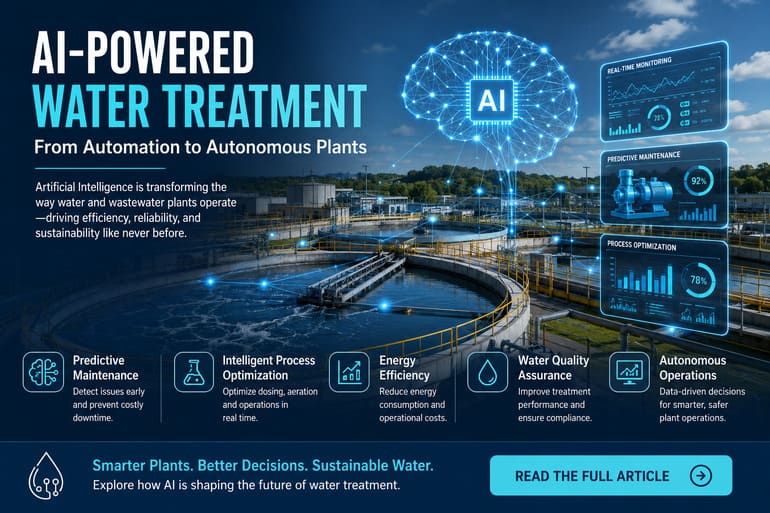
Artificial Intelligence is rapidly reshaping the water and wastewater sector, moving utilities beyond conventional automation toward intelligent, data-driven operations. In this opinion piece, the author explores how AI, predictive analytics, digital twins, and autonomous technologies are transforming plant performance and why embracing these innovations will be essential for the future of sustainable water management.
Artificial Intelligence in water treatment refers to the use of machine learning, predictive analytics, intelligent automation, and advanced data analytics to optimize treatment processes, predict equipment failures, improve water quality, reduce energy consumption, and support faster operational decision-making. Unlike traditional automation, AI continuously learns from operational data, enabling treatment plants to become increasingly adaptive and efficient over time.
AI-powered water treatment enables utilities to automate complex operational decisions, predict equipment failures before they occur, optimize chemical dosing and energy consumption, improve water quality, and support operators through intelligent, data-driven insights. These capabilities are helping treatment plants evolve from reactive facilities into predictive and increasingly autonomous operations.
Water and wastewater systems account for approximately 2% of global electricity consumption worldwide, according to the International Energy Agency (IEA). As utilities strive to balance operational efficiency with sustainability goals, reducing energy consumption is no longer just a cost-saving measure. It has become a strategic priority. AI-powered optimization enables plants to monitor, analyze, and continuously improve energy performance without compromising treatment quality.
Key Applications of AI in Water Treatment
AI is transforming water and wastewater treatment through:
- Predictive maintenance
- Intelligent process optimization
- AI-driven chemical dosing
- Digital twins
- Real-time water quality monitoring
- Energy optimization
- Leak detection
- Remote operations
- Asset performance management
- Decision support systems
The water and wastewater industry is entering a new era where intelligence is becoming just as important as infrastructure. As utilities grapple with growing population, climate change, stricter environmental regulations, and aging assets, traditional automation alone is no longer enough. Artificial Intelligence (AI) is emerging as a powerful enabler, helping treatment plants move beyond simply controlling processes to predicting outcomes, optimizing operations, and making smarter decisions in real time. This evolution from automation to autonomy is reshaping how water is produced, treated, and managed, paving the way for more resilient, efficient, and sustainable utilities.
The foundation for this transformation was laid by decades of progress in industrial automation. Distributed Control Systems (DCS), Supervisory Control and Data Acquisition (SCADA), and programmable logic controllers (PLCs) have enabled water and wastewater treatment plants to monitor processes, control equipment, and maintain regulatory compliance with remarkable precision. These technologies have significantly improved operational reliability, reduced manual intervention, and enhanced process stability across municipal and industrial facilities. However, as treatment plants become increasingly complex and operational demands continue to evolve, conventional automation alone is no longer sufficient. Today’s utilities require systems that can not only monitor and control processes but also interpret vast amounts of operational data, anticipate potential issues, and recommend or implement optimal actions in real time.
The industry is now entering a new era where Artificial Intelligence (AI), machine learning, advanced analytics, and digital technologies are working alongside automation to create treatment plants capable of learning, predicting, and optimizing operations in real time. Rather than simply responding to operator commands or pre-defined control logic, these intelligent systems continuously analyze vast amounts of operational data, recognize patterns, predict equipment failures, recommend operational changes, and in some cases automatically execute corrective actions. This evolution marks the transition from automated facilities to autonomous water treatment plants, an advancement that has the potential to redefine operational excellence across the global water sector.
Also Read: RenewSys Showcases Next-Generation Solar Manufacturing Innovations at Anusandhan 2026
Why Traditional Automation Is No Longer Enough
Conventional automation has delivered tremendous improvements in plant reliability and consistency. It excels at executing programmed sequences, maintaining process parameters, and providing operators with real-time visibility into plant performance. However, traditional automation is inherently reactive. It responds to changing conditions only after thresholds have been exceeded or alarms have been triggered.
Today’s treatment facilities generate millions of data points every day through sensors monitoring flow, pressure, pH, turbidity, dissolved oxygen, nutrient levels, energy consumption, equipment vibration, and countless other parameters. While automation systems collect this information, operators are often left with the enormous task of interpreting the data, identifying trends, and making timely decisions.
Artificial Intelligence bridges this gap by transforming raw operational data into actionable intelligence. Instead of merely reporting that a pump is vibrating beyond acceptable limits, AI can determine why the vibration is increasing, estimate when the equipment is likely to fail, evaluate the operational impact, and recommend maintenance before production is disrupted. This shift from reactive to predictive operations significantly improves reliability while reducing maintenance costs and unplanned downtime.
Consider a wastewater treatment plant receiving a sudden surge in inflow following heavy rainfall. A conventional automation system reacts only after process limits are reached, prompting operators to manually adjust aeration rates, chemical dosing, or pump operations. An AI-enabled system can however analyze weather forecasts, historical rainfall patterns, and real-time process data to anticipate the increased load, automatically recommending or implementing operational changes before plant performance is affected. This proactive approach helps maintain treatment efficiency while reducing operational stress and energy consumption.
The Evolution from Automation to Autonomy
An autonomous water treatment plant is not one where human operators are replaced. It is rather a facility where intelligent systems continuously support operational decision-making, allowing personnel to focus on strategic and high-value activities.
These systems combine AI, machine learning, digital twins, advanced sensors, cloud computing, and edge analytics to create a continuously learning environment. Every operational decision from chemical dosing and aeration control to pump scheduling and sludge management can be optimized based on historical performance, current operating conditions, weather forecasts, energy pricing, and anticipated demand.
As these technologies mature, plants become increasingly capable of self-monitoring, self-diagnosing, and even self-optimizing, creating a level of operational efficiency that was previously unattainable through conventional automation alone.
Predictive Maintenance: Preventing Failures Before They Occur
Maintenance remains one of the largest operational expenses for municipal and industrial water utilities. Unexpected equipment failures can result in costly downtime, emergency repairs, regulatory penalties, and interruptions to water supply.
Artificial Intelligence is transforming maintenance strategies by continuously monitoring equipment health through vibration sensors, thermal imaging, motor current analysis, lubrication data, acoustic monitoring, and historical maintenance records. Machine learning algorithms identify subtle changes in equipment behaviour that are often invisible to human operators.
Instead of following fixed maintenance schedules or waiting for equipment to fail, utilities can adopt predictive maintenance strategies where interventions occur precisely when needed. Pumps, blowers, compressors, centrifuges, membranes, and rotating equipment receive maintenance based on actual operating condition rather than elapsed time. This approach not only extends equipment life but also reduces spare parts inventory, minimizes emergency maintenance, improves workforce planning, and significantly lowers lifecycle costs.
Imagine a high-capacity pump that has operated reliably for several years. Traditionally, maintenance may be scheduled at fixed intervals or only after signs of failure become apparent. With AI-driven predictive maintenance, subtle changes in vibration, temperature, and motor current are continuously analyzed to detect early signs of bearing wear. Instead of experiencing an unexpected breakdown during peak demand, maintenance teams receive advance notice and can plan repairs during scheduled shutdowns, reducing downtime, repair costs, and service disruptions.
Also Read: GAIL Invites EPC Bids for 600 MW Solar Project with Battery Energy Storage in Jhansi
Intelligent Process Optimization Through AI
One of the most promising applications of AI lies in optimizing treatment processes that have traditionally relied on operator experience and manual adjustments.
Chemical dosing, for example, represents a significant operating expense in both drinking water and wastewater treatment facilities. Variations in raw water quality, seasonal conditions, rainfall events, industrial discharges, and flow fluctuations require constant adjustments to maintain optimal treatment performance.
AI continuously evaluates incoming water quality data, historical treatment performance, laboratory results, and weather conditions to recommend or automatically implement precise chemical dosage adjustments. This improves treatment efficiency while reducing chemical consumption and minimizing sludge generation.
Similarly, biological wastewater treatment processes benefit enormously from AI-driven aeration control. Aeration typically accounts for nearly half of a wastewater treatment plant’s total energy consumption. By continuously analyzing dissolved oxygen levels, ammonia concentrations, biological loading, and microbial activity, AI can dynamically optimize blower operation, maintaining treatment efficiency while significantly reducing energy usage. The result is lower operating costs, improved process stability, and reduced environmental impact.
For example, raw water quality can change significantly during the monsoon season due to higher turbidity and increased organic matter. Rather than relying solely on manual adjustments, AI can continuously analyze incoming water quality data and automatically optimize coagulant dosing. This not only helps maintain consistent treated water quality but also avoids excessive chemical usage, lowering operating costs and reducing sludge generation.
Digital Twins: A Virtual Replica for Smarter Decision-Making
Digital twin technology is becoming one of the most powerful tools supporting autonomous water treatment. A digital twin is a dynamic virtual representation of an actual treatment plant that continuously receives live operational data. Unlike traditional simulation models, digital twins evolve alongside the physical facility, accurately reflecting current operating conditions.
Plant operators can safely evaluate operational changes within the virtual environment before implementing them in the real plant. Whether testing new treatment strategies, anticipating storm events, planning capacity expansions, or evaluating energy optimization initiatives, digital twins allow utilities to reduce operational risks while improving decision-making.
These virtual models also provide valuable training environments where operators can practice responding to emergency situations without affecting live operations, improving workforce readiness and operational resilience.
A useful way to think about a digital twin is as a flight simulator for a water treatment plant. Just as pilots train and test emergency procedures in a virtual environment before flying an aircraft, plant operators can use a digital twin to evaluate process changes, prepare for emergency situations, and optimize plant performance without affecting live operations.
AI-Driven Water Quality Monitoring
Maintaining consistent water quality has always been central to treatment plant operations. Traditionally, water quality assessment relied heavily on periodic laboratory testing and manual sampling, creating inevitable delays between measurement and corrective action.
Modern AI-powered monitoring systems integrate continuous online analyzers with advanced analytics to provide real-time water quality intelligence. Sensors monitoring pH, turbidity, conductivity, dissolved oxygen, ammonia, nitrate, chlorine residual, TOC, and other parameters continuously feed data into AI algorithms capable of detecting anomalies almost instantly.
Rather than waiting for laboratory confirmation, operators receive early warnings about deteriorating water quality, potential contamination events, sensor failures, or treatment inefficiencies. This enables faster corrective action while improving regulatory compliance and public confidence.
For instance, if an online analyzer detects a sudden increase in turbidity or ammonia levels, AI can immediately identify the anomaly, recommend corrective actions, and alert operators before water quality is compromised. This enables faster intervention and helps maintain regulatory compliance even during rapidly changing operating conditions.
Also Read: Yamuna Water Project Set to Improve Drinking Water Access Across Shekhawati
Powering Efficiency Through Intelligent Energy Management
Energy consumption continues to be one of the largest operating costs for water utilities worldwide. Rising electricity prices and increasing sustainability commitments are driving utilities to seek more intelligent energy management strategies.
AI continuously analyzes plant energy usage, equipment performance, production schedules, weather forecasts, and electricity tariffs to determine the most energy-efficient operating strategy. Rather than operating all pumps or blowers uniformly, intelligent systems optimize equipment sequencing, variable speed drives, and operating schedules to minimize energy consumption while maintaining treatment objectives.
Some advanced facilities are even integrating renewable energy sources, battery storage systems, and demand-response programs into AI-driven operational strategies, moving closer to energy-neutral or even energy-positive operations.
Consider a wastewater treatment facility where electricity tariffs vary throughout the day. An AI-enabled energy management system can schedule non-critical pumping operations during off-peak tariff periods while ensuring essential treatment processes continue uninterrupted. Combined with intelligent blower control and variable speed drives, this approach can significantly reduce energy costs without compromising treatment performance. In addition, AI can continuously optimize aeration systems, typically one of the most energy-intensive processes in wastewater treatment by adjusting blower output based on real-time dissolved oxygen levels and biological load, ensuring efficient treatment while minimizing electricity consumption.
Remote Operations and Intelligent Decision Support
The increasing adoption of cloud computing and secure industrial connectivity is enabling water utilities to monitor and manage multiple treatment facilities from centralized control centers. AI-powered dashboards consolidate operational data from geographically dispersed plants into unified interfaces that prioritize actionable insights instead of overwhelming operators with thousands of alarms.
Intelligent decision-support systems help operators understand not only what is happening, but why it is happening and what actions are likely to produce the best outcome. This greatly improves operational consistency, particularly for utilities managing multiple facilities with limited staffing resources. Remote operations also improve workforce flexibility, reduce travel requirements, and enable expert support across distributed treatment networks.
Imagine a utility responsible for operating multiple treatment plants across different cities. Instead of requiring specialist engineers to travel to each site, AI-powered monitoring platforms enable experts to oversee plant performance remotely, identify emerging issues, and provide operational guidance from a central control centre. This not only improves response times but also makes better use of limited technical resources.
The Human Role in Autonomous Water Plants
Despite rapid advances in Artificial Intelligence, the future of water treatment is not about replacing human expertise; it is about enhancing it. Experienced operators possess invaluable process knowledge, practical intuition, and situational awareness that cannot be fully replicated by algorithms. Rather than replacing operators, AI augments human expertise by processing large volumes of operational data far more quickly than manual analysis alone. This allows engineers and plant operators to focus on strategic decision-making, process optimization, compliance, and continuous improvement while routine analytical tasks are handled intelligently. The future workforce will increasingly combine traditional process engineering skills with digital competencies, creating a new generation of water professionals capable of managing highly intelligent treatment facilities.
The Road Ahead: Building the Autonomous Water Utility
As digital transformation accelerates across the water sector, autonomous operations are becoming a realistic objective rather than a distant vision. Utilities that embrace Artificial Intelligence today are positioning themselves to improve resilience, reduce operating costs, strengthen regulatory compliance, optimize energy use, and deliver higher-quality services to their communities.
However, successful implementation requires more than simply deploying AI software. It demands a strong digital foundation that includes reliable instrumentation, robust automation systems, secure industrial networks, integrated operational data, and scalable analytics platforms capable of supporting future innovation. Organizations that invest in these foundational technologies today will be best positioned to evolve towards fully intelligent water treatment operations in the years ahead.
The Future of Water Treatment Is Intelligent
The evolution from automation to autonomy represents one of the most significant transformations the water industry has experienced since the introduction of digital control systems. Artificial Intelligence is enabling treatment plants to become more predictive, adaptive, and sustainable than ever before. By combining automation with advanced analytics, digital twins, predictive maintenance, and intelligent optimization, water utilities can move beyond simply controlling processes to continuously improving them.
The transition to AI in water treatment is likely to mirror the industry’s earlier shift from manual operations to digital automation. When Distributed Control Systems (DCS) were first introduced, many questioned whether they could replace conventional control methods. Today, they are regarded as an indispensable part of modern plant operations. Artificial Intelligence may well follow a similar path, not replacing operators but becoming a trusted partner that enhances decision-making, improves operational efficiency, and supports more sustainable water management.
As global water challenges continue to intensify, intelligent and increasingly autonomous treatment plants are poised to play a critical role in delivering reliable, efficient, and resilient water services for future generations. The real question is no longer whether AI has a place in water treatment, but how quickly utilities can embrace its potential and integrate it into their digital transformation journey. Ultimately, the future of water treatment will not be defined by Artificial Intelligence alone, but by how effectively utilities combine human expertise with intelligent digital technologies to deliver safer, more efficient, and more sustainable water services.
* The perspectives shared in this opinion piece are informed by emerging industry trends, technological advancements, global best practices, and ongoing developments in digital transformation across the water and wastewater sector.

1 Comment
Pingback: Brine Management: Tackling Desalination’s Biggest Challenge