



India’s next phase of industrial growth may depend on more than labour, capital, infrastructure and access to markets. An increasingly important factor is beginning to shape the competitiveness of Indian manufacturing: access to electricity that is affordable, reliable, available at scale and low-carbon.
The issue is not simply whether India can produce cheap electricity or add more renewable capacity. The larger question is whether the country can provide electricity that is affordable, reliable, available at scale and increasingly low-carbon.
If India succeeds, its green-energy transition could become more than a climate strategy. It could become a powerful industrial strategy. The prize may not lie in exporting electricity. It may lie in exporting products made with cleaner and more reliable electricity.
Cheap Electricity Is Not Always Cheap Energy
Solar power projects can generate electricity at increasingly attractive prices. But an industrial facility cannot operate on the basis of a low solar tariff alone. A factory needs power when its production line needs it.
Steel plants, chemical facilities, data centres, electrolyzers and advanced manufacturing units cannot simply stop operating when the sun sets or wind speeds fall. For them, the relevant question is not only how cheaply electricity can be generated, but how much it costs to provide usable energy at the required time.
That means industrial consumers must consider several factors: the reliability and predictability of supply, the availability of storage, the strength of the local grid and the ability to demonstrate that the electricity used in production is genuinely low-carbon. Increasingly, they may also need to prove the carbon intensity of the products they sell.
India has already demonstrated how dramatically the economics of renewable generation have changed. According to the International Renewable Energy Agency, utility-scale solar photovoltaic projects commissioned in India in 2024 had a weighted average levelized cost of electricity of about US$ 0.038 per kilowatt hour. Globally, IRENA’s 2026 analysis also found that renewables remained the most cost-competitive source of new electricity generation in 2025.
However, low-cost generation is only one part of the industrial-energy equation. The more important measure is the cost of delivering dependable, low-carbon power when it is needed.
Also Read: From EVs to Energy Storage: Maxvolt’s Aligarh Project Has a Wider Ambition
The Missing Link Between Renewable Power and Industry
Solar and wind power are not inherently unsuitable for industry. Their variability is the challenge. Energy storage, supported by stronger transmission networks and more flexible power markets, can help bridge the gap between when renewable electricity is produced and when factories need it.
The concept is straightforward: renewable generation can be combined with storage to create a more dependable supply of clean power. In practice, the system would also involve transmission, grid balancing and other sources of electricity. The goal is not necessarily to create an isolated power system that operates entirely independently of the wider grid. It is to build a system capable of providing industry with a more predictable supply of affordable, low-carbon electricity.
India’s power planning already reflects the importance of this challenge. The Central Electricity Authority has identified energy storage as essential for integrating rising volumes of variable renewable energy. A 2025 CEA advisory noted that India had 4.86 gigawatts of installed energy storage capacity as of December 2024, while much larger capacity would be needed as solar and wind deployment expands.
This points to a shift in the next phase of India’s renewable energy story. The focus will need to move beyond adding generation capacity. It will also have to include making clean electricity available whenever industry requires it. That is a significantly more valuable industrial proposition.
Could Factories Begin Following Clean Energy?
Energy could eventually become a more important factor in determining where companies build factories. Today, manufacturers typically evaluate access to ports, highways, skilled labour, industrial land, suppliers and customers. In the future, they may also compare locations based on access to reliable low-carbon energy.
Consider two possible industrial locations. One may have excellent road connectivity but expensive or carbon-intensive electricity. The other may offer strong solar and wind resources, transmission infrastructure, large-scale storage and access to green hydrogen.
If the second location can provide reliable low-carbon energy at a competitive delivered cost, it could become more attractive to energy-intensive manufacturers. This does not mean companies will abandon established industrial clusters or ignore transport and labour considerations. Rather, energy could become an additional source of location advantage.
The question may gradually shift from “Where can we build the factory?” to “Where can we secure reliable, affordable and low-carbon energy for the next 20 years?”
That change could influence the geography of Indian manufacturing.
The Rise Of Energy-based Industrial Clusters
India’s renewable resources are not evenly distributed. Some regions have stronger solar potential, while others have better wind resources. Certain locations may offer stronger transmission connectivity, proximity to ports or greater potential for developing hydrogen, ammonia, battery and renewable-power industries.
This creates the possibility of a new kind of industrial cluster, one built around an integrated energy ecosystem rather than a standalone power project.
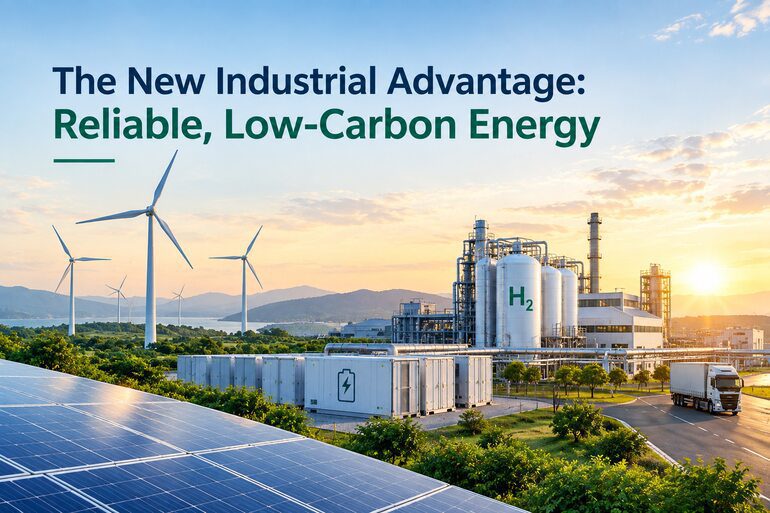
A large renewable energy development could be located alongside battery or pumped-storage facilities, transmission infrastructure, green-hydrogen production, green-ammonia plants, electrolyzer manufacturing, industrial consumers, component suppliers, logistics networks and export terminals.
Such a cluster would not merely generate electricity. It would convert electricity into industrial products and connect energy production directly with manufacturing and exports. This is where the discussion about renewable power begins to merge with the question of industrial competitiveness.
India May Not Need To Export Electricity
India does not necessarily need to become a major exporter of electricity to benefit from abundant renewable energy. It could export products made using that energy.
The value chain could begin with renewable electricity and extend through green hydrogen or ammonia to lower-carbon industrial processes and products. These could include lower-emission steel, chemicals, fertilizers, manufactured components and other goods whose carbon footprint can be demonstrated to customers and regulators.
The National Green Hydrogen Mission reflects this broader ambition. It identifies the production, use and export of green hydrogen and its derivatives, including green ammonia and green methanol as important objectives.
This offers a different way of thinking about India’s renewable energy advantage. The value of clean electricity may not appear on an electricity-export invoice. It could emerge further down the value chain in the form of a tonne of green ammonia, a lower-carbon chemical, a cleaner steel product or a manufactured component produced using low-emission power.
India may not export renewable energy directly. It could export the economic value created by that energy.
From Green Premium To Green Advantage
For many years, decarbonization has primarily been viewed as a cost. Companies need to invest in renewable power, upgrade equipment, purchase certificates, improve efficiency, measure emissions and meet new reporting requirements. From this perspective, going green can appear to be another expense on the balance sheet.
That view may become incomplete as customers, investors and export markets place greater emphasis on embedded emissions.
If buyers begin preferring lower-carbon products and if export markets increasingly account for the emissions associated with imported goods, access to clean energy could become a source of competitive advantage. It could help manufacturers meet customer requirements, reduce exposure to future carbon-related costs and demonstrate lower product emissions.
The European Union’s Carbon Border Adjustment Mechanism is relevant to this trend. Its definitive regime began on 01st January 2026 and covers sectors including iron and steel, aluminium, cement, fertilizers, electricity and hydrogen. The mechanism is intended to account for the embedded emissions of covered imports entering the European Union.
This does not mean that every Indian manufacturer using renewable electricity will immediately gain a competitive advantage. However, it does indicate that the carbon characteristics of industrial production are becoming increasingly important in international trade.
For Indian manufacturers, the strategic question is whether access to cleaner energy can help determine which products are easier to sell in global markets.
Also Read: Laser Power Gets WBIDC Nod for 40-Acre Kharagpur Project
The Electricity Bill Does Not Tell The Whole Story
The value of clean energy may be difficult to capture on a conventional electricity bill. One manufacturer may reduce its power costs by securing cheaper electricity. Another may obtain reliable low-carbon power and gain additional benefits: stronger access to global customers, better compliance with sustainability requirements, greater resilience against future carbon costs and improved eligibility for green finance or long-term supply contracts.
These benefits may appear not in the price paid per unit of electricity but in customer contracts, procurement decisions, sustainability disclosures, financing terms and export opportunities. For business-to-business companies, this broader value could become increasingly important. The relevant measure may eventually be not the price of electricity alone, but the economic value created by each unit of clean energy.
Storage Could Become An Industrial Technology
Long-duration storage is especially important because it can help address the timing problem associated with renewable generation. When solar and wind output is high, electricity can be stored for later use. That stored energy can then help meet industrial demand when renewable generation declines. The result is a closer match between the operating patterns of renewable projects and the continuous requirements of factories.
IRENA’s 2026 analysis of 24/7 renewable electricity examines systems combining solar, wind and battery storage to provide continuous power. It notes that the economics of firm renewable electricity are changing rapidly and identifies India among the markets where such systems are moving towards greater competitiveness with fossil-fuel generation.
This represents a change in the way renewable energy is understood. The key question is no longer only how much renewable electricity India can generate. It is how much reliable renewable electricity the country can deliver when industry needs it.
That is the difference between renewable generation capacity and renewable industrial infrastructure.
A New Manufacturing Map
If this trend develops, India’s future industrial map could look different from today’s. Ports, roads, railways and skilled labour will remain essential, but energy could become a location advantage in its own right. A region with abundant renewable resources, sufficient transmission capacity, large-scale storage, green-hydrogen infrastructure and industrial demand could attract companies seeking access to predictable, low-carbon energy.
Such a region could develop as an integrated industrial ecosystem. Solar and wind farms would provide generation, storage would add flexibility, transmission networks would move electricity, hydrogen facilities would convert power into industrial molecules, manufacturers would consume the resulting energy and ports would transport finished products to global markets.
In this model, energy would not simply be another input for industry. It would form part of the industrial infrastructure itself.
Also Read: What Really Powers India’s Data Center Growth? Look Beyond the Servers
The Gap India Still Needs To Close
The opportunity is significant, but it should not be mistaken for an outcome that has already been achieved. Low-cost renewable generation does not automatically produce cheap, reliable industrial power. India will need to expand transmission, scale up storage, improve grid flexibility, evolve power markets and create commercially viable procurement structures for industrial consumers.
Green hydrogen and its derivatives will also need more competitive economics and dependable demand. At the same time, companies will require credible systems for measuring and demonstrating the carbon intensity of their products.
The central economic question is how much it costs to turn low-cost renewable electricity into firm, round-the-clock power. That is the number industrial decision-makers ultimately need. The falling cost of solar and wind is encouraging, but the next phase will depend on the economics of the entire system: generation, storage, transmission, balancing and delivery. Storage and grid infrastructure may therefore become just as important to India’s industrial transition as the next large solar tender.
From Climate Strategy To Industrial Strategy
India’s renewable energy transition is often described in terms of capacity targets, emissions reductions and energy security. These objectives remain important, but there is another way to view the opportunity.
Renewable energy could help create a new generation of competitive industries. With sufficient storage and grid flexibility, it could provide reliable low-carbon power. That power could support cleaner industrial production, lower-carbon products and improved access to global markets. The result would be much more significant than simply installing more solar panels or wind turbines. It would mean turning India’s energy transition into an industrial capability.
The most important question for Indian manufacturers may therefore not be whether renewable energy will become cheaper. That process is already well underway. The more consequential question is whether India can deliver clean energy reliably enough, cheaply enough and at sufficient scale for companies to build their competitive advantage around it.
If the answer is eventually yes, the implications will extend well beyond the power sector. Companies could assess industrial locations partly through the availability of renewable energy and storage. Industrial parks could be designed around clean energy resources. Hydrogen and ammonia could connect renewable power with hard-to-abate industries. Manufacturers could use low-carbon energy as part of their export strategy.
India’s future advantage may not come from having the cheapest electricity alone. It may come from offering industry something more valuable: energy that is affordable enough, reliable enough and clean enough to support the next generation of manufacturing.
