



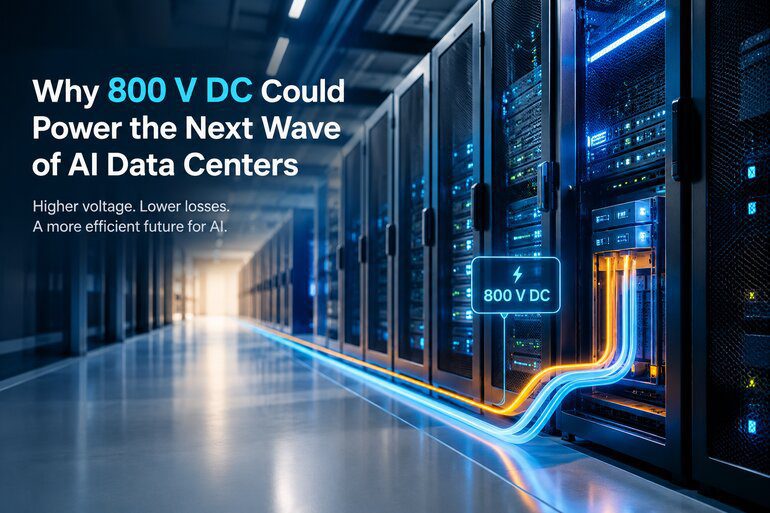
Artificial Intelligence is changing far more than the software running on our computers. Behind every AI model, chatbot, image generator and enterprise application is a data center filled with increasingly powerful servers. These servers require enormous amounts of electricity, and delivering that power efficiently is becoming one of the biggest engineering challenges facing the AI industry.
This is where gallium nitride (GaN) and silicon carbide (SiC) are attracting growing attention. At the same time, the industry is exploring a significant change in data center power architecture: the move from traditional low-voltage distribution toward 800 V DC systems.
The reason is simple. AI processors are becoming so power-hungry that conventional power-delivery architectures are approaching their practical limits.
AI’s Growing Power Challenge
Conventional data centers already consume substantial amounts of electricity. AI data centers take this demand to another level. Modern AI servers contain powerful GPUs and accelerators that often operate continuously under heavy workloads. As computing performance increases, so does the power required by individual servers and, increasingly, entire racks.
The challenge is not simply generating more electricity. That electricity must also be delivered, converted and controlled efficiently.
Every time power is converted from one voltage to another, some energy is lost as heat. Cables, connectors and electrical connections also introduce losses. Two basic electrical relationships explain why higher-voltage distribution is receiving so much attention: P = V × I and P_loss = I²R.
For a given amount of power, increasing the voltage allows the system to operate at a lower current. Because resistive losses increase with the square of the current, reducing current can significantly reduce losses in the distribution system.
This is one of the fundamental reasons the industry is investigating 800 V DC architectures for future AI data centers. Higher-voltage distribution could reduce conduction losses, copper requirements, voltage drop and heat generation. It could also help reduce the physical size of parts of the power-delivery system.
From 50 V to 800 V
Traditional server power architectures have commonly used relatively low-voltage DC buses, often around 48-50 V. This voltage is closer to the point at which power is ultimately converted for processors and other components. However, AI workloads are pushing power requirements much higher. Delivering large amounts of power at only 50 V results in extremely high currents. At 800 V, the same power can be delivered at a fraction of that current.
This does not mean that every data center will immediately replace its existing 48 V infrastructure with an 800 V system. The transition introduces several engineering challenges, including insulation, electrical safety, protection, connectors, switching devices, power conversion and thermal management.
Nevertheless, the direction of development is significant. The industry is increasingly considering whether high-voltage DC can provide a more practical way to distribute large amounts of power throughout future AI facilities.
What Happens to the 800 V at the Rack?
An AI accelerator cannot operate directly from an 800 V supply. The voltage must be converted through several stages before it reaches the much lower voltage required by the processor.
One emerging architecture being demonstrated for AI systems involves an 800 V-to-6 V power-conversion stage. This can be thought of as a high-power electronic gearbox. Electricity is distributed efficiently at a high voltage, then converted near the computing hardware to a much lower voltage.
The purpose of this approach is to keep the very-high-current portion of the electrical path as short as possible. AI processors can require extremely large currents at very low operating voltages, creating a difficult engineering problem: how can thousands of amps be delivered to a processor without generating excessive heat?
As accelerator power continues to rise, this question will become increasingly important. The success of future AI systems will depend not only on the performance of their processors, but also on the efficiency and physical design of the power-conversion system surrounding them.
Why GaN and SiC Matter
This is where wide-bandgap semiconductors enter the picture. Traditional power electronics have relied heavily on silicon, and silicon will remain important for many applications. However, gallium nitride and silicon carbide offer electrical characteristics that can provide advantages in selected high-performance power-conversion systems.
Although GaN and SiC are often discussed together, they are not interchangeable technologies. Their characteristics make them suitable for different parts of the power architecture.
GaN: High Frequency and Power Density
Gallium nitride is particularly attractive for high-frequency power conversion. A power converter repeatedly switches electrical energy thousands or even millions of times per second. Increasing the switching frequency can allow magnetic components such as inductors and transformers to become smaller.
This can help engineers develop smaller converters, more compact power supplies and systems with higher power density. In AI infrastructure, where rack space is valuable and power requirements are rising rapidly, these advantages are especially relevant.
However, higher switching frequency is not free. It introduces challenges involving electromagnetic interference, PCB layout, parasitic inductance, switching losses, thermal management, gate driving and protection.
GaN should therefore not be viewed simply as a faster replacement for silicon. Using GaN effectively often requires engineers to rethink the entire converter design, including the topology, layout, packaging and control strategy.
SiC: High Voltage and High Power
Silicon carbide has become particularly important in high-voltage and high-power applications. It is already used in electric vehicles, solar inverters, energy-storage systems, industrial equipment, grid infrastructure and high-power charging systems.
SiC’s ability to operate efficiently at high voltages and elevated temperatures makes it attractive for demanding power-conversion stages. This is particularly relevant to systems that must handle large amounts of power between the electrical grid and the data center.
The future, therefore, is unlikely to be defined by a simple choice between GaN and SiC. In many systems, both technologies could play important but different roles. GaN may be well suited to high-frequency DC-DC conversion, while SiC may be more appropriate for high-voltage, high-power stages.
GaN or SiC? The Architecture Comes First
The question of whether GaN or SiC is better is too broad to have a universal answer. The more useful question is which technology best suits a particular power-conversion stage.
Engineers must consider the input and output voltages, power level, switching frequency, efficiency target, thermal environment, power-density requirement, reliability expectations, cost, system topology and component availability.
A high-frequency conversion stage may benefit from GaN’s switching characteristics. A high-voltage, high-power stage may be better suited to SiC. Some future systems may use both technologies, with each one placed where its electrical and thermal characteristics provide the greatest benefit.
This is why a simple “GaN versus SiC” narrative can be misleading. The important issue is not which technology wins in isolation, but how each one fits into the overall power architecture.
AI Could Change the Power Grid
The transformation will not stop at the data center rack. If AI facilities begin requiring hundreds of megawatts, the electrical infrastructure supplying those facilities will also need to evolve.
One technology attracting attention is the Solid-State Transformer. Traditional transformers use magnetic fields and coils to change voltage. A solid-state transformer uses power semiconductors and high-frequency power conversion to perform a similar function.
The technology is still developing, but it could eventually offer higher power density, more controllable conversion, high-frequency operation, bidirectional power flow, digital control and better integration with DC power systems.
A particularly interesting demonstration discussed around the 2026 APEC event involved a 250 kW single-stage solid-state transformer with a reported 3.3 kVAC input and 800 VDC output. Such a system illustrates a possible bridge between the electrical grid and the 800 V DC architectures being considered for high-power computing.
Instead of following the traditional model of medium-voltage AC passing through a conventional transformer before entering the data center, future infrastructure could use a more integrated path in which medium-voltage AC is converted directly into an 800 V DC bus.
That would represent a much broader change than simply replacing one transistor technology with another. It would mean reconsidering how power moves from the grid into the data centre and ultimately to the processor.
Implications for Electronics Manufacturers
The growth of high-power AI infrastructure could affect a large part of the electronics supply chain. The opportunity is not limited to GPU manufacturers.
Demand could increase for power semiconductors, GaN devices, SiC MOSFETs, power modules, gate drivers, DC-DC converters, transformers, inductors, capacitors, busbars, high-current connectors, thermal-management systems, PCB assemblies, protection components, sensors and control electronics.
For OEMs, the central question is whether existing designs can handle higher voltages, currents, temperatures and reliability requirements. Designs originally developed for conventional server power levels may not be suitable for AI systems that place far greater demands on every part of the electrical path.
Procurement teams will also need to consider component availability, supplier qualification, product lifecycles, second-source options and total system cost. A technically superior component is of limited value if it cannot be supplied consistently or supported throughout the intended operating life of the equipment.
Data centre operators meanwhile will need to determine whether a new power architecture can deliver enough savings in energy consumption, cooling and infrastructure requirements to justify the cost and complexity of transition.
Thermal Management Remains Critical
Improving power-conversion efficiency does not eliminate the thermal challenge. Even a small percentage of energy lost across a system handling hundreds of megawatts can translate into a substantial amount of heat.
Higher power density can also concentrate that heat into smaller spaces. As a result, future AI infrastructure will require close coordination between power electronics, cooling systems, mechanical design and facility infrastructure.
Liquid cooling is already becoming more relevant for high-performance computing, but power-conversion equipment will also need careful thermal design. Semiconductors, magnetic components, capacitors, connectors and busbars all have temperature limits that affect efficiency, reliability and operating life.
The best power architecture will therefore not be determined by semiconductor performance alone. It will be determined by how effectively the entire system manages electrical, thermal and mechanical constraints together.
What the Industry Should Watch
Several questions will shape the development of AI power infrastructure over the coming years.
The first is whether 800 V will become a mainstream data centre architecture. Adoption will depend on economics, safety requirements, standards, facility design and the pace at which AI rack power continues to increase.
The second is how GaN and SiC will divide the workload. It is unlikely that one technology will simply replace the other. Different stages of the power conversion chain will favor different semiconductor technologies.
The third is whether power conversion can keep pace with GPU and accelerator growth. Processor performance is advancing quickly, but the supporting electrical infrastructure must evolve at a similar rate.
Thermal management will be another critical factor. Higher efficiency can reduce losses, but increasing power density will continue to create major cooling requirements.
Solid-state transformers also deserve close attention. Demonstrations show the potential of the technology, but commercial adoption will depend on efficiency, reliability, cost, standards, maintenance requirements and the economics of replacing established transformer infrastructure.
Finally, the supply chain will become increasingly important. As AI infrastructure scales, the availability of qualified power semiconductors, magnetic components, capacitors, connectors and other critical parts could become a limiting factor.
The Next AI Infrastructure Race May Be About Power
The semiconductor industry has spent decades trying to make processors faster and more capable. The next major challenge may be just as important: delivering enough electricity to those processors efficiently and reliably.
This is why 800 V DC, GaN, SiC, high-frequency DC-DC conversion and solid-state transformers are appearing more frequently in discussions about AI infrastructure. These technologies are not isolated developments. Together, they represent a broader attempt to redesign the way electricity moves through the data centre.
For engineers, this transition creates new design challenges. For OEMs, it creates an opportunity to rethink power architectures from the grid connection to the processor board. For procurement teams, it introduces new questions about component availability, qualification and long-term supply. For data centre operators, it raises a fundamental issue: whether the electrical infrastructure can keep pace with the rapidly growing demands of AI.
The future of AI infrastructure will not be determined by a single semiconductor material or a single voltage standard. It will depend on how effectively the industry combines power semiconductors, high-efficiency conversion, thermal management, electrical distribution and grid infrastructure.
The future of AI is being shaped not only by what happens inside the GPU, but also by everything that delivers power to it.
