



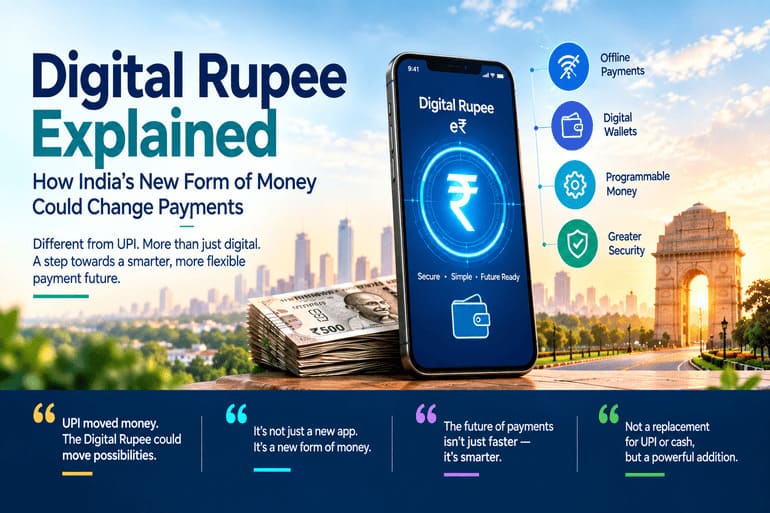
India’s payments landscape has changed dramatically over the past decade, with UPI making instant digital payments part of everyday life. But the next experiment could involve something deeper than the way we pay. The Reserve Bank of India is testing the Digital Rupee, or e₹, a central bank digital currency that represents the Indian rupee in digital form. The bigger question is no longer whether India can create digital money, but what this new form of money could eventually do.
Unlike UPI, which is a payment system used to move money between bank accounts, the Digital Rupee is digital money issued by the Reserve Bank of India (RBI). RBI describes e₹ as India’s Central Bank Digital Currency (CBDC), the digital form of the Indian rupee. It is designed to have features similar to physical cash, including being issued by the central bank and providing finality of settlement.
The Digital Rupee is already being tested through pilot programmes. RBI launched the retail e₹ pilot in December 2022 and has subsequently expanded the pilot to test additional features, including offline payments and programmability.
What exactly is the Digital Rupee?
The simplest way to understand the Digital Rupee is:
UPI is a way of making a payment. e₹ is a form of money.
When you make a UPI payment, you generally instruct your bank account to transfer money to another bank account. The UPI infrastructure enables that payment to happen quickly.
With e₹, the money itself is represented digitally and is held in an e₹ wallet on a supported device.
RBI says e₹ can be used for person-to-person as well as person-to-merchant transactions. It can be held in digital wallets provided by participating banks and non-banks.
This is why the comparison with physical cash can be useful: physical cash sits in your wallet, while Digital Rupee can sit in your digital wallet.
Digital Rupee vs UPI: What Is The Difference?
This is one of the most important distinctions to understand.
UPI
UPI is a payment interface/infrastructure.
When you use UPI, you can link your bank account to a UPI application and authorize a payment. The transaction moves funds between accounts through the payment system.
Digital Rupee
The Digital Rupee is currency issued by the RBI in digital form.
The e₹ is stored in a digital wallet and can be used for payments. RBI has also made CBDC interoperable with UPI infrastructure, meaning an e₹ user can make payments at merchants using UPI QR codes.
A simple analogy is:
UPI is like the road on which the payment travels; e₹ is the money being carried.
The analogy is not technically exact, but it helps explain why UPI and Digital Rupee are not the same thing.
Does Digital Rupee Require a Bank?
This is where some explanations of Digital Rupee can become misleading. It is not accurate to say that Digital Rupee simply eliminates banks from the system.
RBI states that it creates and issues retail e₹ and distributes it electronically through banks and non-banks participating in the pilot. These entities facilitate the opening of e₹ wallets for users. RBI’s January 2025 FAQ also stated that, at that stage, opening an e₹ wallet was linked to a user’s savings account for onboarding purposes, although other onboarding models were being explored.
Therefore, “Digital Rupee does not require a bank at any stage” is not an accurate description of the current system. What is different is that the Digital Rupee itself is a direct digital representation of sovereign currency rather than an ordinary commercial-bank deposit.
Also Read: India Opens New Front in Semiconductor Race: High-Voltage SiC
What is an e₹ wallet?
Think of an e₹ wallet as a digital version of the wallet in your pocket. Instead of holding ₹100 in a physical note, an eligible user can hold Digital Rupee in an e₹ wallet.
RBI says e₹ wallets are offered by participating banks and non-banks and can be used to send and receive e₹ as well as make payments. The Digital Rupee is also different from money sitting in an ordinary savings account. A bank deposit represents a claim on the commercial bank. A CBDC by contrast is issued by the central bank.
Can Digital Rupee Work Without The Internet?
Potentially, yes, but this needs an important qualification. Offline functionality is one of the features RBI has been actively testing.
RBI’s January 2025 FAQ says the offline feature is intended to allow e₹ transactions in locations with limited or no internet connectivity. It also says different solutions are being explored, including one that can work without internet but still requires telecom connectivity and another solution testing transactions using NFC communication.
Therefore, the statement that Digital Rupee will universally work by simply transferring money from one phone to another through Bluetooth is too broad. The official material supports the idea of offline CBDC transactions, but the exact technology and operating conditions depend on the solution being tested.
What is NFC?
NFC stands for Near Field Communication. It allows compatible devices to exchange information when they are brought close together. This makes NFC potentially useful for offline or proximity-based digital payments.
RBI’s Digital Rupee FAQ specifically identifies an NFC-based approach as one of the offline solutions being tested. So the basic concept mentioned in the conversation, bringing devices close together to facilitate an offline transaction has a real basis in the CBDC pilot. However, it should be described as a pilot/tested functionality, rather than suggesting that every Digital Rupee payment in India currently works this way.
Also Read: 6G Is Coming: Rohde & Schwarz Reveals What Comes Next for Wireless Testing
Will Digital Rupee Replace Physical Cash?
There is no basis for saying that physical cash is about to disappear. RBI’s own CBDC concept note describes the Digital Rupee as an additional payment avenue that is intended to complement rather than replace existing forms of money and payment systems.
In other words, the Digital Rupee is being developed as another form of sovereign money, not as an announced replacement for banknotes.
Will Digital Rupee Replace UPI?
Again, not necessarily. UPI and CBDC serve different functions. RBI has actually made the two systems interoperable. CBDC users can use UPI QR infrastructure for merchant payments, allowing the Digital Rupee to benefit from India’s extensive UPI acceptance network.
So the more likely way to understand the relationship is:
UPI and Digital Rupee can co-exist and work together rather than one simply replacing the other.
What Makes Digital Rupee Different From Ordinary Digital Payments?
Most of us already use money digitally. When you pay through UPI, debit cards or internet banking, you are not physically handing over notes. Yet the underlying money is generally represented through balances held in bank accounts or other payment arrangements.
CBDC introduces another form: central-bank-issued digital money. RBI describes e₹ as legal tender and a liability of the Reserve Bank, with features designed to resemble physical currency.
That is the fundamental innovation.
Could Digital Rupee Be Programmable?
Yes. This is one of the most interesting features being explored by RBI.
Programmability means that the use of certain CBDC funds can be restricted or defined according to pre-determined conditions.
RBI says programmability can involve parameters such as:
- Expiry dates
- Geographic locations
- Merchant category codes
- Merchant VPAs
- Specific designated purposes
RBI says potential use cases include government direct-benefit transfers, interest-subvention schemes, lending and employee allowances for defined purposes.
A simple example
Suppose a government provides a benefit of ₹2,000 to a particular beneficiary. With ordinary money, once the money reaches the person’s account, it may generally be spent wherever permitted. With a programmable CBDC arrangement, the funds could potentially be designed for a specific purpose or category of spending, subject to the rules of the particular programme.
RBI has been testing such use cases. Its 2024-25 Annual Report says programmability pilots have included direct-benefit transfers to farmers linked to specific conditions, loans to tenant farmers, employee allowances for fuel and meals, and other defined-use cases.
This is one of the areas where Digital Rupee could potentially have applications beyond ordinary person-to-person payments.
Could Digital Rupee help government subsidies?
Potentially, yes. This is one of the use cases specifically being explored.
The ability to define how certain CBDC funds may be used could potentially help governments and other sponsoring entities deliver funds for specified purposes. RBI’s published material explicitly identifies DBT and other targeted-use cases as areas being explored through programmability. However, this should be described as a potential or pilot use case, not as a universal rule that all government benefits will eventually be restricted in this way.
Does Digital Rupee mean every transaction will be completely anonymous?
No. Physical cash provides a high degree of practical anonymity because a note can change hands without creating a conventional electronic transaction record.
Digital transactions are different. RBI’s CBDC concept note specifically recognizes privacy and anonymity as important design considerations and notes that digital transactions can leave a trail. Therefore, Digital Rupee should not simply be described as “cash with complete anonymity.”
The degree of privacy depends on the architecture, rules, technology and safeguards adopted for the system.
Will Digital Rupee Eliminate Black Money?
That claim should be treated cautiously. A digital currency can potentially create greater visibility into transactions than physical cash, particularly where transactions are recorded electronically. But it would be an overstatement to say that the Digital Rupee will automatically make black money impossible.
RBI itself identifies privacy, AML/CFT and other policy considerations as important issues in CBDC design. The effect on tax compliance, illicit transactions and the informal economy would depend on how the system is implemented and used.
Will Digital Rupee Transactions Have No Charges?
Such a conclusion is yet to be clearly established. RBI has discussed the potential for CBDC to improve efficiency and reduce certain transaction or settlement costs, particularly in some use cases. But that does not amount to a blanket promise that every retail e₹ transaction will always be free of charges.
What Happens If The Phone Is Lost?
According to RBI’s January 2025 FAQ, e₹ wallets have a cybersecurity framework and the Digital Rupee stored in the wallet is designed to remain safe even if the mobile device is lost. RBI says the wallet can be recovered using the same phone number/SIM on a new device, subject to the applicable wallet process. This means Digital Rupee should not be treated simply like a pile of physical cash stored inside a phone.
Is Digital Rupee Already Fully Launched In India?
The Digital Rupee is not yet a nationwide replacement for cash or UPI. The RBI’s retail and wholesale CBDC programmes continue to operate as pilots, with the central bank progressively expanding participants and testing additional use cases and technologies. RBI’s 2024-25 Annual Report notes that the pilots have been expanded to explore offline functionality, programmability and distribution of CBDC wallets through select non-bank participants. It is therefore more accurate to describe India’s Digital Rupee as an actively expanding CBDC pilot rather than a fully rolled-out nationwide payment system.
The Bigger Picture
The most important point about the Digital Rupee is that it is not simply another UPI payment app. UPI transformed how Indians make payments, while CBDC explores a different question: what happens when the money itself is issued digitally by the central bank? RBI is testing how that form of sovereign digital money could work across retail payments, offline transactions, programmable payments and other specialized use cases.
Digital Rupee in Simple Terms
If we reduce the entire concept to a few lines:
Cash:
Physical rupee stored in your wallet and handed directly to another person.
UPI:
Bank-account money that is authorized through UPI and transferred between accounts.
Digital Rupee:
RBI-issued digital rupee stored in an e₹ wallet and used for digital transactions, with offline and programmable features currently being tested.
That distinction is the key to understanding why the Digital Rupee is different from UPI.
What Could Change in the Future?
If the ongoing pilots successfully demonstrate that the technology is secure, scalable and convenient, CBDC could eventually find applications across several areas:
- Retail payments
- Person-to-person transactions
- Merchant payments
- Offline payments
- Government benefits and subsidies
- Programmable payments
- Institutional settlement
- Cross-border applications
- Other specialized financial use cases
RBI is already exploring several of these areas, including offline functionality, programmability, cross-border CBDC use cases and tokenization-related applications. But the eventual scale and design of India’s Digital Rupee will depend on the results of these pilots, technology choices, regulatory decisions and user adoption.
Final Takeaway
The Digital Rupee is already an active RBI pilot, not simply a future proposal. India’s central bank has already issued a CBDC in pilot form, and the system is being tested for retail and wholesale applications. RBI has confirmed that e₹ can be held in digital wallets, used for payments, interoperated with UPI infrastructure, and tested for offline and programmable functionality.
But some of the more dramatic claims surrounding Digital Rupee should be treated carefully. It is not accurate to say that banks will simply disappear from the payment process, and that Bluetooth transfers will universally replace UPI, or all e₹ payments will automatically be free, or that digital money will make black money impossible.
The more significant story is perhaps simpler: India is experimenting with a new form of sovereign money that combines some characteristics of cash with the programmability and digital capabilities of modern technology.
Whether it becomes a major part of everyday payments will depend on how the technology develops and how widely consumers, merchants, banks, governments and businesses adopt it.
References:
- Reserve Bank of India, Digital Rupee (e₹) – FAQs, January 9, 2025
- Reserve Bank of India, Annual Report 2024-25
- Reserve Bank of India, Concept Note on Central Bank Digital Currency, October 7, 2022
- Reserve Bank of India, Annual Report 2022-23 / CBDC Retail Pilot

1 Comment
Pingback: The Infrastructure Behind India’s Data Center Growth