



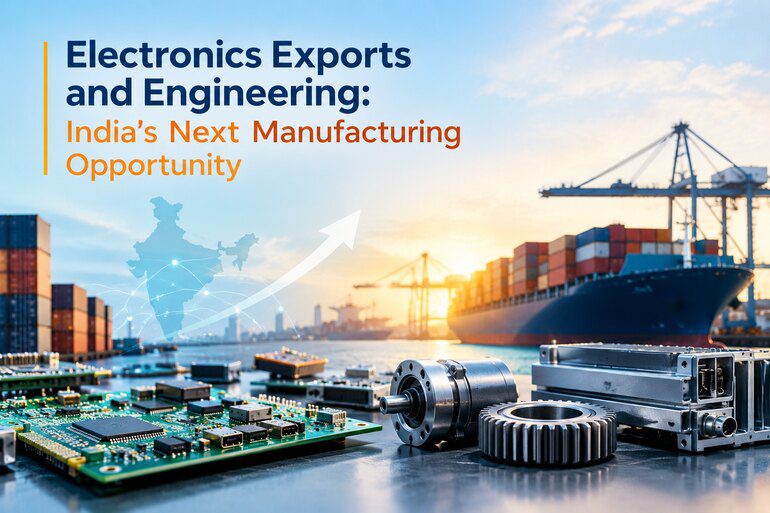
India’s export story is beginning to look different from the one the country has been used to telling.
For years, the conversation around India’s manufacturing exports was largely about increasing production, attracting investment and reducing dependence on imports. But the latest trade numbers point towards another question: Can India become a meaningful supplier of manufactured components and products to other major manufacturing economies?
That question becomes particularly interesting when looking at India’s recent exports to China. India’s exports to China increased by nearly 40% during the first five months of FY 2026-27, with electronics and engineering goods among the major contributors, according to government trade data reported in a recent analysis. Electronics shipments to China have also continued to grow, with products such as printed circuit board assemblies, smartphones, display modules and telecom equipment contributing to the broader electronics trade. The headline number is certainly interesting. But the more important story may be what is happening underneath it.
From Finished Products To Industrial Supply Chains
A manufacturing economy does not become globally competitive simply by assembling finished products. The deeper opportunity lies in becoming part of the supply chain for components, sub-assemblies, equipment and specialized engineering products.
This is where the recent electronics export movement deserves attention. If Indian manufacturers can increasingly supply components and sub-assemblies to companies operating within large Asian manufacturing ecosystems, India’s role changes. It is no longer only a market for imported components or a destination for final assembly. It starts becoming a supplier within the wider industrial network.
That does not mean India has suddenly become a manufacturing alternative to China. The numbers do not support such a conclusion. China remains a major source of imports for India, and the bilateral trade relationship continues to be heavily tilted in China’s favour. But a change in the direction of selected product flows is still worth watching.
Also Read: India’s Energy Security Is Being Built Beyond Oil Imports
Why AI and Data Centres Matter
There is another layer to this story: Artificial Intelligence. The global expansion of AI infrastructure is creating demand for data centres, servers, networking equipment, power electronics, telecom infrastructure and a wide range of supporting components. Industry representatives have linked some of the increased electronics demand to the expansion of AI and data-centre infrastructure.
This is important because AI’s manufacturing impact extends well beyond GPUs. Every new data centre requires electrical systems, power-management equipment, networking hardware, cooling systems, cables, connectors, control electronics and other industrial products. That creates opportunities across several layers of the electronics and engineering ecosystem. For Indian manufacturers, the opportunity may therefore be larger than simply exporting consumer electronics.
The Engineering Connection
Electronics is only one part of the emerging export story. Engineering goods are also contributing to India’s export momentum. At the overall merchandise-export level, engineering exports increased by nearly 25% year-on-year in August 2026, while electronic-goods exports rose nearly 90% during the month, according to Ministry of Commerce and Industry data released through PIB.
These numbers should not be interpreted as evidence that every segment of Indian manufacturing is accelerating at the same pace. Export performance varies significantly by product and market. However, the combination of electronics, engineering and industrial demand points towards an important structural possibility: India’s export opportunity could increasingly lie in supplying the machinery, components and systems behind the next generation of manufacturing and digital infrastructure.
The Bigger Test Is Consistency
The recent increase in exports to China is encouraging data, but one period does not establish a long-term trend. The more meaningful test will be whether Indian companies can sustain export growth, move into higher-value products, deepen domestic component manufacturing and build relationships with global customers beyond a limited number of product categories.
That is where India’s manufacturing ambitions will ultimately be tested. The opportunity is not simply to export more electronics. It is to build an industrial ecosystem capable of repeatedly producing products that global manufacturers need at the quality, scale, cost and reliability they expect. If that happens, the current electronics export surge may be remembered not as an isolated trade statistic, but as an early indication of a broader change in India’s position within global manufacturing supply chains.

2 Comments
Pingback: JBM Auto Races Ahead with a Market-Leading 33% Share
Pingback: India’s Mobile Subscriber Base Surges Past 1.26 Billion