



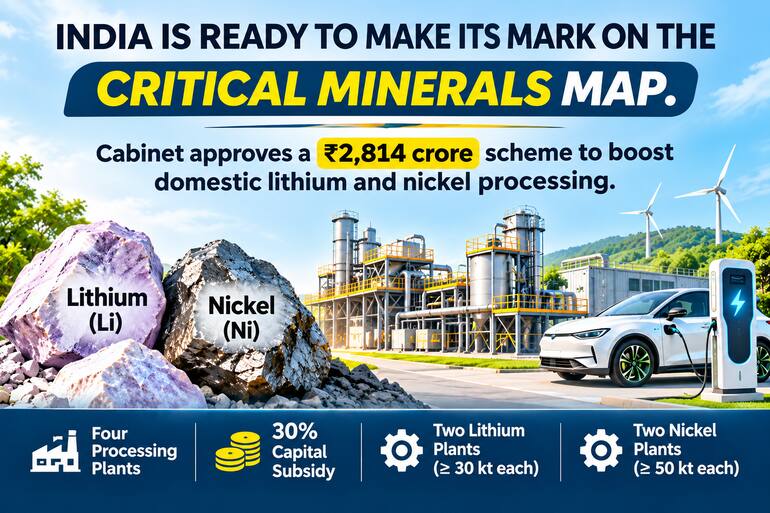
India’s Critical Minerals strategy has received a significant boost, with the Union Cabinet approving a ₹2,814 crore capital expenditure (CAPEX) support scheme to strengthen domestic lithium and nickel processing capabilities. The initiative aims to reduce dependence on imported refined materials, promote domestic value addition and establish resilient supply chains for industries such as electric mobility, battery energy storage systems (BESS), electronics, defence and speciality steel.
The scheme approved under the chairmanship of Prime Minister Shri Narendra Modi will be implemented over five years, from FY 2026-27 to FY 2030-31. It aims to support the establishment of four critical mineral processing plants in India, comprising two lithium processing facilities and two nickel processing facilities.
₹2,814 Crore Scheme to Support Four Processing Plants
Under the Critical Minerals processing scheme, the government will provide capital subsidies covering 30% of eligible investment for setting up the proposed processing facilities.
The initiative envisages the establishment of:
- Two lithium processing plants: Each with a minimum processing capacity of 30 kilotonnes (kt).
- Two nickel processing plants: Each with a minimum processing capacity of 50 kt.
The maximum capital support will be capped at ₹500 crore per lithium beneficiary and ₹900 crore per nickel beneficiary.
Through this financial assistance, the government aims to encourage investments in domestic processing infrastructure and address the high capital requirements associated with establishing commercial-scale critical mineral processing facilities.
Also Read: Making Waves in Maritime Logistics: TCI Seaways Adds 500 TEU Vessel with ₹178.8 Crore Investment
India Looks to Reduce Dependence on Imported Critical Minerals
The processing of critical minerals remains concentrated in a limited number of countries, exposing global supply chains to geopolitical disruptions, price volatility and potential supply restrictions.
India currently relies substantially on imports for refined intermediates and high-purity materials, including those derived from lithium, nickel and cobalt. Limited domestic beneficiation and processing infrastructure has also constrained the development of commercial-scale projects.
The newly approved scheme seeks to address these challenges by encouraging domestic processing capabilities, strengthening supply chain resilience and increasing value addition within the country.
The initiative also aligns with India’s broader objectives of reducing import dependence, enhancing economic security and advancing the vision of Atmanirbhar Bharat.
Lithium, Nickel and Cobalt to Support Key Industries
The scheme primarily targets the processing of lithium and nickel ores and intermediate products into high-purity compounds. Cobalt is also expected to be recovered as a by-product of nickel production.
These minerals are important raw materials for several strategic and emerging industries.
Lithium and nickel play significant roles in battery manufacturing and energy storage technologies, making their processing capabilities increasingly important for India’s electric mobility and battery energy storage ecosystem.
The proposed facilities are also expected to support downstream industries such as electronics, defence and speciality steel, helping strengthen domestic manufacturing and reduce exposure to external supply chain disruptions.
Two-Stage Selection Process for Beneficiaries
The government will select beneficiaries through a two-stage process designed to assess technical eligibility and financial competitiveness.
In the first stage, applications will undergo technical evaluation. Only applicants meeting the prescribed technical qualification requirements will be eligible to participate in the second stage of financial bidding.
For each mineral category, two beneficiaries will be selected based on the least-cost criterion, considering the lowest capital expenditure support sought by bidders under the scheme.
The financial incentives will be disbursed in three tranches linked to the achievement of specified project milestones.
Strengthening India’s Mineral Security for the Energy Transition
The ₹2,814 crore scheme marks an important step towards building domestic critical mineral processing infrastructure and strengthening India’s position across the global mineral value chain.
By supporting investments in lithium and nickel processing, the initiative aims to create opportunities for domestic value addition while supporting industries that are central to India’s energy transition and manufacturing ambitions.
As demand for electric vehicles, battery storage systems and advanced electronics continues to drive the need for critical minerals, developing domestic processing capabilities will be an important part of India’s efforts to build more resilient and diversified supply chains.
