



When crude oil prices rise or a major shipping route is disrupted, the question for a country like India is not simply how much oil it imports. The bigger question is: how quickly can the country find alternatives, protect essential supplies and prevent a global energy shock from becoming a domestic crisis?
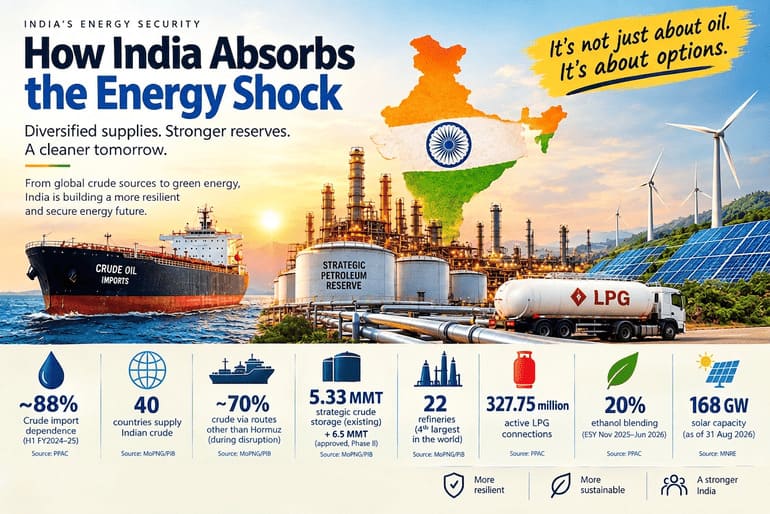
India remains heavily dependent on imported oil. According to the Petroleum Planning & Analysis Cell (PPAC), crude-oil import dependence was about 88% of consumption in the first half of FY 2024-25. That vulnerability has not disappeared. Yet India’s response to the latest disruption in West Asia shows that energy security is increasingly being built around diversification, inventories, refining capacity and multiple fuel sources rather than domestic crude production alone.
The important point is that India’s energy security is not a single policy. It is a system of several layers.
The First Line of Defence: Don’t Depend On One Source
India imports crude from a wide range of countries. In March 2026, the Petroleum Ministry told Parliament that India was sourcing crude from 40 countries, compared with 27 in 2006-07. The government also said the share of crude arriving through routes other than the Strait of Hormuz had risen to around 70%, from about 55% before the West Asia disruption.
This diversification matters because India’s problem is not simply the price of crude. It is also the risk that a geopolitical event can interrupt a particular route or supplier. The logic is similar to financial diversification: if one source becomes unavailable, the entire system does not have to stop.
That does not make India immune to higher oil prices. Imported oil will still become more expensive when international prices rise. But having more suppliers and routes gives refiners greater flexibility to keep physical supplies moving.
India Is Not Only an Oil Importer; It Is Also a Major Refiner
There is another important distinction. India imports a large quantity of crude, but it has built substantial refining capacity to convert that crude into petrol, diesel, aviation fuel, LPG and other products. That gives the country a second layer of protection.
The government said in May 2026 that India was the world’s third-largest oil refiner and fourth-largest exporter of petroleum products, exporting refined products to more than 150 countries while meeting domestic demand. This creates an unusual position: India can be highly dependent on imported crude while simultaneously being a major exporter of refined petroleum products.
PPAC data illustrates the scale. In FY 2023-24, India consumed about 234 million tonnes of petroleum products, while domestic refineries produced around 276 million tonnes. At the same time, crude-oil imports were worth about $133 billion.
In simple terms, India imports the raw material, processes a significant portion of it domestically and then distributes the resulting fuels through a nationwide network. That refining capacity becomes particularly valuable during a supply disruption.
Also Read: Shivalik BESS Clears Key Regulatory Hurdle as DERC Approves Tariff
Strategic Reserves Provide Time and Time Is Valuable
The third layer is physical inventory. India has established Strategic Petroleum Reserves at Visakhapatnam, Mangaluru and Padur with a combined capacity of 5.33 million tonnes of crude. The government has also approved another 6.5 million tonnes of storage capacity at Chandikhol in Odisha and Padur in Karnataka under a commercial-cum-strategic model.
The significance of a strategic reserve is not that it can permanently replace imports. It cannot. Its purpose is to create a buffer. If an international shipping route is disrupted, inventories can help bridge the period between a supply interruption and the arrival of alternative cargoes.
In May 2026, the government said India had around 60 days of crude-oil rolling stock, along with 60 days of natural-gas and 45 days of LPG rolling stock. These are broader industry stocks rather than simply the underground Strategic Petroleum Reserve capacity, so the figures should not be treated as interchangeable. That distinction is important: strategic reserves and commercial inventories perform different functions, but together they increase the system’s ability to absorb shocks.
Gas and LPG Require a Different Response
Oil is only one part of the energy equation. The recent disruption also exposed India’s dependence on imported natural gas and LPG. The government’s March 2026 response was therefore not simply to find more cargoes. It also introduced priority allocation.
According to the Petroleum Ministry, India produces roughly 90 million standard cubic metres of natural gas per day domestically, with additional LNG imported from abroad. During the disruption, household piped gas and CNG for transport were given the highest priority, while supplies to industrial users were managed at lower levels. LPG presented an even more immediate challenge because it reaches household kitchens.
The government said around 60% of India’s LPG requirements had previously been imported from Gulf countries, with the remainder produced domestically. In response, procurement was diversified to sources including the US, Norway, Canada, Algeria and Russia. Refineries were also directed to maximize LPG production; the government reported a 28% increase in LPG production over five days during the initial response.
This is a useful example of crisis management: supply is not always increased simply by importing more. Sometimes the faster solution is to change refinery output, redirect existing supplies and prioritize essential consumers.
Also Read: India’s Largest Solar Cell Plant? Premier Energies Takes Capacity to 10.6 GW
The Scale Of The LPG Network Matters
India’s energy story is also about the sheer size of its consumer base. PPAC reported around 327.8 million active domestic LPG connections as of September 2026, including more than 105.7 million PMUY connections.
Government data shows that LPG consumption has increased from around 17.6 million tonnes in FY 2014-15 to about 34 million tonnes in FY 2025-26. LPG consumers have increased from roughly 145 million to more than 333 million over the same period. That expansion has improved access to modern cooking fuel, but it also means that an LPG disruption now affects a much larger network.
Consequently, resilience increasingly depends on logistics: import terminals, storage, bottling plants, pipelines, distributors and last-mile delivery, not merely on the availability of crude.
The Longer-Term Insurance Policy is Diversification Away From Oil and Gas
There is one more layer that receives less attention during an oil crisis: electricity. Every unit of transport, industrial or household energy that can eventually be supplied through electricity rather than imported fossil fuel reduces exposure to international oil and gas markets.
India’s renewable-energy capacity has expanded rapidly. According to the Ministry of New and Renewable Energy as of 31st August 2026, India had about 168 GW of solar capacity and 58.5 GW of wind capacity. Total renewable capacity, including large hydro stood at roughly 295.6 GW, while total non-fossil installed capacity including nuclear was about 304.3 GW.
The country has also reached 20% ethanol blending in petrol under the current ethanol supply year, according to PPAC. These numbers do not mean India can quickly eliminate oil imports. Transport, aviation, petrochemicals and several industrial activities will continue to require hydrocarbons for years. But every additional source of energy reduces the economy’s exposure to a single commodity.
The Bigger Lesson: Resilience, Not Self-Sufficiency
India cannot realistically become insulated from global oil prices while it remains one of the world’s largest and fastest-growing energy consumers. The more practical objective is resilience.
The strategy visible in the latest crisis has five broad components:
- Diversify the suppliers.
- Diversify the transport routes.
- Maintain inventories.
- Use India’s refining capacity as a buffer.
- Gradually replace some fossil-fuel demand with domestic non-fossil energy.
The numbers show why this matters. India still imports roughly nine barrels of crude for every ten barrels consumed, but it also has a large refining industry, strategic petroleum infrastructure, multiple international suppliers, a vast domestic fuel-distribution network and a rapidly expanding renewable energy base.
That means India’s energy security story is no longer simply about finding more oil. It is about building enough alternatives in sources, routes, inventories, technologies and fuels, so that when one part of the global energy system is disrupted, the entire Indian economy does not have to stop.
The real test will come not when prices are stable, but when several shocks arrive at the same time. India’s progress should therefore be measured not by whether it can avoid every external shock, but by how much of that shock reaches households, businesses and economic activity, and how quickly the system can adjust.
