



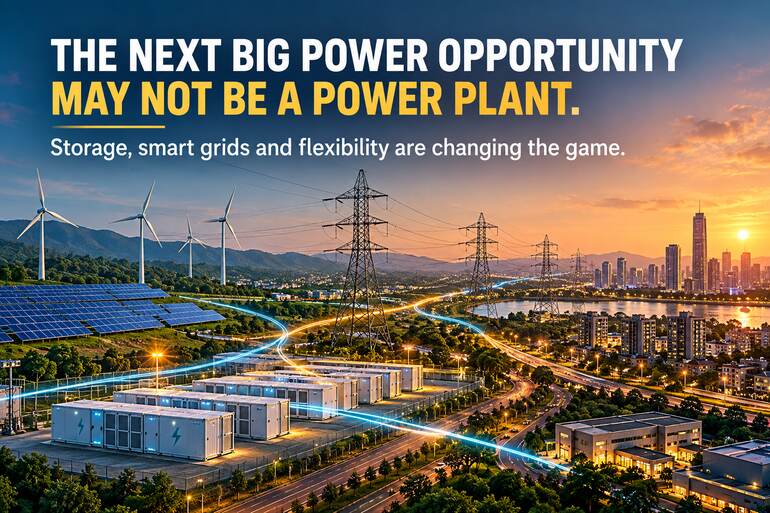
As renewable generation expands and electricity demand becomes more dynamic, storage, flexible generation, smarter grids and demand response could become increasingly valuable parts of India’s power economy. Together, these changes are also beginning to reshape power economics, shifting attention from simply producing more electricity to understanding when, where and how it creates value.
India’s power story has traditionally been measured in large numbers: gigawatts of generation capacity, kilometres of transmission lines, new power plants and rising electricity demand. That made sense when the central challenge was straightforward: produce enough electricity to keep a rapidly growing economy running. But the emerging power economics of a more renewable and flexible electricity system are becoming considerably more complex.
The next stage of the electricity transition presents a different problem. It is no longer enough to ask how much electricity the country can generate. Increasingly, the harder question is when that electricity is available, when consumers need it and how quickly the system can respond when the two do not match.
That shift could create a new layer of opportunity in India’s power sector. Solar generation, for example, can produce substantial amounts of electricity during the day, while demand can rise sharply later in the day. Wind output can change with weather conditions. At the same time, electricity consumption is becoming more dynamic as cooling demand rises and transport, industry and other activities become increasingly electrified.
The consequence is subtle but important: the value of electricity will increasingly depend not only on how much is generated, but on how effectively the power system can move, store, shift and balance it. That is where the changing power economics of India’s electricity system could become particularly significant.
The New Problem: Electricity Is Not Always Needed When It Is Generated
For decades, the power system was designed around a relatively simple principle. Generation was scheduled to follow demand, with different types of power plants operating according to their technical and economic characteristics.
Renewable generation changes that equation because solar and wind output depends on natural conditions. That does not make renewable power less valuable; it changes what the rest of the system must do around it. This is where flexibility enters the picture.
In power-system terms, flexibility means the ability to adjust generation, storage, networks or consumption so that supply and demand remain balanced. It can come from batteries, pumped storage hydropower, flexible thermal generation, transmission networks, electricity markets or consumers themselves.
The important point is that these resources do not necessarily compete with renewable energy. They can make renewable energy more usable. A battery can absorb electricity when supply is abundant and release it when demand increases. A pumped storage plant can perform a similar function at a different scale and duration. A transmission network can move electricity from a region with surplus generation to another facing higher demand. A consumer can shift some electricity consumption from a constrained period to a time when power is more readily available.
The power system therefore begins to look less like a collection of power plants and more like a coordinated network of generation, storage, transmission and flexible demand.
Storage Is Becoming More Than a Backup Technology
This is one reason the economics of energy storage deserve closer attention. Battery storage is often described simply as a way to store surplus renewable electricity. That is only part of the story. Grid-scale batteries can respond rapidly and provide several system services, including balancing and capacity support.
India is also moving towards much larger storage requirements. The Ministry of Power’s National Electricity Plan projects a BESS requirement of 47.24 GW/236 GWh by 2031-32, while pumped storage requirements are projected at 26.69 GW/175 GWh. Those numbers suggest that storage could become an important infrastructure category in its own right.
There is also evidence that its economics are changing as storage costs decline and competitive procurement expands. That matters because falling storage costs can change the business case for how electricity is generated, stored, traded and delivered.
The question for power companies and investors therefore may not simply be who builds the most renewable capacity. It may increasingly be who can build and operate the infrastructure that makes variable electricity more valuable.
The Grid Could Become a Bigger Business Opportunity
Storage, however cannot solve every problem. Electricity must still travel from where it is generated to where it is consumed. This makes transmission and distribution infrastructure an equally important part of the flexibility equation.
India’s power grid has become increasingly interconnected, while inter-regional transmission capacity continues to expand. As renewable generation grows across different parts of the country, the ability to move electricity between regions can become increasingly important.
That creates opportunities beyond traditional generation companies. Transmission developers, grid equipment manufacturers, power electronics companies, control-system providers, battery developers and digital-grid businesses could all become part of the emerging flexibility economy.
The reason is simple: when electricity flows become more variable, the infrastructure controlling those flows becomes more valuable.
A grid capable of moving power efficiently across regions can reduce local shortages and absorb renewable surpluses. Digital monitoring and forecasting can improve system visibility. Advanced controls can help operators respond more quickly. Better market signals can encourage storage and flexible consumers to respond at the right time. The future grid may therefore need to become not just larger, but smarter.
Consumers May Become Part of the Power System
Perhaps the most underappreciated source of flexibility is sitting on the other side of the electricity meter. For a long time, electricity consumers have largely been treated as passive users. They consume power, receive a bill and leave the balancing of the system to utilities and generators.
That model can change. Demand response allows consumers to modify the timing or level of their electricity consumption in response to system conditions or financial incentives. Large industrial users may be able to shift certain processes. Commercial buildings can manage cooling loads. Electric vehicle charging can potentially be scheduled around system conditions. Batteries installed behind the meter can also change when customers draw electricity from the grid.
For India, this could become increasingly relevant as electricity moves deeper into everyday economic activity and new forms of electrification expand. The opportunity is not necessarily about asking consumers to use less electricity. It is about asking a more sophisticated question:
Can some electricity use happen at a different time? That distinction could eventually support new business models involving aggregators, smart meters, energy management platforms and distributed storage.
The Power Market Could Change Alongside the Hardware
There is another piece of the puzzle that receives less attention: market design. Flexibility has economic value only when the electricity system can recognize, measure and reward it.
If a battery can provide several services but is compensated for only one, its business case may remain weak. If an industrial consumer can reduce demand during a system peak but receives no meaningful compensation, there may be little reason to participate. If electricity prices do not reflect changing system conditions, consumers have fewer incentives to shift consumption.
India has already developed mechanisms such as real-time electricity markets, while the broader evolution of market and regulatory frameworks will influence how flexibility resources participate in the power system. This could make power market design almost as important as technology.
The next phase of the electricity market may therefore reward not only companies that own physical assets, but also those capable of optimizing those assets across multiple revenue streams.
From Capacity Addition to System Optimization
This is where India’s power story may be entering an interesting transition. The first phase of the renewable energy expansion was largely about adding capacity. The next phase may be about getting more value from that capacity.
That means asking different questions. How much solar power can be absorbed without unnecessary curtailment? How much storage is required at a particular location? When should a battery charge and discharge? Which transmission projects can unlock renewable generation? How can demand be shifted without disrupting consumers? What price signals will encourage flexible consumption? Which existing power plants can operate more flexibly?
These are not merely engineering questions. They are increasingly commercial questions. For businesses operating across the electricity value chain, that distinction matters. A company that can improve the utilization of an existing asset may create value without necessarily adding another large generating unit. A storage operator that can participate across different market services may have a different revenue opportunity from a conventional power generator. A technology provider that helps utilities forecast and manage electricity flows may become increasingly relevant as the system becomes more complex.
The opportunity is therefore moving from simply building more capacity to optimizing the capacity already being built.
A New Layer of the Power Economy
India’s energy transition is creating something more interesting than a simple shift from conventional generation to renewables. It is creating a need for an entire flexibility layer around the electricity system.
That layer could include batteries and pumped storage, flexible generation, stronger transmission networks, digital control systems, demand-response platforms, smart charging, energy management technologies and new electricity market mechanisms.
The companies that participate in this market may come from very different parts of the existing energy ecosystem. Some will own infrastructure. Others may provide technology, software or services. Some may make money from storing electricity, others from moving it, and others from helping customers consume it at the right time.
That is why the next power sector opportunity may not be defined simply by another race to build generation capacity. The bigger opportunity could be in making the entire system more responsive.
India will continue to need more electricity. It will continue to need more generation capacity, more transmission and more renewable energy. But as the system becomes more complex, the ability to co-ordinate all of those assets could become just as important as building them.
The next question for India’s power economy, then, may not be how much more electricity can we generate? It may be, How intelligently can we move, store and use the electricity we have, and how much new value can that flexibility create?
