



Artificial Intelligence (AI) has become the defining technology of this decade. Every week brings news of breakthrough AI models, billion-dollar investments, new semiconductor plants and ambitious national strategies aimed at securing leadership in what many believe will be the next industrial revolution.
The global conversation often focuses on one question: Who is winning the AI race?
Is it the United States, home to some of the world’s most influential AI companies? Is it China, which continues to invest aggressively in AI research, advanced manufacturing and digital infrastructure? Or will another nation emerge as an unexpected leader?
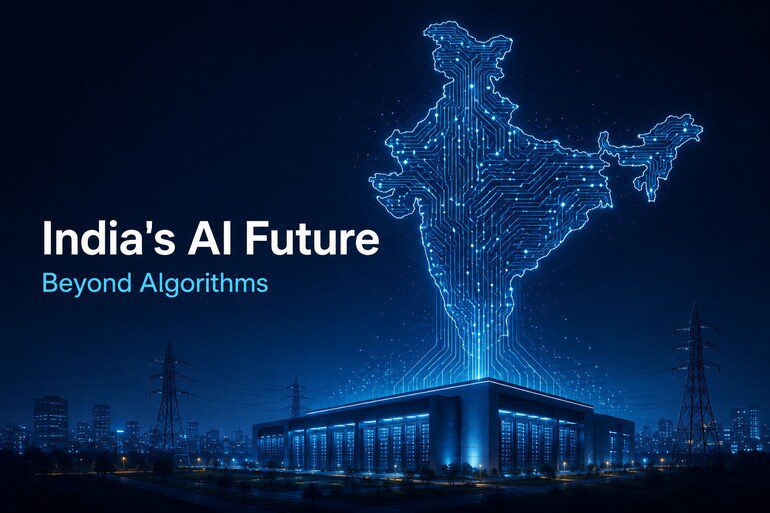
India is undoubtedly part of this global race. Yet, unlike many other countries, India’s opportunity may not lie in building the largest language models or owning the most advanced graphics processors. Instead, its greatest strength could lie in something far less glamorous but infinitely more important; the infrastructure that enables AI to thrive.
Artificial Intelligence does not exist in isolation. Every AI application, from a chatbot answering customer queries to a sophisticated healthcare diagnostic system depends on an ecosystem of data centres, electricity, high-speed connectivity, semiconductor supply chains, skilled professionals and supportive public policy. Without these foundations, even the most advanced AI software remains little more than a promising idea.
This is why India’s AI journey deserves to be viewed not merely as a technology story, but as a story of nation-building.
Also Read: Government Clarifies No Proposal to Blend Ethanol with Aviation Turbine Fuel
Every Industrial Revolution Has Had Its Foundation
History reminds us that transformative technologies rarely succeed on innovation alone. The Industrial Revolution was not powered simply by the invention of the steam engine. It required railways to transport goods, ports to facilitate trade and factories to scale production. The automobile revolution depended on roads, highways, refineries and supply chains that stretched across continents. The internet era would never have reshaped the global economy without fibre-optic networks, telecommunications infrastructure and billions of dollars invested in digital connectivity.
Artificial Intelligence is no different. Behind every intelligent application lies an enormous physical infrastructure that is often invisible to users. Large AI models are trained on thousands of powerful processors housed in hyperscale data centres. These facilities consume significant amounts of electricity, require advanced cooling technologies and rely on uninterrupted connectivity to deliver services in real time.
In other words, AI runs on infrastructure. This simple reality is changing the way governments and businesses think about economic development. Countries are no longer competing only to attract technology companies; they are competing to build the ecosystems that make AI investments possible.
India’s Moment Is About More Than Technology
India’s digital transformation over the past decade has demonstrated how technology can reshape an economy when supported by the right infrastructure.
Initiatives such as Aadhaar, Unified Payments Interface (UPI), DigiLocker and the broader Digital India programme have fundamentally changed how millions of citizens access financial services, government programmes and digital commerce. These platforms did not become successful because of technology alone. They succeeded because they were supported by policy reforms, public infrastructure and large-scale adoption.
Artificial intelligence represents the next chapter in this evolution. Rather than viewing AI as a standalone technology, India has an opportunity to integrate it into sectors that collectively employ hundreds of millions of people and contribute significantly to the national economy.
Manufacturing can use AI to optimize production lines and reduce downtime through predictive maintenance. Agriculture can benefit from precision farming, weather forecasting and crop-health monitoring powered by machine learning. Healthcare can improve diagnostic accuracy, support medical professionals and expand access to quality care in underserved regions. Education can become more personalized, enabling students to learn at their own pace while giving teachers powerful digital tools. Logistics, retail, banking, energy and public administration are equally poised for transformation.
The real value of AI will therefore not be measured by the number of algorithms India develops, but by the productivity gains those algorithms create across the broader economy.
The Rise of AI Is Quietly Reshaping Infrastructure Priorities
One of the most significant yet underappreciated aspects of the AI revolution is the growing importance of infrastructure. Until recently, discussions around digital transformation focused largely on software, cloud services and internet connectivity. Today, the conversation has expanded considerably.
Governments are investing in semiconductor manufacturing. Technology companies are building hyperscale data centres. Utilities are strengthening electricity grids. Renewable energy developers are planning larger projects to meet future demand. Telecommunication providers are expanding fibre networks and 5G coverage. These developments are not isolated. They are deeply interconnected.
An AI-powered economy requires reliable computing infrastructure. Computing infrastructure depends on data centres. Data centres require uninterrupted electricity. Electricity must be generated, transmitted and managed efficiently. High-speed connectivity links these facilities to businesses and consumers. Skilled engineers, technicians and researchers ensure that the entire ecosystem functions effectively.
Each component reinforces the others. This interconnectedness means that AI has become much more than a technology trend. It is increasingly influencing investment decisions across sectors that were once considered unrelated to digital innovation.
Data Centres Are Emerging as the New Industrial Hubs
Factories powered the manufacturing economy. Information technology parks accelerated the software revolution. In the AI era, data centres are becoming the factories of the digital economy.
Unlike traditional server facilities, modern AI data centres house thousands of specialized processors capable of handling enormous computational workloads. They operate continuously, process vast quantities of information and support everything from cloud computing and generative AI to financial transactions and scientific research.
As AI adoption accelerates, these facilities are becoming strategic national assets. Countries that can provide reliable land, electricity, water, connectivity and favourable regulatory environments are likely to attract greater investments from global technology companies.
India possesses several advantages in this regard. A rapidly growing digital economy, an expanding internet user base, improving infrastructure and a large pool of technology professionals position the country as an attractive destination for future AI infrastructure investments. However, maintaining this momentum will require sustained investment not only in digital infrastructure, but also in the physical systems that support it.
Why Electricity Has Become the New Strategic Resource
Perhaps the biggest misconception about Artificial Intelligence is that it is primarily a software business. In reality, AI is one of the most energy-intensive technologies the world has ever developed. Every AI model requires enormous computing power. Every computing cluster generates heat. Every server must operate continuously with minimal downtime. As AI capabilities expand, electricity is becoming one of the most valuable strategic resources in the digital economy.
This shift explains why conversations about AI increasingly involve energy companies, transmission utilities, renewable energy developers and infrastructure planners alongside technology firms. The future of AI will depend as much on reliable electricity as it does on better algorithms. And for India, this presents both one of its greatest opportunities and one of its most important challenges.
Building the Foundations of India’s AI Future
Artificial Intelligence has often been described as the next great technological revolution. Yet history shows that no revolution succeeds on innovation alone. Every major leap in human progress has been supported by the infrastructure that made it possible.
For India, the AI opportunity extends far beyond developing sophisticated algorithms or attracting global technology companies. The country’s long-term success will depend on its ability to strengthen the foundations that support an AI-driven economy; reliable power, world-class data centres, resilient digital networks, semiconductor capabilities, a highly skilled workforce and forward-looking public policies.
The encouraging part is that many of these building blocks are already taking shape. Investments in digital public infrastructure, renewable energy, semiconductor manufacturing, data centres and advanced connectivity signal that India is laying the groundwork for its next phase of growth. The challenge now is to ensure these developments progress in a co-ordinated and sustainable manner.
If India succeeds, AI will not simply transform the technology sector. It has the potential to improve productivity across manufacturing, agriculture, healthcare, education, financial services and public administration, creating benefits that extend throughout the economy. In that sense, AI should not be viewed merely as another technological milestone, but as an enabler of broader economic and social transformation.
Ultimately, the global AI race is unlikely to be won by algorithms alone. It will be shaped by the strength of the ecosystems that support innovation, including robust infrastructure, reliable energy, skilled talent and forward-looking policies. India has already demonstrated its ability to build digital public infrastructure at scale. The next challenge is to extend that success into the AI era.
As governments, businesses and researchers work together to shape this future, one thing is becoming increasingly clear: AI may power the applications of tomorrow, but it is infrastructure that will power the AI revolution itself. If India continues investing in these foundations, it will be well placed not only to participate in the global AI race, but to help define its next chapter.
