


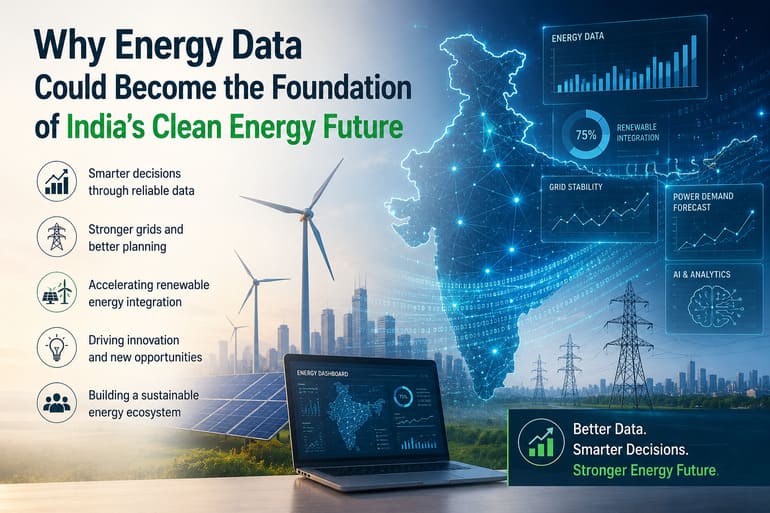
For nearly a decade, India’s renewable energy story has been driven by one headline after another. Record-breaking solar parks, larger wind turbines, massive transmission projects and ambitious government targets have become symbols of the country’s transition towards cleaner sources of electricity. According to government data, India had installed 253.96 GW of renewable energy capacity by November 2025, after adding a record 44.5 GW during the year. This has been the highest annual renewable energy capacity addition in the country’s history. This remarkable growth has strengthened India’s position as one of the world’s leading renewable energy markets and reinforced its ambition of achieving 500 GW of non-fossil fuel power capacity by 2030. Yet the real transformation extends beyond the capacity figures. Every new solar park, wind farm, battery storage system, transmission line and smart meter is also creating an enormous volume of data that is quietly becoming one of the power sector’s most valuable assets.
What makes this data so valuable is that it provides a real-time picture of how India’s electricity system is functioning. It captures changes in renewable energy generation, electricity demand, grid frequency, transmission constraints, equipment performance and consumer consumption patterns. When analyzed effectively, this information enables utilities and developers to forecast demand more accurately, identify equipment issues before failures occur, integrate renewable energy more efficiently and make faster operational decisions. In many ways, data is becoming as essential to modern power systems as electricity itself.
This is why the Ministry of Power’s proposed National Electricity Data Sharing Framework deserves much greater attention than it has received. At first glance, it appears to be another policy document discussing data standards, governance and interoperability. However, beneath the technical language lies a much bigger story. The proposal recognizes that India’s next energy challenge is no longer limited to generating more electricity. It is about making better decisions using better information.
Why Modern Power Systems Depend on Data
Two decades ago, electricity systems were comparatively simple. Large coal-fired power stations generated electricity according to predictable demand. Electricity travelled in one direction, from the generating station to industries, offices and homes. Grid operators mainly focused on ensuring enough electricity was available to meet demand. Today’s electricity system looks completely different.
Solar generation rises and falls depending on cloud cover and daylight. Wind farms produce electricity only when wind conditions are favourable. Rooftop solar installations not only consume electricity but can also export surplus power back into the grid. Battery energy storage systems decide when electricity should be stored and when it should be supplied. Electric vehicles are beginning to create entirely new patterns of electricity demand. Managing such a dynamic electricity system requires far more than engineering expertise. It requires continuous access to reliable information.
Imagine driving through an unfamiliar city without using Google Maps. You could eventually reach your destination, but the journey would take longer because you would have little idea about traffic congestion, road closures or faster alternative routes. Google Maps does not create roads; it simply helps people use existing roads more efficiently by analyzing millions of pieces of information every minute. The electricity sector is undergoing a similar transformation. Transmission lines, substations and power plants are the roads. Data is becoming the navigation system.
Why Electricity Data Matters
To understand the importance of data, consider a renewable energy developer planning to build a new wind farm. Finding land with good wind resources is only one part of the decision. The developer also needs answers to several practical questions.
- Is there enough transmission capacity available nearby?
- Are substations already operating close to their limits?
- Has renewable electricity in the region been curtailed because of grid congestion?
- How quickly is electricity demand growing in the surrounding districts?
- Are there industrial parks expected to increase future power consumption?
Historically, such information has often been spread across multiple organizations, reports and databases. Developers may need to collect information from utilities, transmission companies, regulators, government agencies and consultants before making an investment decision. Now imagine the same information being available through a standardized digital framework using common data formats. Instead of spending weeks searching for information, developers could focus on analyzing it. That seemingly small difference could reduce project timelines, improve planning and support better investment decisions.
The World Is Already Moving Towards Data-Driven Energy
India is not alone in recognizing the importance of electricity data. Germany provides one of the best-known examples. Researchers and energy institutions launched the Open Power System Data initiative to solve a practical problem. Electricity information existed across several organizations, but different formats made analysis difficult. The initiative standardized datasets covering electricity demand, renewable generation, weather and market information, making it much easier for universities, researchers and analysts to study Europe’s energy transition.
Australia has taken another approach. The country’s National Electricity Market publishes extensive operational and market information, enabling energy companies, software developers, researchers and consultants to analyze electricity trends and develop innovative digital services.
In the United States, regional grid operators such as ERCOT publish real-time information on electricity demand, renewable generation, transmission constraints and wholesale market prices. These datasets are used not only by utilities but also by technology companies, financial institutions, universities and energy market analysts.
The common lesson from all these examples is straightforward. Open and well-governed electricity data does not simply improve transparency. It creates opportunities for innovation. Just as GPS technology enabled ride-hailing platforms, logistics companies and food delivery services, accessible electricity data can support entirely new digital businesses focused on forecasting, analytics, asset management and energy intelligence.
India Has Already Demonstrated the Power of Digital Infrastructure
India does not have to look overseas to understand how common digital standards can transform an entire sector. Over the past decade, the country has built some of the world’s most successful digital public infrastructure platforms, demonstrating how technology can improve efficiency, transparency and accessibility at a national scale.
Perhaps the most striking example is the Unified Payments Interface (UPI). According to the National Payments Corporation of India, UPI processed more than 18.68 billion transactions in May 2026, with a transaction value exceeding ₹25 trillion. What began as a simple digital payment platform has evolved into the backbone of India’s digital economy, enabling seamless transactions between banks, businesses and consumers. Millions of people now transfer money instantly using a mobile phone, something that would have seemed ambitious just a decade ago.
India’s transport sector offers another compelling example. The FASTag programme has transformed toll collection across the country’s national highways by replacing manual cash payments with electronic tolling. According to the National Highways Authority of India, more than 10 crore FASTags have been issued, significantly reducing waiting times at toll plazas while improving traffic flow and operational efficiency. What was once a time-consuming manual process has become largely automated through digital identification and data exchange.
A similar transformation has taken place in taxation. Since the introduction of the Goods and Services Tax (GST), businesses across India have adopted digital filing and compliance through the GST Network (GSTN). The platform processes millions of tax returns every month, creating a standardized digital ecosystem that has simplified indirect tax administration for governments and businesses alike.
These initiatives have one important feature in common. They are not successful merely because they are digital. They succeeded because they established common standards that allow different organizations, systems and users to exchange information quickly, securely and efficiently.
The proposed National Electricity Data Sharing Framework follows the same philosophy. Rather than creating another standalone database, it aims to establish a common framework through which electricity-related information can be managed, shared and analyzed across the power sector. If implemented effectively, it could enable developers, utilities, regulators, researchers and technology companies to make faster, more informed decisions based on reliable and standardized data.
Just as UPI transformed digital payments and FASTag modernized toll collection, a robust energy data ecosystem could help build a smarter, more connected and more efficient electricity sector. As India pursues its clean energy ambitions, the ability to harness information effectively may become just as important as expanding generation capacity or strengthening transmission infrastructure.
