



An electric vehicle may carry a “Made in India” label, but that does not necessarily mean the technology powering it was born here. Beneath the bodywork sits a complex network of batteries, motors, controllers, electronics and software, and increasingly, the ownership of that technology is becoming as important as the ability to manufacture the vehicle itself.
That is the distinction Avore Electric wants to make with its approach to EV development. For the company, building an indigenous electric motorcycle is not simply about assembling the vehicle in India. It is about developing the technology underneath it, understanding how those systems work together and retaining the ability to improve them over the life of the product.
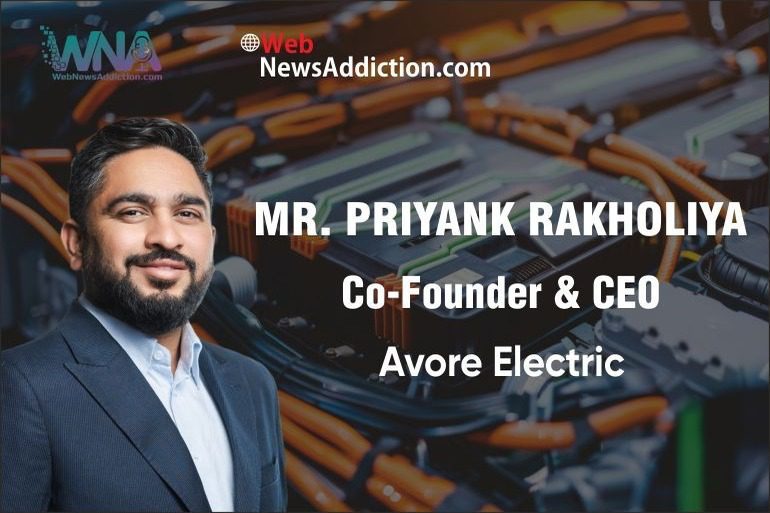
At the centre of this approach is Mr. Priyank Rakholiya, Co-Founder and CEO of Avore Electric, who sees technology ownership as the next frontier for India’s EV industry. For him, the real measure of an indigenous electric vehicle lies not just in where it is built, but in how much of the technology behind it is conceived and developed in India.
“For us, indigenous technology means going beyond manufacturing the final vehicle in India and developing ownership of the technology that goes into it”, Mr. Priyank Rakholiya pointed out.
Over the past three years, Avore says it has developed more than nine critical vehicle systems in-house, including the battery pack, battery-management system (BMS), motor, motor controller, power-control module, DC-DC converter, onboard fast charger, display system and proprietary operating system. The company has also filed more than 120 intellectual-property applications.
Also Read: The Next Energy Frontier: Abinash Sahoo on India’s Battery Ambition
Owning the Technology Stack
The decision to develop much of the technology stack internally is central to Avore’s strategy. In an electric vehicle, the performance of individual components is only part of the equation. How the battery communicates with the BMS, how the controller manages the motor, how diagnostics are built into the system and how software interacts with the hardware can all influence the ownership experience.
According to Mr. Priyank Rakholiya, controlling the technology stack gives Avore greater freedom to engineer around the needs of Indian riders while also providing greater control over development, diagnostics, reliability and future updates.
“Controlling the technology stack gives us greater integration between the vehicle’s hardware and software and allows us to engineer the product around the requirements we have identified for Indian riders,” Mr. Rakholiya noted.
The company says predictive-maintenance and diagnostic capabilities have been considered during the engineering process itself, while its proprietary operating system allows the motorcycle to evolve through over-the-air updates rather than remaining fixed at the point of purchase.
That approach also changes the role of software. Instead of treating connectivity or digital features as additions to an otherwise conventional motorcycle, Avore sees software as an integral part of the vehicle platform.
Three Years of Engineering and Validation
Developing core technology internally comes with another challenge: can systems designed in-house withstand the demands of everyday use?
Avore says it spent three years developing its platform before launching the EX. The company has completed more than 1,00,000 km of road testing and more than 2,500 hours of dynamometer validation, alongside extensive rider testing across diverse Indian conditions.
For an electric motorcycle, such testing is critical because the real-world performance of systems such as the battery, BMS, motor and power electronics can vary considerably depending on operating conditions. The development journey has reinforced an important lesson for the company: technology ultimately has to translate into reliability, consistency and a predictable riding experience.
“The biggest learning has been that technology must ultimately translate into reliability, consistency and a riding experience that works in the real world,” Mr. Rakholiya said.
The validation programme, therefore, is as much a part of Avore’s technology story as the components it has developed. For customers, sophisticated engineering only matters if it can deliver dependable performance over the course of everyday use.
Also Read: Ashok Leyland and Drivn Join Forces to Make Electric Trucks Easier to Own
Designing for Indian Riders
Local technology development also gives Avore the ability to engineer around India’s specific riding and environmental conditions rather than adapting a generic EV architecture. The company says its BMS incorporates region-wise and age-wise AI-driven optimization, allowing the system to adapt to how and where a vehicle is used. Its battery pack uses four-way active cooling and IPU-X Shield protection.
The company’s focus on motorcycles is similarly rooted in the requirements of Indian commuters, including longer commutes and higher-load conditions. The larger argument is that localization should not stop at manufacturing. It should extend to how the vehicle’s underlying technology responds to the conditions in which it is actually used.
Mr. Rakholiya stated that developing these systems internally gives Avore the flexibility to design specifically around Indian usage rather than relying entirely on a generic technology architecture.
For a country where electric two-wheelers are increasingly becoming part of everyday commuting, that distinction could prove important. The challenge is not merely to make an electric motorcycle work, but to make it work consistently across the varied conditions in which Indian riders use their vehicles.
When The Motorcycle Becomes A Software Platform
If hardware provides the foundation, Avore sees software as the layer that can allow the motorcycle to keep evolving. The company’s proprietary AVORE SENSE operating system works alongside AVA and Avore Synapse to create a more connected and personalized interaction between the rider and the motorcycle. The platform is designed to bring together functions such as ride statistics, rider insights, performance modes and other intelligent capabilities.
But for Avore, the bigger opportunity lies beyond individual features. A proprietary operating system gives the company the ability to continue developing the motorcycle after it reaches the customer through software updates.
“Software is central to the way we see the future of electric mobility,” Mr. Rakholiya emphasized, adding that the software layer allows intelligence to be built into the motorcycle rather than treated as an additional feature.
This could increasingly change how customers perceive an electric motorcycle. Instead of being a finished product at the moment of purchase, the vehicle can become a platform capable of gaining new capabilities and improvements over time.
For an EV manufacturer, owning the software layer also means having greater control over the interaction between the vehicle’s hardware and digital experience.
India’s Remaining Technology Gaps
If India is to build a deeper EV ecosystem, however, vehicle manufacturing and assembly alone may not be enough. From Avore’s perspective, the larger opportunity is for Indian EV companies to move from assembling systems developed elsewhere to developing and owning the core technologies themselves. That requires sustained investment in research and development, engineering capabilities and intellectual property.
Avore’s own approach has been to develop critical vehicle systems in-house while also looking at ways to reduce dependence on critical imported materials. For example, its motor uses a rare-earth-free permanent-magnet synchronous motor (PMSM) architecture, which the company says reflects its focus on supply-chain resilience and greater technology independence.
The issue is ultimately bigger than any single component. For India, building a competitive EV ecosystem will require capabilities across engineering, electronics, software, materials, manufacturing and testing.
From Individual Startups To An Ecosystem
If more Indian EV startups begin investing in core technologies rather than assembling systems developed elsewhere, the impact could extend well beyond individual products.
Greater investment in R&D could strengthen India’s engineering capabilities, increase localization and create more intellectual property within the country. It could also help create a technology and manufacturing base capable of supporting multiple generations of products rather than limiting India’s role to vehicle assembly.
“Greater investment by startups in core technology development would encourage deeper R&D capabilities, increase localization and create more intellectual property within India,” Mr. Rakholiya observed.
For Avore, its AVORE Source technology stack is part of this larger ambition. The company’s stated objective is to develop Indian technology for Indian mobility requirements while building capabilities that can continue to evolve beyond a single product.
The distinction is important. A manufacturing ecosystem can assemble a product, but a technology ecosystem can create the next generation of products.
Beyond the EX: What’s Next for Avore
The EX is being positioned as the beginning of Avore’s technology journey rather than its endpoint.
The company says its future focus will remain on advancing its technology platform, with an emphasis on greater intelligence, improved performance, reliability and localization. While Avore has not disclosed a specific next-generation breakthrough, its direction points towards continued investment in in-house R&D and technologies aimed at making electric mobility more accessible and practical for Indian riders.
“The EX is the beginning of our journey, and we intend to continue investing in in-house R&D and developing technologies that can make electric mobility more accessible and practical for Indian riders,” Mr. Rakholiya said, outlining the company’s vision for the road ahead.
The significance of Avore’s approach, therefore, may ultimately lie beyond the EX itself. The company’s ambition is to build the underlying capabilities to design, test, refine and evolve its own technology platform, rather than simply putting together technologies developed elsewhere.
India’s EV transition will certainly be measured in vehicles sold and kilometres electrified. But another measure could prove just as important: how much of the technology behind those vehicles is conceived, engineered and owned in India?
That is the larger bet Avore Electric is making. The journey from “Made in India” to “Engineered in India” is a much harder one. But if Indian EV companies can make that leap, the country would not merely be producing electric vehicles. It would be building the technology that powers the next generation of mobility.
