



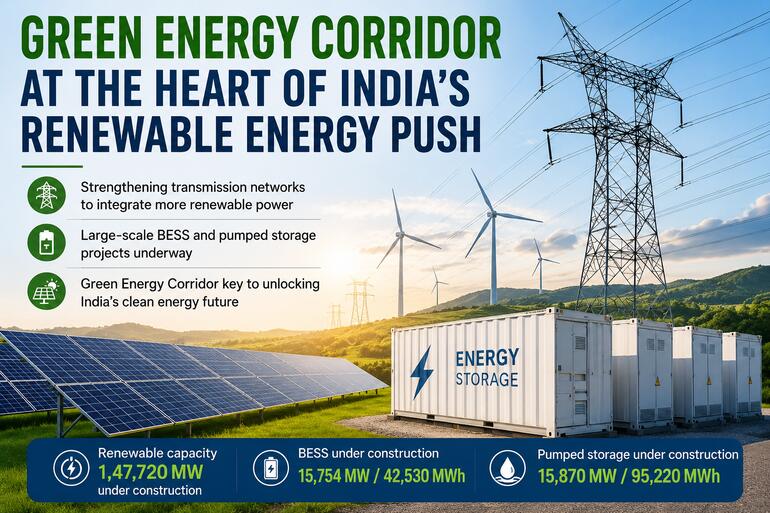
India’s renewable energy expansion is increasingly shifting the focus from how much clean power the country can generate to how efficiently that power can be transmitted, stored and delivered to consumers. With renewable capacity continuing to grow, the government is placing greater emphasis on transmission infrastructure, grid flexibility and energy storage as critical components of the country’s energy transition.
A recent government update has highlighted the measures being undertaken to strengthen renewable energy integration, including the continued development of the Green Energy Corridor, expansion of intra-state transmission networks and deployment of energy storage systems.
The development comes at a time when India’s power system is preparing to accommodate a significantly larger share of renewable electricity. The government has said coordinated transmission planning is being undertaken to avoid congestion, minimise curtailment and optimise network augmentation requirements.
From Renewable Capacity to Renewable Power Delivery
India’s clean energy ambitions are creating a new infrastructure challenge. Building solar and wind capacity is only one part of the transition. The electricity generated from renewable-rich regions must also reach demand centres reliably, requiring transmission networks capable of handling changing generation patterns.
The government’s latest update underlines the importance of strengthening the intra-state transmission network in line with planned renewable energy additions. It also notes that inter-state transmission systems for renewable energy schemes are being interconnected with intra-state networks to improve overall grid reliability.
The Green Energy Corridor is an important part of this effort. The government has been providing budgetary support for intra-state transmission projects under the GEC scheme to facilitate renewable energy integration.
Earlier phases of the programme have focused on creating transmission infrastructure in renewable-rich states, helping establish the network needed to evacuate power from large renewable energy projects.
The next stage of India’s renewable expansion therefore increasingly depends on infrastructure that can move electricity as efficiently as it can be generated.
Also Read: Apraava Energy Secures Major Transmission Project to Power Andhra Pradesh’s Renewable Future
Storage Becomes the Other Half of the Grid Story
Transmission expansion alone cannot address all the challenges created by variable renewable generation. Solar and wind output can change according to weather conditions and the time of day, making flexibility and storage increasingly important.
The government update provides a snapshot of the scale of storage deployment now being developed in India.
As of June 30, 2026, pumped storage projects with a combined capacity of 15,870 MW / 95,220 MWh were under construction. A further 6,580 MW / 39,480 MWh of pumped storage capacity had been concurred and was yet to enter construction.
Battery energy storage is also expanding. The government reported 15,754 MW / 42,530 MWh of BESS capacity under construction, while another 11,747 MW / 38,425 MWh had been awarded and 19,192 MW / 67,574 MWh was at the tendering stage.
These numbers point to a power system increasingly being designed around a combination of renewable generation, transmission and storage rather than generation capacity alone.
The government has also considered around 47 GW of BESS integration by 2031-32, alongside a roadmap for integrating 100 GW of pumped storage plants between 2025-26 and 2035-36.
Together, these measures are intended to provide greater flexibility to the grid as renewable electricity takes on a larger role in India’s power mix.
Why the Green Energy Corridor Matters Now
The importance of the Green Energy Corridor is likely to grow as India adds more renewable generation capacity.
The government has reported that 1,47,720 MW of renewable capacity, including solar and wind projects, was under construction as of June 30, 2026. Another 47,830 MW of renewable capacity was at various stages of planning, with projects targeted for completion by 2029-30.
That scale of capacity addition makes transmission planning a central part of India’s energy strategy.
The government has identified several measures to improve renewable integration, including renewable energy zones and pooling stations, renewable energy management centres, improved forecasting and scheduling, real-time dispatch, ancillary services and market reforms.
The transmission network is also being strengthened through technologies designed to improve grid stability and utilisation. These include Static Synchronous Compensators and Static VAR Compensators, while high-ramp-rate generation sources such as hydro and gas can help maintain the balance between generation and demand.
Against this backdrop, reports that the government is preparing the next phase of the Green Energy Corridor, with a proposed investment of more than ₹50,000 crore and a potential renewable evacuation target of around 135 GW, underline the scale of the infrastructure challenge ahead. The reported proposal is yet to receive Cabinet approval and should therefore be viewed as a development under consideration rather than an approved government scheme.
Also Read: mayr Presents Smart Safety Solutions for Wind Power at WindEnergy 2026
Building the Infrastructure Behind India’s Clean Energy Ambition
India’s renewable energy story is entering a stage where transmission and storage could become as important as generation capacity.
The government’s latest measures show that the transition is increasingly being approached as an integrated power-system challenge. Renewable energy zones need evacuation infrastructure. Transmission networks need greater flexibility. Storage systems need to balance variable generation. And grid operators need better forecasting, scheduling and real-time management capabilities.
The Green Energy Corridor sits at the centre of this evolving infrastructure architecture. As India moves toward a power system with a much larger contribution from renewable sources, the ability to move and manage clean electricity will determine how effectively new generation capacity can translate into reliable power for consumers.
The next phase of the country’s energy transition may therefore not be defined only by how many gigawatts of solar and wind capacity are added, but by how successfully India builds the grid capable of carrying them.
* This article is based on information released by the Government of India through the Press Information Bureau.

1 Comment
Pingback: Delhi Free Solar Panels 2026: Eligibility for 3 kW Rooftop Solar