



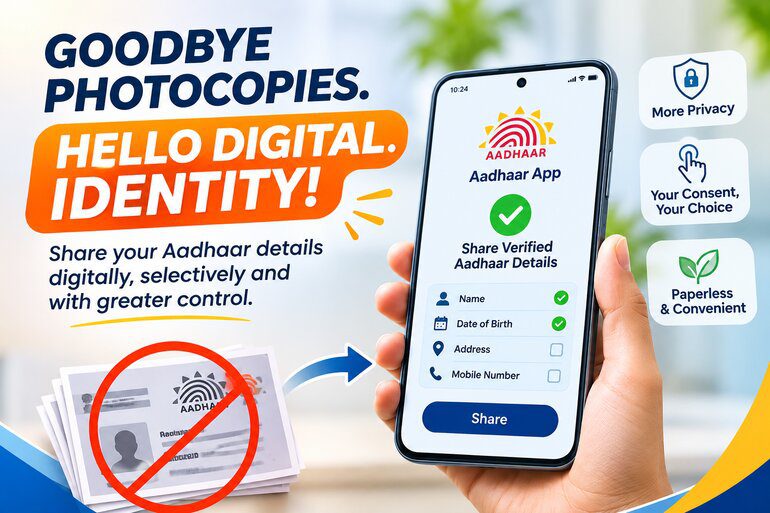
Carrying Aadhaar photocopies for hotel check-ins, residential society entry, hospital visits and other everyday services could gradually become less necessary as India moves towards digital identity verification. The Unique Identification Authority of India (UIDAI) is expanding its offline verification ecosystem through the new Aadhaar App, enabling individuals to share verified identity details digitally with their consent, instead of routinely submitting physical copies of their Aadhaar cards.
The initiative is gaining momentum, with UIDAI onboarding 300 Offline Verification Seeking Entities (OVSEs) since the rollout of the Aadhaar App in January 2026. The expansion is expected to extend paperless identity verification across sectors such as hospitality, healthcare, education, events and the gig economy.
The development marks an important shift in how identity verification can be carried out across India’s digital services ecosystem. Rather than collecting photocopies containing personal information, organizations can use digital credentials shared directly by Aadhaar holders through the official application.
Also Read: Gopal Vittal Retains GSMA Chair Role as Industry Focuses on AI and Security
What Is Paperless Aadhaar Verification?
Traditionally, individuals have often been asked to submit photocopies or digital images of their Aadhaar cards to establish their identity when accessing various services.
For example, a hotel may request an Aadhaar copy during check-in, a residential society may collect identity documents from visitors, and an organization engaging gig workers may require identity proof during onboarding.
Although these practices help organizations establish identity, they also involve the collection and storage of personal information. Unnecessary retention or circulation of document copies can create opportunities for misuse.
Paperless Aadhaar verification offers an alternative. Under UIDAI’s offline verification framework, an individual can share digitally verifiable Aadhaar credentials with a registered organization through the Aadhaar App. The individual can choose whether to share complete or selected identity information, depending on the verification requirement.
The verification can be performed without the organization connecting to UIDAI’s Central Identities Data Repository (CIDR).
This is an important distinction: offline verification is designed to establish the authenticity of Aadhaar credentials without requiring a real-time authentication request to UIDAI’s central database.
How Does the New Aadhaar App Work?
The Aadhaar App acts as a digital platform through which Aadhaar holders can manage and share their identity credentials.
Instead of handing over a physical photocopy, an individual can use the application to share the required information with an organization registered as an Offline Verification Seeking Entity.
The process broadly involves the following steps:
- The organization initiates an identity verification request through its registered verification system.
- The Aadhaar holder uses the Aadhaar App to review and share the requested identity credentials.
- The individual provides consent for sharing the information.
- The organization verifies the digitally signed credentials using UIDAI’s prescribed verification framework.
The application supports QR-based verification and selective sharing, allowing individuals to exercise greater control over the information disclosed during identity checks.
Depending on the verification requirement, an organization may need only selected identity details rather than the complete Aadhaar information.
Also Read: A New Chapter for Satellite Telecom? BIF Welcomes TRAI’s Key Recommendation
What Information Can Aadhaar Holders Share?
One of the important features of the new Aadhaar App is selective information sharing. Individuals can choose to share complete or selected Aadhaar information rather than automatically disclosing every detail available on their identity document. This approach supports data minimization, where organizations collect only the information required for a particular purpose.
The app also provides several other facilities, including:
- Multiple Aadhaar profiles: Users can manage Aadhaar details of up to five family members through the application.
- Mobile number updates: Eligible users can update their registered mobile numbers through the app.
- Address updates: Individuals can submit requests to update their Aadhaar address.
- Biometric security: Users can lock and unlock biometric authentication through the application.
- Authentication history: Aadhaar holders can review their authentication records.
- Digital identity sharing: Verified credentials can be shared selectively with participating organizations.
These features extend the application beyond identity verification and make it a more comprehensive platform for managing Aadhaar-related services.
Where Can Paperless Aadhaar Verification Be Used?
The offline verification ecosystem has applications across several industries where identity checks are part of routine operations.
1. Hotels and Hospitality
Hotels can use app-based verification during guest check-ins, reducing the need to routinely collect and retain Aadhaar photocopies.
2. Healthcare Facilities
Hospitals can explore digital identity verification for patient-related processes and the verification of visitors and attendants.
3. Residential Societies
Housing societies can use digital verification for residents, visitors and other authorized individuals entering their premises.
4. Gig Economy and Recruitment
Companies engaging delivery partners, drivers, service professionals and other gig workers can use digital credentials during identity verification and onboarding.
5. Events and Entertainment
Event organizers can explore paperless verification for entry management and access control.
6. Education and Consumer Services
Educational institutions and participating service providers can also use the framework wherever Aadhaar-based identity verification is required.
The expansion of participating organizations could gradually make digital Aadhaar verification more familiar across everyday transactions.
Why Is Offline Verification Different from Traditional Aadhaar Authentication?
The term offline verification can sometimes be confusing because people may associate Aadhaar verification with entering an Aadhaar number and completing an OTP or biometric authentication process.
However, offline verification follows a different approach. In conventional online Aadhaar authentication, the requesting organization sends an authentication request through the authorized system to UIDAI for verification.
Under offline verification, the individual presents digitally verifiable credentials that can be checked by the registered organization without connecting to UIDAI’s central identity database.
The distinction is important for both individuals and organizations. Offline verification can reduce dependence on real-time central database connectivity while enabling individuals to share identity information directly and selectively.
UIDAI’s framework also uses digitally signed credentials, allowing organizations to check their authenticity and identify potential tampering.
Does Paperless Verification Mean Better Privacy?
Reducing the circulation of Aadhaar photocopies is an important step towards improving the handling of personal identity information.
The new approach places greater emphasis on individual consent and selective disclosure. Instead of routinely handing over a complete Aadhaar copy, users can share only the information required for a particular verification.
However, paperless verification should not be confused with a guarantee that no personal information will ever be collected or stored.
Registered Offline Verification Seeking Entities may collect and store verifiable credentials shared by Aadhaar holders with explicit consent, subject to the applicable rules and conditions.
Organizations must also follow the prescribed requirements governing the purpose and use of collected information.
UIDAI’s offline verification framework provides for alternative identification methods as well, so individuals should not be denied services solely because they refuse or are unable to undergo Aadhaar offline verification when they can establish their identity through another viable means.
For users, the important consideration is to understand what information is being requested, why it is needed and which organization will receive it before providing consent.
UIDAI’s Expanding Offline Verification Ecosystem
The expansion of the OVSE network is an important part of making paperless Aadhaar verification practical beyond government services.
UIDAI has expanded its Offline Verification Seeking Entity (OVSE) network to 300 organizations since January 2026, up from the initial 100 entities onboarded in April. The expansion reflects the growing adoption of digital Aadhaar verification across multiple sectors.
The report also highlights growing adoption of the Aadhaar App, with nearly 7.5 crore downloads. More than 86 lakh users have reportedly updated their registered mobile numbers through the application without visiting an Aadhaar centre.
It further reports 22.16 lakh address updates and 40.25 lakh email updates through the app. These figures indicate that the application is increasingly being used for services beyond digital identity sharing.
A New Direction for India’s Digital Identity Verification
The move towards paperless Aadhaar verification is about more than replacing physical documents with smartphones. It represents a broader shift towards consent-based identity verification, where individuals have greater control over the information they share and organizations can adopt digital processes instead of relying on document photocopies.
For businesses, the framework offers an opportunity to streamline identity checks, reduce paperwork and improve operational efficiency. For individuals, it can make everyday verification more convenient while reducing unnecessary exposure of personal information.
The success of this initiative will depend on how widely organizations adopt the system, how effectively they integrate the technology and how consistently privacy and consent requirements are followed.
As more service providers join the ecosystem, paperless Aadhaar verification could become an increasingly familiar part of India’s digital identity infrastructure.
The bigger change is simple: proving who you are need not always mean handing over a copy of your identity document.
