



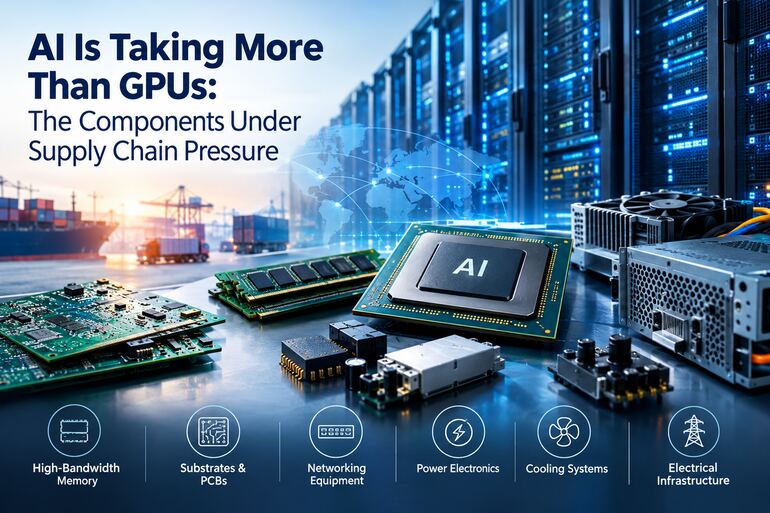
The global Artificial Intelligence boom is creating a new kind of pressure on the electronics industry. The obvious story is the race for GPUs and AI accelerators, but for companies that design, manufacture, distribute or procure electronic equipment, the more consequential question may be what is happening further down the supply chain. As hyperscalers expand AI data centres at an extraordinary pace, demand is rising not only for processors but also for high-bandwidth memory, advanced substrates, printed circuit boards, networking equipment, power electronics, cooling systems and the electrical infrastructure needed to keep increasingly dense computing systems running.
This matters because electronics supply chains do not operate as isolated markets. A semiconductor manufacturer can shift capacity towards products that command stronger demand. A component supplier can prioritize customers with larger or longer-term commitments. A PCB manufacturer can allocate specialized production capacity to applications offering better margins. The result is that a company making industrial automation equipment, telecom hardware or another non-AI product can feel the effects of the AI investment cycle without ever purchasing an AI accelerator.
That is the less visible side of the AI infrastructure boom, and it is becoming increasingly important for B2B buyers to understand.
Also Read: Hyderabad’s AI Moment: TCS HyperVault Plans Massive 1GW Data Center Campus
The AI Data Centre Is an Electronics Ecosystem
The tendency to describe AI infrastructure through the lens of GPUs can obscure just how much hardware sits around an accelerator. An AI server is a highly integrated system in which processors, memory, boards, networking, power delivery and thermal management have to work together. As AI workloads become larger and more demanding, each of these layers becomes more sophisticated.
High-bandwidth memory is a good example. AI accelerators require extremely fast access to large amounts of data, making HBM a critical part of modern AI computing architectures. As semiconductor manufacturers devote more capacity and investment to AI-related memory products, the consequences can extend into conventional memory markets. S&P Global has highlighted the way AI-driven demand is creating pressure across memory and other parts of the electronics supply chain, with manufacturers balancing rapidly growing AI requirements against demand from traditional electronics markets.
For a procurement manager, this creates a situation that can initially seem counterintuitive. Imagine an industrial electronics company that buys conventional memory for programmable controllers, gateways or automation equipment. Its products have nothing to do with generative AI, yet its component costs and lead times can still be influenced by the investment decisions of semiconductor manufacturers responding to AI demand.
The industrial company has not suddenly entered the AI market. Its supplier has simply become part of a market in which AI customers are competing for manufacturing capacity. That distinction is important because it changes how businesses should think about supply-chain risk.
When AI Demand Reaches the PCB
The same dynamic can be seen further down the electronics chain. AI servers require highly sophisticated PCBs capable of handling high-speed signals, dense component placement and substantial power requirements. As server architectures become more complex, the boards and materials used to build them also become more demanding. Industry analysis has pointed to increasing component density, memory requirements and the use of specialized materials as factors contributing to higher server-board costs.
Now consider an electronics manufacturer producing equipment for a factory, telecom network or industrial application. It may use a different board design, but it can still depend on some of the same upstream suppliers, materials or manufacturing capabilities.
This is where the AI boom starts to look less like a semiconductor story and more like a capacity-allocation story. When suppliers have abundant capacity, a buyer can often negotiate around price, delivery schedules and volumes. When capacity becomes constrained, the conversation changes. The critical question becomes who gets priority.
A large hyperscaler or data centre operator placing substantial orders with long-term visibility can have a very different position from a smaller manufacturer purchasing components on a short-term basis. For the smaller buyer, the challenge may not necessarily be that the component has disappeared from the market. It may simply be harder to secure the required quantity at the required price within the required timeframe. For an OEM with production commitments to its customers, that distinction can have significant consequences.
Also Read: Electronics Procurement Needs a New Definition of Cost
The Power Problem Behind the AI Boom
There is another part of the story that deserves considerably more attention: power. The computing capability of AI systems is increasing, but so is the amount of electricity and thermal-management infrastructure required to operate them. High-density AI racks require sophisticated power-delivery systems, while the heat generated by dense computing is driving greater interest in advanced cooling technologies, including liquid cooling.
The implications extend well beyond the server cabinet. A large AI data center needs transformers, switchgear, power distribution equipment, cables and other electrical infrastructure before the computing equipment can even begin operating. S&P Global has identified transformer availability and specialty electrical-steel supply among the constraints affecting the broader data-centre buildout.
This creates an unusual situation for the electronics and electrical industries. A company that manufactures electrical equipment may not sell anything directly to an AI data centre, but it can still find itself competing for manufacturing capacity, raw materials or specialist components with companies that do.
The AI infrastructure race is therefore creating demand across an increasingly wide industrial ecosystem. And this is where the story becomes particularly relevant to B2B buyers.
A Component Can Be Available and Still Be Difficult to Buy
Consider a hypothetical manufacturer of industrial networking equipment. Six months before production, its procurement team identifies a memory device or power-management component that meets the product’s requirements. Under normal conditions, the purchasing team might compare suppliers, negotiate the price and place an order according to the production schedule.
But suppose demand from AI infrastructure suddenly increases for related semiconductor capacity. The component may still be technically available. The supplier may still accept orders. Yet the lead time could lengthen, minimum order quantities could change, or customers with larger commitments could receive priority.
The manufacturer then faces a difficult choice. It can wait and risk delaying production, pay more to secure inventory, redesign the product around another component or attempt to find supply through distribution channels.
None of these options is particularly attractive. And redesigning the product is not as simple as replacing one part with another. The alternative component may need engineering validation, software changes, thermal testing, electromagnetic compatibility testing or customer approval. For products used in industrial or safety-critical environments, qualification can take considerable time. This is why component availability is increasingly becoming an engineering issue as much as a procurement issue.
Procurement Is Moving From Price to Resilience
For years, electronics procurement has been built around familiar priorities: price, quality, delivery and supplier reliability. Those factors remain important, but the AI infrastructure cycle is adding another dimension: capacity security.
Companies increasingly need to know not only what a component costs today but also how secure its supply will be six, twelve or eighteen months from now. That could encourage more companies to qualify alternative components before a shortage appears, develop relationships with multiple suppliers and maintain better visibility into their suppliers’ own manufacturing capacity. For particularly critical components, longer-term agreements or advance capacity commitments may become more attractive than spot purchasing.
The shift is already visible among technology companies. Hewlett Packard Enterprise, for example has recently highlighted strong demand for AI infrastructure alongside supply constraints affecting components including memory, NAND, CPUs and drives, underscoring the growing importance of securing component availability as AI infrastructure expands.
For B2B buyers, the lesson is straightforward. The cheapest component is not necessarily the lowest-cost component if it creates a production bottleneck later. A slightly more expensive part with reliable supply may ultimately be the better commercial decision.
Also Read: SPML Infra Moves Closer to Commercial BESS Deployment With Its Made-in-India Battery Technology
What Should Electronics Buyers Watch Next?
The difficult part of the current environment is that the bottleneck can move. One period may be dominated by concerns over AI accelerators and HBM. Another may be shaped by advanced packaging capacity. Further down the chain, pressure can appear in PCBs, networking components, optical equipment, power semiconductors or cooling systems. Beyond the data centre itself, transformers, switchgear and other electrical infrastructure can become constraints on how quickly new capacity is brought online.
This makes the AI infrastructure cycle different from a conventional product boom. It is not simply creating demand for one category of electronics. It is increasing demand across multiple interconnected layers at the same time. For OEMs, EMS companies, distributors and industrial electronics manufacturers, that means watching AI infrastructure investment may become part of routine supply-chain planning even when AI is not part of their own product strategy.
The question procurement teams should therefore ask is no longer simply whether a component is available today. They need to understand what other industries are competing for the same capacity, which suppliers are expanding or reallocating production, how quickly an alternative can be qualified and where the next bottleneck could emerge.
That is ultimately why the AI hardware story matters to the wider electronics industry. The competition is no longer just for the fastest processor. It is increasingly a competition for the capacity, materials, components, power systems and manufacturing resources needed to build the infrastructure around it.
And for B2B electronics buyers, that could prove to be one of the most important supply-chain stories of the AI era.

4 Comments
Pingback: Balu Forge Adds Large-Scale Ring Rolling Capability
Pingback: WeWork India Builds 10 MW Solar Plant
Pingback: Siemens and TSMC Bring AI Into Chip Design
Pingback: India Prepares for Future Warfare