



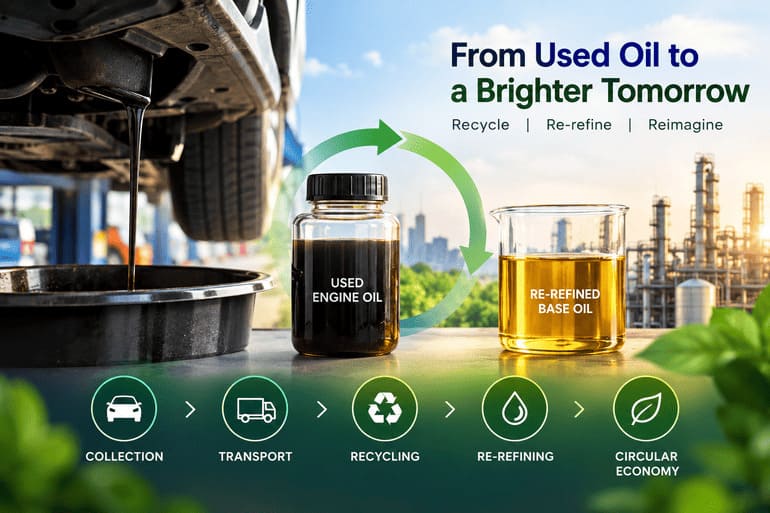
Used engine oil rarely attracts attention once it has been drained from a vehicle. Yet the black liquid collected at workshops and service centres represents a much bigger environmental and resource challenge than its appearance suggests. As India’s automotive industry expands, the question is no longer simply how much lubricant is consumed, but what happens to it after use.
Recent industry initiatives, including the used-oil recycling pilot launched by PETRONAS Lubricants India and Tata Motors across Maharashtra and Tamil Nadu, point towards an important shift: used lubricant is increasingly being viewed not merely as waste, but as a recoverable resource. The initiative aims to create a traceable system covering collection, storage and recycling, with used oil channelized to registered recyclers for conversion into re-refined base oil.
That shift is significant because the real challenge begins after the oil leaves the vehicle.
Collection is the first link in the chain
Used oil can originate from commercial vehicles, passenger vehicles, industrial machinery, workshops and other equipment. Bringing this material into an organized collection system is therefore critical.
India’s Extended Producer Responsibility (EPR) framework for used oil, which came into effect in April 2024, is designed to create greater accountability across the lubricant value chain. Producers, recyclers, collection agents and other stakeholders have defined responsibilities, while recycling targets are scheduled to increase over the coming years.
But regulation alone cannot create circularity. The industry needs reliable collection networks, appropriate storage, documented transportation and authorized recycling facilities. CPCB’s guidelines specifically recognize collection agents as an important link for aggregating used oil from smaller and more dispersed generators before it reaches recyclers.
Also Read: Used Oil, New Rules: PETRONAS and Tata Motors Set a Sustainability Benchmark
The real opportunity lies in re-refining
The strongest argument for used-oil recycling is that the material still contains valuable resources. Through appropriate processing, used lubricants can be converted into re-refined base oil. Instead of continuously depending on virgin resources for producing base oils, a portion of the material already circulating in the economy can potentially be recovered and returned to the lubricant value chain.
That is the essence of circularity: extending the productive life of a resource rather than treating every used product as the end of its journey.
The opportunity is particularly relevant for India, where automotive and industrial activity generates a large and geographically dispersed stream of used lubricants.
Also Read: Torrent Green Energy Completes One of Maharashtra’s Biggest Decentralized Solar Projects
From pilot projects to an industry-wide system
The next challenge is scale. A pilot can demonstrate that collection and traceability work in selected locations. The bigger test is whether similar systems can eventually connect thousands of workshops, fleet operators, service centres, collection agents and recyclers.
That requires participation from more than lubricant manufacturers and vehicle companies. Workshops, fleet owners, consumers, recyclers, logistics providers and regulators all have a role.
For vehicle owners, the message is relatively simple: used oil should not be treated as ordinary waste. It needs to enter an authorized collection and recycling chain. For industry, the opportunity is larger. A transparent used-oil ecosystem can support regulatory compliance while also improving resource efficiency and creating a measurable circular-economy model.
Also Read: HCLTech’s Bengaluru Semiconductor Lab to Power Global Chip Innovation
The PETRONAS-Tata Motors pilot is therefore worth watching not simply because of the companies involved, but because it highlights a broader question for India’s automotive sector: can used lubricants move from an informal waste stream into a traceable industrial resource?
If the answer is yes, used oil could become an important example of how India’s circular economy develops not through a single technology, but through better collection, accountability, recycling and reintegration of resources.

4 Comments
Pingback: Ceramic Machining: Why Speed Matters
Pingback: Aimtron Electronics Secures Curtiss-Wright Pilot Order
Pingback: Maharashtra’s Next Big Power Play Could Be Nuclear
Pingback: Tata Motors Q2 Volumes Jump 42.7%