



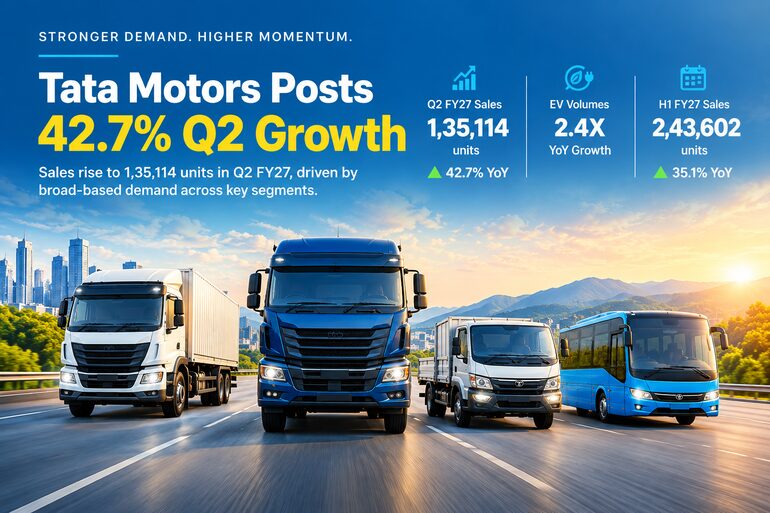
Tata Motors reported strong sales performance in Q2 FY27, with domestic and international sales reaching 1,35,114 units, compared with 94,681 units in Q2 FY26, registering a robust 42.7% year-on-year growth. For September 2026, domestic and international sales stood at 51,062 units, up from 35,862 units in September 2025.
The growth was supported by broad-based demand across Tata Motors’ commercial vehicle portfolio. Domestic sales of MH&ICV reached 22,616 units in September 2026, compared with 15,669 units in September 2025, marking a 44.3% YoY increase. For Q2 FY27, domestic MH&ICV sales stood at 55,582 units, compared with 41,461 units in Q2 FY26, representing 34.1% growth.
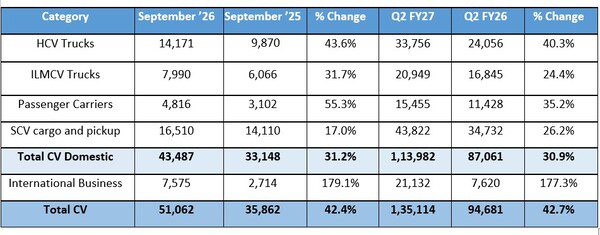
- Domestic & International sales for MH&ICV in September 2026 stood at 23,910 units, compared with 16,759 units in September 2025, registering 42.7% YoY growth. In Q2 FY27, the segment recorded 59,194 units, compared with 45,095 units in Q2 FY26, representing 31.3% YoY growth.
- EV volumes grew 2.4X YoY in Q2 FY27.
Also Read: Rajasthan Opens the Door to a 5,400 MWh Energy Storage Giant at Rampura
Mr. Girish Wagh, MD & CEO, Tata Motors Ltd. said: “We are encouraged by the strong, broad-based momentum built across our businesses in the past 12 months as an independent commercial vehicle company, reflecting the strength of our portfolio, technology-led innovation and deep customer understanding.
In Q2 FY27, sales grew to 1,35,114 units, a strong 42.7% growth, taking H1 FY27 volumes to 2,43,602 units, up 35.1% year-on-year. Importantly, the growth registered during the quarter was broad-based, reflecting healthy demand across the economy. HCVs benefited from continued activity in core sectors, sustained infrastructure, construction and mining activity; ILMCVs from e-commerce and FMCG, FMCD, and two-wheeler logistics; and SCVPU from consumption-led freight movements. Passenger transportation also maintained momentum, supported by last-mile mobility, government orders and growing intercity travel. Overall fleet utilisation levels were stable, indicating healthy underlying freight activity.
Also Read: RECPDCL and Resonia Take Balsane Power Project Into Its Next Phase
Looking ahead, commodity costs remain a significant concern, while diesel prices, potential interest rate hikes and global uncertainties remain key monitorables. While the high H2 base could moderate growth rates, industry fundamentals remain supportive. Sustained government capital expenditure, a post-monsoon pickup in mining and construction activity, rising e-commerce volumes and the festive season are expected to support freight and transportation demand. Through this, we remain confident in our ability to drive sustainable growth through innovation, customer value and disciplined execution.”

1 Comment
Pingback: JBM Auto Races Ahead with a Market-Leading 33% Share