



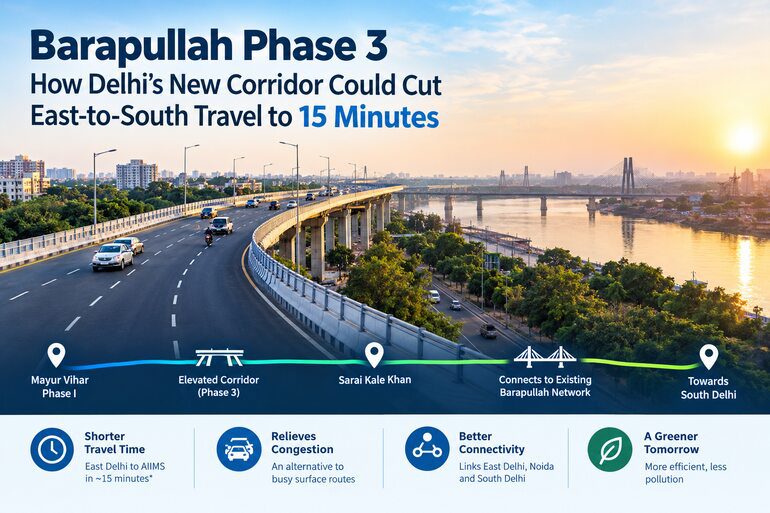
Delhi’s Barapullah Elevated Road Phase 3 has opened as a new elevated connection between Mayur Vihar Phase I and Sarai Kale Khan, adding an important link between East Delhi and the existing Barapullah road network.
The project extends the elevated corridor from Sarai Kale Khan towards Mayur Vihar Phase I, creating a more direct connection between the eastern side of Delhi and the wider Barapullah network.
Its significance goes beyond the opening of another elevated road. The project was planned to provide signal-free movement, reduce travel time and improve connectivity between East Delhi and South and New Delhi. It also forms part of Delhi’s wider effort to address congestion through grade-separated road infrastructure.
What Is Barapullah Phase 3?
Barapullah Phase 3 is the third phase of the elevated road system over the Barapullah Nallah. The project extends from the junction of the Ring Road at Sarai Kale Khan towards Mayur Vihar Phase I.
Delhi Planning Department records identify the Phase 3 stretch from Sarai Kale Khan to Mayur Vihar Phase I as a major elevated-road project. Earlier planning documents recorded the project as being developed to improve connectivity and provide signal-free movement between important parts of the city.
The completed section connects with the existing Barapullah elevated network at Sarai Kale Khan. This brings Mayur Vihar and surrounding areas into a more continuous elevated route towards central and southern parts of Delhi. The project is therefore better understood as an extension of an existing transport corridor rather than as an isolated flyover.
Also Read: ₹4,200 Crore Green Finance Deal: IRFC to Fund DVC’s Solar and Energy Storage Expansion
A Signal-Free Link Between East and South Delhi
One of the principal objectives of Barapullah Phase 3 is to provide signal-free movement and reduce travel time. The Delhi Planning Department’s infrastructure documentation specifically lists “signal free movement and reduction in travel time” among the project’s objectives.
The Social Impact Assessment prepared for the project also identifies improved connectivity between East Delhi and South and New Delhi as an expected benefit. It notes that completion of the elevated road would help decongest routes including the Nizamuddin Bridge and NH-24 Bypass near the Akshardham flyover, as well as Bhairon Marg and Ashram Chowk on Ring Road.
The practical impact for individual commuters will depend on where they enter the corridor, traffic conditions on approach roads and congestion after leaving the elevated section. The project’s documented objective is therefore more accurately described as improving connectivity and reducing travel time rather than guaranteeing a particular journey duration.
Connecting Mayur Vihar With the Existing Barapullah Network
The connection at Sarai Kale Khan is one of the most important aspects of Phase 3. Earlier phases of the Barapullah corridor established elevated connectivity towards central and southern parts of Delhi. Phase 3 extends the system in the direction of Mayur Vihar, bringing the eastern side of the city more directly into the network.
The result is a more continuous elevated connection between Mayur Vihar Phase I and Sarai Kale Khan. This additional link can provide an alternative to some surface-level routes and reduce the need for through-traffic to depend entirely on signal-heavy roads and major intersections.
A Project Years in the Making
Barapullah Phase 3 has been under development for several years. Delhi Planning Department records show that the stretch from Sarai Kale Khan to Mayur Vihar Phase I had been sanctioned as a major infrastructure project and was under construction during earlier planning periods. The project encountered delays associated in part with land requirements for a section of the proposed corridor.
A 2023 Social Impact Assessment provides further details on the project’s development. It records that construction began in April 2015 but could not be completed because part of the road required construction over private land that had not been acquired when construction began. The assessment concerned acquisition of land in the Revenue Estate of Village Nangli Razapur.
The project’s history therefore includes not only engineering and construction challenges but also a formal land-acquisition process.
The Land Acquisition Process
Delhi Revenue Department records provide a detailed official record of the land requirements associated with Phase 3. The proceedings describe the acquisition required for construction of the Barapullah Elevated Road Phase III from the junction of Ring Road at Sarai Kale Khan to Mayur Vihar. The land was located in Village Nangli Razapur.
The Revenue Department also published a Gazette notification in December 2023 concerning the construction of the third phase of the elevated road on the Barapullah Nallah from Sarai Kale Khan to Mayur Vihar.
Further official records include the final Social Impact Assessment and subsequent land-acquisition proceedings and awards connected with the project. These documents illustrate the additional administrative processes involved in completing major infrastructure projects in a densely developed urban environment.
Also Read: 300+ Partners, Three New Solar Inverters: Inside Servotech’s Navaarambh 2026
Why the Connectivity Matters
Delhi has a network of flyovers, elevated roads and underpasses, but their effectiveness depends heavily on how well different sections connect.
Barapullah Phase 3 adds value by connecting Mayur Vihar with the existing Barapullah corridor rather than functioning as a standalone grade-separated structure. This gives traffic from East Delhi an additional route towards Sarai Kale Khan. From there, vehicles can connect with the wider Barapullah network and travel towards central and southern parts of the city.
The project consequently adds continuity to an elevated road system that has been developed in multiple phases.
What It Could Mean for East Delhi
Mayur Vihar is an important part of Delhi’s eastern road network, with connections towards Patparganj and other parts of East Delhi. The Phase 3 connection can therefore have an impact beyond the immediate elevated-road stretch. By improving the link between Mayur Vihar and Sarai Kale Khan, the project provides another route for traffic travelling between the eastern and southern parts of the capital.
The project’s Social Impact Assessment specifically identifies improved connectivity between East Delhi and South and New Delhi as one of the expected public benefits. For commuters, the value of the corridor will depend not only on the elevated section itself but also on the roads feeding into it and the roads carrying traffic away from it.
Congestion Relief Will Depend on the Wider Network
The opening of an elevated corridor does not automatically eliminate congestion across an entire city. The effectiveness of Barapullah Phase 3 will depend on how traffic enters the corridor, how efficiently vehicles move through it and how the connecting roads handle traffic at its approaches and exits.
The project’s official planning documents nevertheless identify signal-free movement and reduced travel time as its intended outcomes. The Social Impact Assessment also identifies the potential for the completed corridor to improve connectivity and reduce congestion on several existing routes.
The longer-term effect will become clearer as traffic patterns adjust to the additional road capacity.
A Wider Piece of Delhi’s Road Infrastructure
Barapullah Phase 3 forms part of Delhi’s broader investment in grade-separated road infrastructure. Elevated roads, flyovers and underpasses can separate through traffic from local movements and reduce the number of interruptions created by busy intersections.
In the case of Barapullah Phase 3, the objective is particularly focused on creating a more direct connection between Mayur Vihar and Sarai Kale Khan and integrating the eastern side of the city with the existing Barapullah corridor.
A New Link in Delhi’s Urban Road Network
Barapullah Phase 3 is best understood as an extension of Delhi’s existing elevated-road network rather than simply another flyover. Its connection between Mayur Vihar Phase I and Sarai Kale Khan brings the eastern side of the capital more directly into the Barapullah corridor and provides an additional route towards South Delhi.
The project’s official planning, PWD and land-acquisition records also demonstrate the scale and complexity involved in delivering such infrastructure, from engineering and construction to land acquisition and administrative approvals. Its long-term impact will depend on how traffic patterns evolve and how effectively the new corridor works with surrounding roads.
For commuters, however, the immediate change is straightforward: Mayur Vihar and the eastern side of Delhi now have an elevated connection to Sarai Kale Khan and the wider Barapullah network.
References:
- Delhi Public Works Department, Government of NCT of Delhi – Project records for the Barapullah Elevated Road Phase III from Sarai Kale Khan to Mayur Vihar.
- Delhi Planning Department, Government of NCT of Delhi – Infrastructure and transport planning documents relating to Barapullah Phase III, including its connectivity and traffic-movement objectives.
- Delhi Revenue Department, Government of NCT of Delhi – Official land-acquisition notifications and proceedings for Barapullah Phase III.
- District Magistrate, South East Delhi, Government of NCT of Delhi – Official Social Impact Assessment, land-acquisition award and related project records.
