



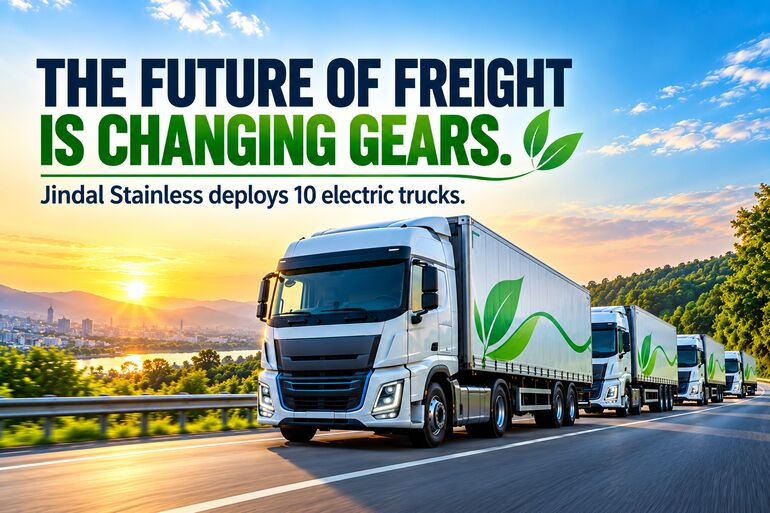
Jindal Stainless has deployed 10 electric trucks for the first time to transport finished goods, marking a new milestone in the company’s efforts to reduce emissions across its logistics operations. The trucks will ply routes connecting its Jajpur plant with Kharagpur and Kolkata, as the stainless steel manufacturer gradually expands its use of electric and alternative-fuel vehicles for transportation.
The initiative builds on the company’s existing fleet of alternative-fuel vehicles. Jindal Stainless currently operates 80 LNG trucks to transport finished goods from its Jajpur and Hisar facilities to western India. It has also begun deploying CNG trucks to transport imported cargo from Dhamra to Jajpur. Additionally, the company operates 60 CNG buses for employee transportation at its Hisar and Jajpur facilities, further extending the use of alternative fuels across its logistics and employee transport operations.
Commenting on the initiative, Managing Director, Jindal Stainless, Mr. Abhyuday Jindal said: “We believe that responsible manufacturing must extend beyond our plants to the entire value chain, including the way we transport our products. The deployment of electric trucks marks an important milestone in our efforts to decarbonise logistics and integrate lower-emission transportation solutions into our operations. Our approach is focused on adopting practical, scalable solutions that reduce our environmental footprint while maintaining operational efficiency. We will continue to advance such initiatives as part of our commitment to ESG goals.”
Also Read: 187 MW of Solar Ambition: Vikram Solar Expands Its Order Pipeline
Jindal Stainless expects its green mobility initiatives to support the transportation of approximately 8,000-10,000 tonnes of cargo each month using electric and alternative-fuel vehicles. The company plans to gradually extend these solutions to additional logistics routes, based on the operational requirements and suitability of individual transportation corridors.
Based on a modelled monthly green dispatch volume of 8,000-9,000 tonnes and an equivalent truck travel distance of around 240,000 km, the combined fleet of electric, CNG and LNG vehicles is expected to reduce carbon dioxide (CO₂) emissions by approximately 71 tonnes per month. This translates into an estimated 26% reduction in emissions compared with diesel-powered transportation under regular operating conditions. The initiative complements Jindal Stainless’ broader sustainability efforts, which include improving energy efficiency, increasing renewable energy use and promoting resource circularity across its operations.

1 Comment
Pingback: Embraer to Acquire 51% of Novavayu Aerospace