



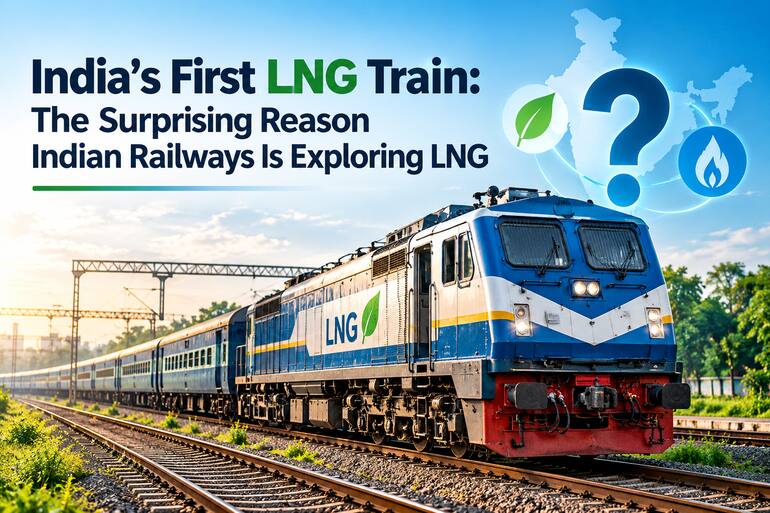
India’s railway story is increasingly becoming an electric one. Yet, at Sabarmati Railway Station in Ahmedabad, another fuel has entered the spotlight.
On September 27, 2026, India’s first LNG-diesel dual-fuel train was formally flagged off, giving Indian Railways another technology to test as it looks for ways to reduce its dependence on conventional diesel. At first glance, the development may seem surprising. If railway electrification is expanding rapidly across India, why introduce LNG into the equation at all?
The answer lies in understanding what this train is actually designed to do.
This Is Not an LNG-Only Train
The first point to clarify is that the train does not replace diesel entirely with LNG. It is a dual-fuel DEMU or Diesel Electric Multiple Unit, designed to operate using both LNG and diesel. The train’s two Driving Power Cars, each rated at 1,400 horsepower have been converted for dual-fuel operation. LNG can substitute a portion of the diesel requirement, while diesel remains available to support regular operations.
According to government and railway-related reports, the system has the potential to replace approximately 40% of diesel consumption. That distinction is important. The project is not an alternative to railway electrification. Instead, it is an attempt to develop a more fuel-efficient solution for railway operations where diesel-powered equipment still has a role.
How Much LNG Can the Train Carry?
Each converted Driving Power Car is equipped with an LNG tank with a capacity of around 2,200 litres. This allows it to hold approximately 850-900 kilograms of usable LNG. A full LNG fill is expected to provide enough fuel for around 1,600 kilometres of operation, reducing the need for frequent refuelling.
For a dual-fuel train, this range is particularly important. The train can continue operating on diesel when LNG is unavailable or when operating conditions require it. This ability to switch between the two fuels provides operational flexibility while allowing LNG to replace a portion of conventional diesel consumption.
The tank capacity also helps explain why the train should not be viewed simply as a demonstration of an alternative fuel. Its practical value will depend not only on how much LNG it can carry, but also on how effectively the available fuel can be integrated into regular railway operations.
What Problem Is Indian Railways Trying to Solve?
Electrification has transformed India’s railway network, but the transition does not mean that every diesel-powered railway asset can disappear immediately.
Locomotives, DEMUs and other railway equipment continue to operate in areas where electrification may not yet be complete or where replacing existing assets would require significant investment. For these applications, waiting for complete electrification may not always be the only option.
A dual-fuel system creates another possibility: use LNG to reduce the quantity of conventional diesel required while continuing to operate existing railway assets.
This makes the Sabarmati train more significant as a technology experiment than as a standalone vehicle. If the system delivers the expected fuel savings under everyday operating conditions, Indian Railways could gain another option for reducing diesel consumption without completely replacing the underlying equipment.
The 40% Figure Is Only the Beginning
The reported potential to replace around 40% of diesel consumption is likely to attract considerable attention. However, a projected figure is only the starting point.
The real test will come through regular operations. Several questions will determine whether the technology has wider potential:
- How consistently can LNG be used in daily railway service?
- How much diesel can ultimately be displaced?
- What are the costs of LNG storage, transportation and refuelling?
- Can the system maintain reliability over long operating periods?
- Will fuel savings justify the conversion and infrastructure costs?
- How will maintenance requirements compare with conventional diesel systems?
These questions will matter far more than the launch ceremony itself. If the technology performs well in real-world conditions, the importance of the first LNG diesel train could extend beyond a single route or railway asset. It could provide a model for converting other suitable diesel-powered trains.
Why Not Use Electricity Instead?
This is perhaps the most natural question for readers. India is pursuing railway electrification aggressively, so the introduction of an LNG-powered system may appear contradictory. However, the two technologies do not necessarily serve the same purpose.
Electric traction remains the dominant direction for India’s long-term railway transition. LNG, meanwhile could function as an intermediate or alternative fuel solution for selected diesel-dependent operations. The development should therefore be viewed less as a contest between LNG and electricity and more as an effort to test another tool for the parts of the railway system where diesel continues to exist.
This distinction is important. The LNG train does not weaken the case for electrification. Instead, it reflects the practical reality that railway assets and operating conditions differ across the network.
The Environmental Story Needs Perspective
It would be tempting to describe the new train simply as a “green train.” That would be an oversimplification.
LNG is still a fossil fuel, and an LNG–diesel train is not a zero-emission railway solution. Its environmental value must instead be assessed through diesel substitution and overall fuel efficiency. If LNG can reliably replace a meaningful share of conventional diesel consumption, the technology could help reduce diesel use in suitable railway operations. However, its benefits will depend on the complete lifecycle of the system, including LNG production, transportation, storage and use.
The more accurate description is that this is a transition technology, not a final solution for railway decarbonization.
What Happens Next Matters More Than the Launch
The first LNG train has now been formally introduced. The next chapter will be about performance. If operating data demonstrates meaningful diesel savings, reliable performance and a viable cost structure, Indian Railways could have a stronger case for exploring similar conversions.
If the economics or operational challenges prove difficult, the project may remain a limited technology demonstration. Even that outcome would provide useful information about the practicality of LNG in railway applications.
The train is therefore worth watching not simply because it is India’s first LNG–diesel dual-fuel train, but because it may help clarify the role that alternative fuels can play in the country’s wider railway energy transition.
A Small Train With a Bigger Question Behind It
The most important takeaway from India’s first LNG-diesel dual-fuel train may not be that Indian Railways has started using LNG. The larger significance is that Railways is testing different ways to reduce fossil fuel dependence while its broader electrification programme continues. For passengers, this may initially appear to be another railway technology story.
For the transport and energy sectors, however, it raises a more important question:
Can alternative fuels provide a practical bridge for parts of India’s railway system that cannot immediately move away from diesel?
The answer will depend on what happens after the launch on the tracks in day-to-day operations and in the numbers. That is what makes the Sabarmati LNG train worth watching.
