



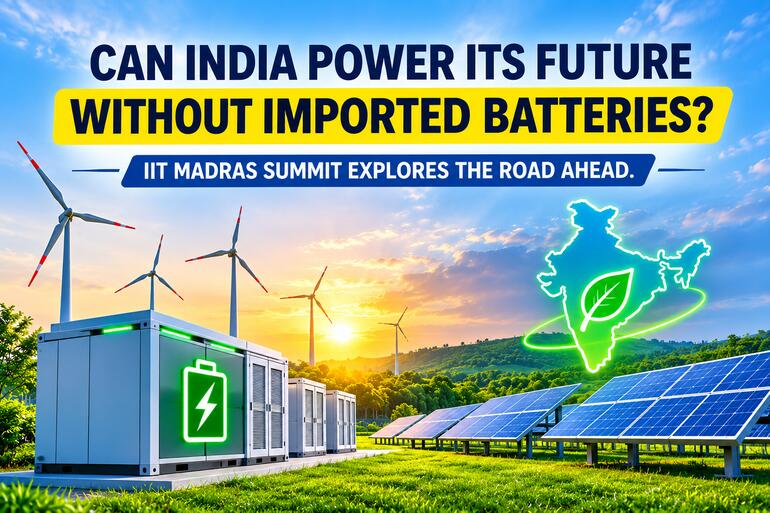
Energy Storage is emerging as a critical priority for India’s clean energy transition, with the Indian Institute of Technology Madras (IIT Madras) bringing together global industry leaders, researchers, academics and government representatives to explore solutions for a sustainable energy future. The fifth edition of the Energy Summit 2026 organized by The Energy Consortium, a Centre of Excellence at IIT Madras is being held from November 17 to 21, 2026 at the institute’s campus.
The summit is focusing on some of the most pressing challenges facing the energy sector, including advanced batteries, hydrogen technologies, artificial intelligence (AI), digitalization, sustainable energy systems and smart power infrastructure. Discussions are centered on strengthening India’s energy ecosystem through research, technological innovation and industry collaboration.
Energy Storage Takes Centre Stage in India’s Energy Transition
Addressing the summit, Guest of Honour Shri Praveen Chakravarthy, Member of Parliament (Rajya Sabha), highlighted Tamil Nadu’s potential to emerge as an alternative energy hub for India and South Asia. He emphasized that while the state has established capabilities in wind and solar energy generation, developing efficient energy storage technologies remains a crucial missing link.
He also highlighted the possibility of using Tamil Nadu’s uninterrupted coastline to export renewable electricity to neighbouring South Asian countries through undersea cables, provided the necessary storage and transmission capabilities are developed.
Shri Chakravarthy further stressed the importance of reducing India’s dependence on imported lithium-ion batteries. According to his remarks at the summit, India imported lithium-ion batteries worth approximately $5 billion last year, with around 80% of imports coming from China. He called for greater domestic innovation and research to strengthen India’s capabilities in battery technology and energy storage solutions.
Energy Storage Innovation, Hydrogen and AI Take the Spotlight
The Energy Summit 2026 is highlighting several emerging technologies, with advanced batteries, hydrogen systems, AI and digitalization in energy systems forming key areas of discussion.
These technologies are expected to play an important role in improving renewable energy integration, strengthening grid reliability and supporting the wider adoption of clean power. Greater investment in energy storage solutions will also be important for addressing the intermittent nature of solar and wind power generation.
Prof. V. Kamakoti, Director, IIT Madras highlighted that energy has become a major global priority across sectors such as artificial intelligence, agriculture and advanced manufacturing. He emphasized the importance of research, development and commercialization in energy generation, storage and distribution, particularly through renewable sources.
Prof. Satyanarayanan Seshadri, Faculty Head, The Energy Consortium, IIT Madras said that the summit has evolved into a platform where industry and academia collaborate to discuss emerging energy challenges and develop ideas for meeting future energy requirements.
This year’s discussions cover advanced batteries and hydrogen, AI and digitalization, sustainable energy and environmental systems, the water-energy nexus, and smart power systems and microgrids.
Industry-Academia Collaboration and Emerging Energy Opportunities
Beyond technical discussions, the summit is providing opportunities for young researchers through student presentations, technical sessions and poster discussions. Workshops are also addressing areas such as agentic AI, deep-tech commercialization, science entrepreneurship and the development of a nuclear design and manufacturing ecosystem among micro, small and medium enterprises (MSMEs).
Prof. Nitin Muralidharan, Convener, Energy Summit 2026, highlighted the importance of creating opportunities for researchers and industry participants to develop practical collaborations and translate new ideas into solutions.
Dr. Prashanth Ravi, Director (Engineering), Caterpillar also emphasized the importance of bringing industry and academia together to advance discussions on emerging energy technologies and the future of the sector.
The summit’s programme includes discussions on sustainable energy and environmental systems, the water-energy nexus, integrated systems, smart power systems and microgrids. Post-conference workshops scheduled for November 20 and 21 will further examine the role of academic institutions, professional engineering bodies and MSMEs in building a nuclear design and manufacturing ecosystem.
Strengthening India’s Energy Storage Capabilities for a Sustainable Future
As India continues to expand its renewable energy capacity, developing reliable energy storage infrastructure and indigenous battery technologies will be essential to building a resilient and self-reliant energy ecosystem.
The IIT Madras Energy Summit 2026 provides a platform for stakeholders to explore these priorities, encourage technological collaboration and accelerate innovation across the energy value chain.
By bringing together expertise from industry, academia and government, the summit aims to contribute to solutions that can strengthen India’s energy security, support renewable energy integration and advance the country’s long-term sustainable energy ambitions.

1 Comment
Pingback: Maharashtra Wage Rules 2026 Explained