



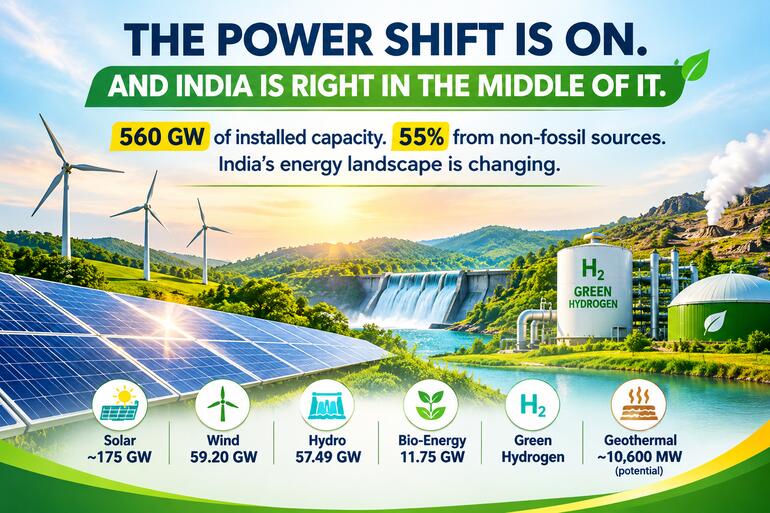
India’s non-fossil energy capacity is playing an increasingly important role in the country’s changing power landscape, with renewable sources and emerging technologies contributing to a broader shift in electricity generation. India’s total installed power capacity reached approximately 560 GW in October 2026, compared with 249 GW in 2014. Non-fossil sources accounted for 308 GW, representing 55% of the country’s total installed capacity as of 31st July, 2026.
India currently ranks third globally in renewable energy installed capacity. The sector also attracted investments worth USD 63.7 billion between July 2024 and June 2026, reflecting growing interest in clean power generation, infrastructure and domestic manufacturing.
Solar Power Leads India’s Renewable Energy Expansion
Solar energy has emerged as a major contributor to India’s renewable energy growth. Installed solar capacity reached approximately 175 GW as of 31st October, 2026, rising significantly from 2.8 GW in 2014. India also became the world’s second-largest solar growth market in 2025, adding more than 37 GW during the year.
Residential rooftop solar adoption is receiving support through the PM Surya Ghar: Muft Bijli Yojana, launched with an outlay of ₹75,021 crore to cover one crore households. As of 02nd November, 2026, approximately 65.26 lakh households had benefitted from rooftop solar installations, while cumulative commissioned rooftop solar capacity under the scheme reached 19.1 GW.
The government has also approved the Pradhan Mantri Surya Sarovar Yojana with an outlay of ₹5,070 crore. The initiative targets 5,000 MW of floating solar photovoltaic projects supported by energy storage systems with a minimum two-hour duration, equivalent to 10,000 MWh.
Wind Energy and Domestic Manufacturing Gain Momentum
Wind power continues to be another important component of India’s clean power portfolio. Installed wind capacity reached 59.20 GW as of 29th October, 2026. The country added 6.05 GW during FY 2025-26, marking its highest-ever annual wind capacity addition.
Around 28 GW of additional wind capacity is currently under implementation. India’s wind turbine manufacturing capacity also reached approximately 24 GW in March 2026, compared with 10 GW in 2014. The sector has achieved 70–80% indigenization across key components, strengthening domestic manufacturing capabilities.
Also Read: Six Stations, Smarter Operations: Alstom’s CBTC Technology Powers Bengaluru Metro
Bioenergy and Hydropower Expand the Energy Mix
India is also exploring opportunities in bioenergy through biomass, biogas, compressed biogas (CBG) and waste-to-energy projects.
Bio-power capacity stood at 11.75 GW as of 29th October, 2026. The compressed biogas ecosystem had 839 registered plants as of 02nd November, 2026, including 210 commissioned facilities and 255 under construction.
The government’s GOBARdhan National Circular Bioenergy Scheme, approved with an outlay of ₹23,731 crore for FY 2026-27 to FY 2035-36, aims to increase domestic CBG production nearly tenfold and support the development of a circular bioeconomy.
Hydropower remains important for reliable and flexible electricity generation, particularly as solar and wind capacity expand. India’s cumulative hydropower capacity, including large and small hydro, reached 57.49 GW as of 29th October, 2026.
The Small Hydro Power Development Scheme, approved with an outlay of ₹2,584.60 crore, aims to add approximately 1,500 MW through projects ranging from 1 MW to 25 MW, with particular support for hilly and northeastern regions.
Green Hydrogen Opens New Opportunities
Green hydrogen is emerging as another important area for India’s energy and industrial sectors, particularly in hard-to-abate industries.
Launched in 2023 with an outlay of ₹19,744 crore, the National Green Hydrogen Mission targets annual production of five million metric tonnes by 2030.
Indian companies have signed green hydrogen offtake commitments of 5.5 lakh metric tonnes per annum since 2023. In 2026, 18 additional agreements covering more than four lakh metric tonnes per annum were signed. Investments of approximately ₹90,000 crore are expected in green hydrogen projects.
The sector is also exploring applications in transportation. In July 2026, the government launched 12 pilot projects covering 70 hydrogen-powered vehicles across 21 routes. India’s first indigenous hydrogen fuel cell-powered train also began operations on the Jind-Sonipat section during the same month.
Also Read: CORPORATE ENERGY PROCUREMENT GETS A NEW MANDATE: POWER, PERFORMANCE AND PURPOSE
Geothermal Energy Adds Another Dimension
Beyond established renewable sources, geothermal energy is receiving attention as a potential contributor to India’s future energy mix.
The National Policy on Geothermal Energy notified in September 2025 provides a framework for exploring and developing the country’s geothermal resources. The Geological Survey of India has estimated geothermal potential at approximately 10,600 MW based on exploration across 381 hot springs, with 42 promising geothermal manifestations identified.
Five projects were sanctioned during July-August 2025, including a pilot production plant, resource assessment projects and a solar–geothermal hybrid plant.
India’s Energy Sector Moves Towards a Diversified Future
India’s changing power landscape extends beyond increasing installed renewable capacity. Non-fossil energy is becoming an increasingly important part of the country’s wider energy strategy, supported by investments in domestic manufacturing, energy storage, infrastructure development and emerging technologies.
The Bharat Renewable Energy Summit & Expo (BRESE) 2026, held in New Delhi from November 2-5, brought together international partners, policymakers, investors, manufacturers and technology providers to explore opportunities across the non-fossil energy sector. The event featured participation from nine international partners, 13 Indian states and Union Territories, and more than 400 exhibitors.
As electricity demand grows, the expansion of solar, wind, hydropower and bioenergy, alongside developments in green hydrogen and geothermal energy, is expected to play an important role in strengthening India’s energy security and supporting a more diversified power system.
