



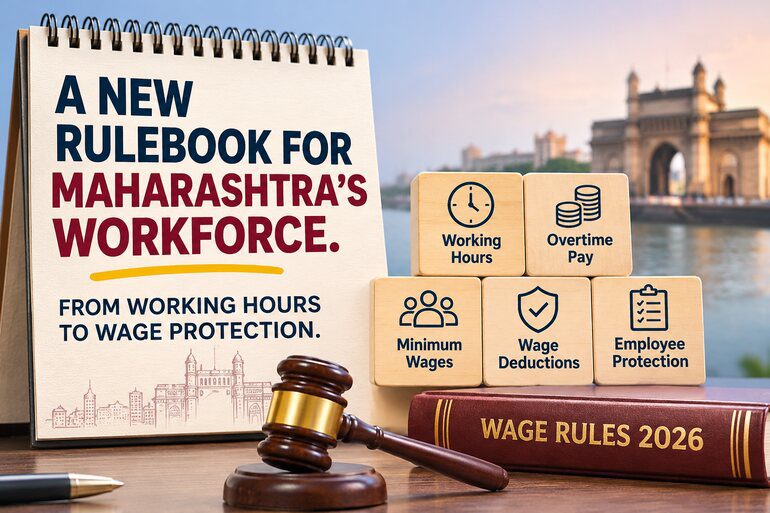
Maharashtra has notified its Maharashtra Wage Rules 2026, putting the spotlight on some of the most important aspects of working life. From the hours employees can work and the overtime payments they may receive to how minimum wages are calculated and salary deductions are regulated, the new framework has several provisions worth understanding. But the biggest question is this: What has changed, and how could these provisions affect employees and employers across the state?
What does a new wage framework mean for employees working in Maharashtra? From working-hour limits and overtime payments to salary deductions and minimum wage calculations, the Maharashtra Government’s latest notification brings several important provisions into focus. The Wage Rules 2026 aim to establish a more structured framework for wage administration and employee protection across the state.
Notified on 05th November, 2026 under the Code on Wages, 2019, the Maharashtra Wage Rules, 2026 replace two older sets of regulations dating back to 1963: the Maharashtra Minimum Wages Rules and the Maharashtra Payment of Wages Rules. The notification applies across Maharashtra and came into force on its publication in the Official Gazette.
The development is significant for employees, employers, businesses and human resource professionals, as it addresses key aspects of wage calculations, normal working hours, weekly rest, overtime payments and deductions from employees’ wages.
Also Read: CAN INDIA STORE ITS WAY TO ENERGY INDEPENDENCE? IIT MADRAS EXPLORES THE POSSIBILITIES
Why Has Maharashtra Introduced New Wage Rules?
To understand the significance of the latest notification, it is important to look at India’s broader labour law reforms.
For several decades, India’s labour regulations were spread across multiple central laws governing wages, industrial relations, social security and workplace conditions. This created different compliance requirements for businesses and sometimes made it difficult for workers to understand their rights.
To simplify the regulatory framework, the Central Government consolidated 29 central labour laws into four broad labour codes:
- Code on Wages, 2019
- Industrial Relations Code, 2020
- Code on Social Security, 2020
- Occupational Safety, Health and Working Conditions Code, 2020
The Code on Wages, 2019, brings together provisions relating to minimum wages, payment of wages, bonus and equal remuneration.
Against this background, Maharashtra has notified its final state rules under the Code on Wages, providing a framework for implementing its provisions. The latest notification supersedes the state’s earlier minimum wage and payment of wages rules introduced in 1963.
Maharashtra Wage Rules: What Changes for Working Hours?
One of the most closely watched provisions under the new Wage Rules concerns normal working hours.
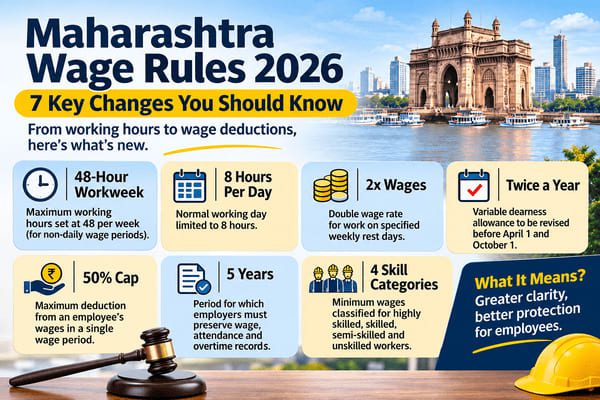
The rules prescribe a normal working day of eight hours for employees whose wages are calculated on a daily basis. For employees whose wage periods are calculated on a basis other than daily wages, normal working hours must be fixed so that total weekly working hours do not exceed 48 hours.
This provides greater clarity regarding normal working hours and the weekly limit.
However, the 48-hour weekly limit should not be interpreted as an automatic introduction of a five-day working week. Employers may follow different weekly schedules, subject to the applicable provisions governing working hours and weekly rest.
For employees, this distinction is important because the number of working days and the total permitted working hours are not necessarily the same.
Overtime Pay and Weekly Rest: What Should Employees Know?
Weekly rest is another important aspect of the new wage framework.
Employees are entitled to one day of rest every week, subject to the prescribed conditions. In a six-day working week, Sunday is ordinarily the rest day, although employers may designate another day.
What happens if an employee is required to work on that day?
The rules provide for compensatory rest, subject to the applicable conditions. They also specify that payment for work on a weekly rest day cannot be less than twice the normal wage rate in the circumstances covered by the rules.
This provision is particularly relevant for employees working in manufacturing, industrial operations and other establishments that require continuous operations.
For employers, the provisions underline the importance of maintaining accurate attendance records, calculating overtime correctly and ensuring that weekly-rest arrangements comply with the rules.
Minimum Wages and Salary Calculations Under the New Framework
Minimum wages are among the most important aspects of employee protection because they establish the minimum amount eligible workers must receive for their work.
Under the new framework, minimum wage rates are calculated on a daily basis. The corresponding hourly rate is determined by dividing the daily minimum wage by eight, while the monthly rate is calculated by multiplying the daily rate by 26.
Occupations are classified into categories such as unskilled, semi-skilled, skilled and highly skilled for determining the applicable minimum wage rates.
The rules also provide for revisions to variable dearness allowance (VDA) twice a year, before 01st April and 01st October, based on the Consumer Price Index for Industrial Workers.
This mechanism is intended to account for changes in the cost of living when determining applicable wage rates.
However, employees should remember that the minimum wage applicable to them depends on their occupation, skill category, geographical zone and the relevant notified rate. The notification does not mean that every employee automatically receives the same salary increase.
Wage Rules and Salary Deductions: Understanding the 50% Limit
Salary deductions can significantly affect an employee’s take-home pay. The Code on Wages establishes a ceiling to prevent excessive deductions from wages.
Under the Maharashtra Wage Rules, total deductions during a wage period cannot exceed 50% of an employee’s wages. If permitted deductions exceed this ceiling, the excess must be carried forward and recovered in subsequent wage periods, subject to the prescribed limit.
The rules also prescribe procedures for deductions relating to fines and damage or loss caused by employees.
Employers must communicate the grounds for such deductions and provide employees with an opportunity to respond before taking the prescribed action.
This is an important safeguard because employees should understand why money is being deducted from their wages and whether the deduction follows the applicable legal procedure.
What Does the New Definition of Wages Mean for Employees?
Another important aspect of the Code on Wages concerns the definition of wages itself.
For statutory calculations, wages primarily include basic pay, dearness allowance and retaining allowance, where applicable.
Certain components such as house rent allowance, conveyance allowance and other specified payments are excluded from the core definition, subject to the conditions laid down in the Code.
However, there is an important 50% rule.
Where the excluded components exceed 50% of the total remuneration, the excess amount is added back to wages for statutory calculations.
Why does this matter?
The structure of an employee’s salary can influence calculations relating to statutory benefits and contributions. Consequently, employers may need to review existing salary structures to ensure compliance with the applicable definition of wages.
Employees should also understand that a change in the statutory definition of wages does not automatically translate into an increase in take-home salary. The actual impact depends on the salary structure and the benefits being calculated.
Employer Responsibilities Under Maharashtra’s New Wage Rules
The notification also places importance on documentation, transparency and wage administration.
Employers are required to maintain prescribed records relating to employees, wages, overtime, fines, deductions and attendance. These records can be maintained electronically or in physical form, subject to the applicable requirements.
The prescribed registers must be retained for five years after the last entry. Employers are also required to issue wage slips electronically or otherwise on or before payment of wages.
These requirements can help employees understand their earnings, deductions and overtime payments while making it easier for authorities to examine compliance when disputes arise.
For businesses, this means reviewing existing payroll systems, attendance registers, wage-slip formats and record-maintenance procedures.
What Can Employees Do if Their Wage Rights Are Violated?
A legal framework becomes meaningful when employees have access to mechanisms for addressing violations.
The Code on Wages provides for claims relating to matters such as unpaid or underpaid wages, unlawful deductions, overtime payments, minimum bonus and wage discrimination.
The Maharashtra rules prescribe procedures relating to wage claims and appeals before designated authorities.
Employees can also seek assistance through the appropriate labour authorities and registered trade unions.
Maintaining employment records, appointment letters, payslips, attendance details and overtime information can be useful when raising wage-related concerns.
Maharashtra Wage Rules 2026: What Lies Ahead for Workers and Employers?
The notification of the Maharashtra Wage Rules, 2026 represents an important development in the state’s wage administration framework.
For employees, the provisions bring greater clarity to normal working hours, weekly rest, overtime payments, wage deductions and salary documentation. For employers, they highlight the importance of reviewing payroll practices, working schedules and statutory compliance procedures.
However, the actual impact will depend on how the rules are implemented across different industries, occupations and employment arrangements.
As Maharashtra continues to evolve as a major manufacturing, industrial and services hub, effective implementation of wage protections will be important for both businesses and workers.
Ultimately, the objective of labour regulation should go beyond compliance. It should help create a workplace environment where employees receive fair compensation, understand their rights and have access to appropriate protection, while businesses operate within a clear and consistent regulatory framework.
