



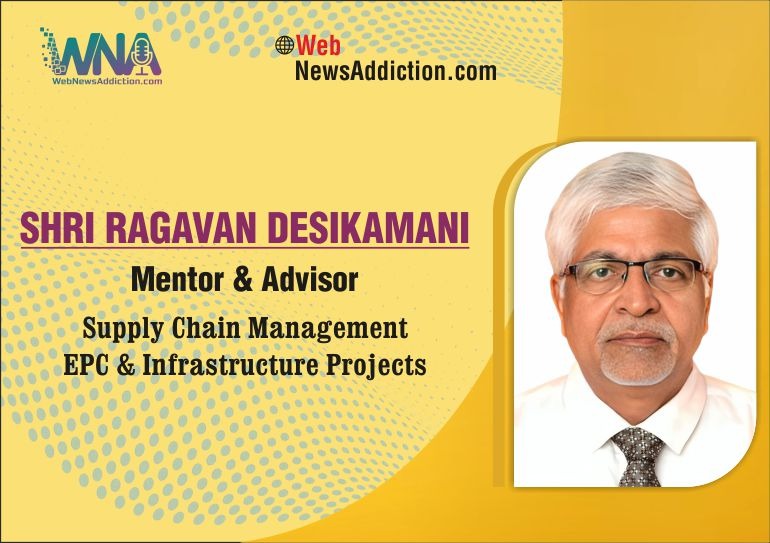
In large-scale petrochemical projects, success is often credited to engineering precision. But as Mr. Ragavan Desikamani, Mentor, Advisor, and Independent Consultant on Supply Chain Management for Projects, points out, the real story begins much earlier, deep within the supply chain.
After more than four decades managing procurement, logistics, and vendor ecosystems across India and Indonesia, he has seen how projects are shaped long before construction even begins. He believes that supply chains are not just a support function, they are where the foundation of execution is laid.
“In large projects, execution does not begin on-site. It begins much earlier in the supply chain, where decisions have long-term consequences,” Mr. Ragavan says.
Where Delays Really Begin
Delays, he explains, rarely originate at the construction site. They typically begin upstream, in procurement decisions, vendor constraints, or logistical bottlenecks.
Over the years, he has observed that even a small disruption in sourcing a critical component can cascade into significant project delays. That is why, he notes, supply chain planning must be treated as a strategic priority rather than an operational afterthought.
“Delays rarely originate at the construction site. They usually start upstream in procurement, vendor constraints, or logistics planning,” Mr. Ragavan mentions.
Sourcing is More than Selection
When it comes to high-value equipment, he explains that sourcing goes far beyond identifying a vendor. It involves a detailed evaluation of whether the vendor can actually deliver under current conditions, taking into account their engineering capability, workload, and ability to meet strict technical specifications. “It is not just about identifying a vendor. It is about assessing whether they can deliver under current conditions, both technically and operationally,” Mr. Ragavan says.
He notes that misalignment at this stage, especially around technical drawings or quality expectations can lead to costly corrections later.
Quality assurance adds another layer of complexity. From raw material verification to component-level checks and testing protocols, every stage requires close monitoring. And then comes logistics, often underestimated, but crucial. Transporting oversized, multi-ton equipment across regions involves navigating infrastructure constraints, coordinating timelines, and ensuring safe handling. Any delay here can disrupt the entire project schedule. “Transporting large equipment is not just a logistical task. It requires detailed coordination, timing, and risk planning to avoid disruptions,” he explains.
He also emphasizes something many overlook, being post-order responsibilities. He points out that timely after-sales support during installation, along with complete documentation plays a key role in ensuring smooth execution. “Delivery is only one part of the process. Installation support and proper documentation are equally critical for smooth execution,” Mr. Ragavan adds.
Managing Risk in Long Project Cycles
In projects where procurement cycles extend over a year, uncertainty is inevitable. What matters most, he says, is how early risks are identified. He explains that continuous monitoring and periodic reviews are essential to detect potential delays before they escalate. The earlier an issue is flagged, the more options teams have to respond effectively. “The earlier a risk is identified, the more options you have to mitigate its impact,” he says.
He strongly believes in having contingency plans in place. In practice, this could mean augmenting vendor capacity, adjusting payment terms to maintain momentum, or in extreme cases, relocating orders altogether. Each of these decisions requires careful judgment and timely execution.
“Having a contingency plan is not optional in large projects. It is an essential part of execution strategy,” Mr. Ragavan notes.
Lessons for Energy and EV Sectors
As industries like renewable energy and electric mobility scale rapidly, he sees strong parallels with petrochemical project execution.
One key factor, he notes, is leadership involvement at the vendor level. When senior management from the vendor side is actively engaged, alignment improves and execution becomes smoother. “When senior management on the vendor side is actively involved, alignment improves significantly and execution becomes more reliable,” he mentions.
Mr. Ragavan also highlights the importance of clarity, ensuring that all stakeholders have a shared understanding of technical requirements, scope, and quality expectations.
Another challenge, he says, lies in managing sub-vendors. Weak coordination or financial constraints at this level can quietly impact timelines without immediate visibility.
A Supply Chain Shaped by Global Shifts
Global disruptions have significantly changed how projects are planned. He explains that companies can no longer rely on static plans. Instead, they must continuously adapt to geopolitical developments, trade dynamics, and logistics challenges. This has led to a more proactive approach, where alternate sourcing strategies and flexible logistics planning are built into the system from the start.
“Planning today cannot be static. It must continuously adapt to global developments and emerging risks,” Mr. Ragavan explains.
Vendor Management as a Strategic Function
Vendor selection, he says, is just the beginning. True success lies in ongoing engagement, tracking progress, resolving issues, and ensuring accountability throughout the procurement cycle.
He views procurement as a strategic role that extends across the entire “procure-to-pay” process, requiring constant coordination and oversight. “Procurement is no longer just about buying equipment. It is about managing relationships and ensuring outcomes,” Mr. Ragavan says.
Strong vendor relationships, he adds, often make the difference between delays and timely delivery.
Common Pitfalls that Derail Projects
Despite experience and systems, certain mistakes continue to occur. He points out that many organizations rely too heavily on past vendor performance without reassessing current capabilities. In a dynamic environment, conditions can change quickly.
“Past performance does not guarantee present capability. Conditions and capacities change over time,” Mr. Ragavan notes.
He also mentions that lack of structured vendor frameworks and overly ambitious planning, without strong data backing can lead to unrealistic timelines and execution gaps.
The Shift towards Intelligent Supply Chains
Looking ahead, he sees supply chains becoming increasingly data-driven. Organizations are adopting integrated ERP systems and end-to-end procurement platforms to improve visibility and coordination. At the same time, advanced analytics and machine learning are enabling more predictive decision-making.
“Data and analytics are increasingly becoming central to how supply chains are planned and managed,” he says.
But beyond technology, he believes the real shift is towards resilience. “The future of supply chains is not just about efficiency. It is about resilience and adaptability,” Mr. Ragavan feels.
Building for Resilience
As infrastructure, energy, and mobility sectors continue to expand, the pressure on supply chains will only increase. Drawing from decades of experience, he underscores a simple but powerful idea. Execution does not begin at the project site, it begins with the decisions made across the supply chain.
“In an uncertain environment, the ability to anticipate, adapt, and respond quickly defines the success of any large project,” Mr. Ragavan concludes.
And in that reality, supply chains are no longer just operational backbones, they are strategic engines that determine whether projects succeed or stall.
