



Large projects rarely fail at the starting line. They typically begin with clarity, ambition, and detailed planning, supported by well-defined goals, structured timelines, and a strong sense of intent. At this stage, everything appears aligned and achievable. However, as projects move beyond planning and into execution, complexity begins to build in ways that are not always immediately visible. Dependencies start to overlap, multiple workstreams begin progressing simultaneously, decisions need to be made at a faster pace, and maintaining alignment across teams becomes increasingly challenging. It is during this transition from plan to practice that the true trajectory of a project is determined.
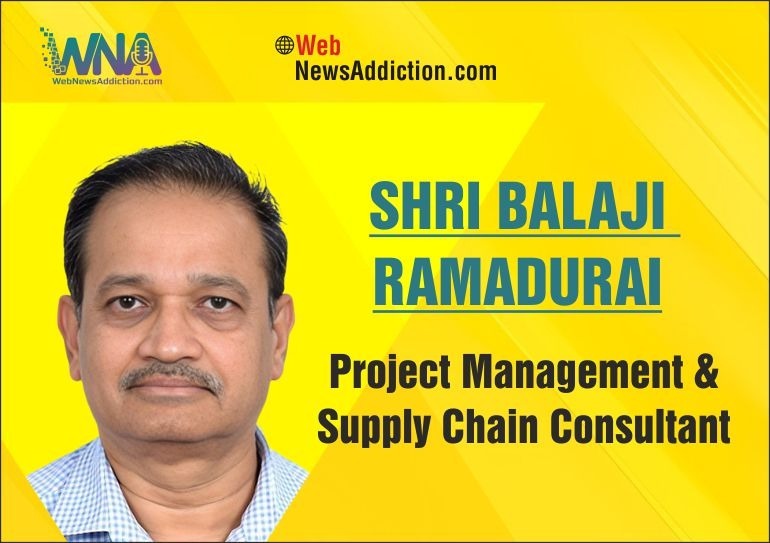
Drawing from his experience across complex and large-scale projects, Mr. Balaji Ramadurai, Project Management & Supply Chain Consultant explains that execution should not be viewed as a separate phase that begins after planning is complete. Instead, it must be understood as a continuous system that combines coordination, discipline, structured decision-making, and constant alignment. “Most people think execution is about moving fast, but it actually begins with how well you plan,” he says. In his view, the groundwork for effective execution is established much earlier than most teams realize, often before any visible progress is made on-site or in operations.
He emphasizes that planning is not just about defining timelines or setting milestones. It is about creating clarity at every level of the project. This includes breaking down the scope into manageable components, identifying and mapping dependencies between tasks, anticipating potential constraints, and building realistic and achievable pathways forward. When this level of rigour is missing, projects do not necessarily fail immediately. Instead, they become inherently fragile, meaning that even small disruptions can have disproportionate impacts as execution progresses.
Also Read: https://webnewsaddiction.com/lawyered-legal-tech-that-moves-at-the-speed-of-enforcement/
How Projects Quietly Lose Direction
In many cases, projects do not slip because of a single major failure or unexpected crisis. Rather, delays tend to emerge gradually through the accumulation of smaller, often overlooked gaps. These can take the form of misaligned expectations between stakeholders, delays in decision-making, or incremental changes in scope that are not fully accounted for within the overall plan. Over time, these seemingly minor issues begin to compound.
Mr. Balaji Ramadurai points out that unrealistic timelines and evolving project scope frequently occur together, particularly in environments where communication is fragmented. When teams operate in silos, without a unified view of progress and priorities, visibility across the project decreases. As a result, decisions take longer, dependencies are not always clearly understood, and coordination becomes more difficult. This gradually creates a disconnect between what was originally planned and what is actually being executed on the ground.
To address these challenges, he highlights the importance of putting structured systems in place early on. Centralized communication frameworks ensure that all stakeholders are working with consistent and up-to-date information. Formal change management processes help teams evaluate and incorporate changes without disrupting overall alignment. Contingency planning provides a buffer against uncertainty by preparing teams to respond effectively when disruptions occur. While these systems cannot eliminate uncertainty entirely, they play a critical role in preventing small issues from escalating into larger problems that derail progress.
Keeping Everyone Moving in Sync
As projects grow in scale and complexity, alignment becomes a more dynamic and ongoing challenge. It is no longer sufficient to establish agreement at the outset. Instead, alignment must be continuously maintained as the project evolves. With multiple stakeholders involved, each with their own perspectives and priorities, even small differences in interpretation can lead to significant deviations over time if not addressed.
“You need a single source of truth. Otherwise, every team starts working with its own version of reality,” Mr. Balaji Ramadurai explains. This highlights the importance of having a centralized and consistently updated reference point that all teams can rely on.
He further emphasizes that alignment must be supported through clearly defined roles and responsibilities. Establishing Single Points of Contact for different areas of the project ensures accountability and reduces ambiguity. In addition, structured communication rhythms, such as regular reviews and updates, help reinforce shared understanding and keep everyone aligned as conditions change. Without these mechanisms, alignment can gradually weaken, leading to fragmentation and reduced cohesion across teams.
Keeping Progress Alive Amid Uncertainty
Uncertainty is an inherent part of any complex project. There will inevitably be moments when progress slows or stalls due to unforeseen challenges. However, what differentiates successful projects from others is not the absence of problems, but the speed and effectiveness with which teams respond to them.
“Delays do not come from problems, they come from slow reactions,” Mr. Balaji Ramadurai notes. This perspective shifts the focus from trying to avoid issues altogether to building the capability to respond quickly and effectively when they arise.
He suggests that teams should treat challenges as an expected part of the execution process rather than as exceptions. This involves developing the ability to quickly understand the nature of an issue, categorize its impact, and take appropriate action without delay. Preparedness plays a critical role in this context. By investing in contingency planning and identifying alternative pathways in advance, teams can continue making progress even when certain activities are blocked. The ability to shift to parallel tasks or reallocate resources ensures that momentum is maintained despite disruptions.
The Subtle Indicators of Trouble
One of the most important aspects of effective execution is the ability to recognize early warning signs before they escalate into major issues. Projects rarely fail without showing signals of strain. However, these signals are often subtle and can be easily overlooked, especially when teams are focused on meeting immediate deliverables.
Mr. Balaji Ramadurai highlights several patterns that can serve as early indicators of deeper problems. Tasks that remain perpetually near completion without being fully closed, declining levels of stakeholder engagement, and changes that are implemented without proper documentation are all signs that something may be going wrong beneath the surface.
By paying attention to these signals, teams can intervene at an early stage and address underlying issues before they grow into significant delays. This requires a shift in mindset from simply tracking progress to actively diagnosing what might be preventing progress. Execution, in this sense, is as much about identifying and resolving bottlenecks as it is about moving tasks forward.
Balancing Speed, Cost, and Quality
Every project operates within a set of constraints, and execution often involves navigating trade-offs between competing priorities. Speed, cost, and quality are the three primary dimensions that teams must balance, and attempting to optimize all three simultaneously is rarely feasible.
“You have to decide early which constraint is non-negotiable,” Mr. Balaji Ramadurai says. Establishing this clarity at the outset helps guide decision-making throughout the project lifecycle and ensures that teams remain aligned on what matters most.
At the same time, he cautions against compromising on baseline quality. While it may be tempting to accelerate timelines or reduce costs by cutting corners, such decisions often lead to rework, inefficiencies, and higher costs in the long run. Maintaining a disciplined approach to quality, while remaining flexible in other areas, is essential for achieving sustainable outcomes.
Why Leadership Shapes Outcomes
Leadership plays a critical role in shaping the trajectory of complex projects. However, effective leadership in this context is not about exerting control over every aspect of execution. Instead, it is about providing clarity, direction, and timely decision-making.
Mr. Balaji Ramadurai emphasizes that decisiveness is one of the most important qualities a leader can bring, particularly in situations where information may be incomplete. Waiting for perfect information often leads to delays that can be more damaging than making an imperfect decision.
Transparency and accountability are equally important. By openly acknowledging challenges and addressing them proactively, leaders can build trust within teams and create an environment where issues are resolved more quickly. Ultimately, leadership is about enabling teams to navigate complexity with confidence and ensuring that execution remains aligned with the overall objectives of the project.
Tools Inform, People Decide
Advancements in technology have significantly improved the tools available for managing projects. Real-time data, predictive analytics, and digital simulations provide teams with greater visibility into project performance and potential risks.
“Tools have made visibility much better, but they do not replace judgment,” Mr. Balaji Ramadurai observes. While these tools enhance the ability to make informed decisions, they cannot substitute for the experience and discipline required to interpret data and act on it effectively.
The true value of technology lies in how well it is integrated into structured processes. Tools should support decision-making, not replace it. Teams that are able to combine data-driven insights with practical experience are better positioned to navigate the complexities of execution.
Lessons from High-Stakes Execution
In industries where precision and reliability are critical, the importance of thorough planning becomes even more evident. Mr. Balaji Ramadurai highlights that front-end planning plays a crucial role in reducing risks during execution. Time invested in understanding requirements, mapping dependencies, and anticipating challenges can significantly reduce the likelihood of costly changes later in the project lifecycle.
He also points to the value of standardized processes, transparency in risk identification, and the inclusion of contingency buffers. These elements create a level of resilience that allows projects to absorb disruptions without losing momentum. In this context, preparation should not be viewed as a delay, but as a strategic investment that enhances overall efficiency and reliability.
How Small Oversights Create Big Delays
A single overlooked detail can sometimes disrupt an entire project. Mr. Balaji Ramadurai shares a particularly telling example that highlights how even minor gaps can have far-reaching consequences.
Lesson: The Invisible Critical Path
In one global SAP integration project, significant attention was given to hardware delivery, with teams working diligently to ensure that equipment was delivered and installed according to schedule. On the surface, the project appeared to be progressing well. However, a delay in obtaining a relatively minor software security certification created an unexpected bottleneck.
As a result, equipment worth approximately 10 million dollars remained idle for several weeks. This not only disrupted the project timeline but also pushed the project into the contract red zone, triggering penalties. The root cause of the issue was not technical complexity, but the absence of clear ownership. The certification task had not been assigned to a specific individual, making it an “orphaned” task that fell through the cracks.
“We had everything ready, but a small certification issue, with no clear owner, brought the project to a halt,” he recalls.
This example underscores a critical lesson. Dependencies must be tracked with the same level of rigour, regardless of their perceived size or cost. Even the smallest task can have a significant impact if it is not properly managed. Ensuring that every activity has a clearly defined Single Point of Contact is essential for maintaining continuity and avoiding such disruptions. Increasingly, global standards are also beginning to recognize and highlight these types of hidden risks in project schedule assessments.
What Drives Successful Execution
Execution is not just about completing individual tasks. It is about ensuring that all elements of a project work together seamlessly. Projects progress through a series of transitions between teams, phases, and decisions, and each of these transitions represents a potential point of risk.
Mr. Balaji Ramadurai emphasizes that while the critical path provides a framework for managing timelines, the real challenges often lie in the hand-offs between tasks. Poorly managed transitions can lead to delays, miscommunication, and loss of momentum.
“Take ownership of the critical path, but actively manage every hand-off,” he advises. By focusing on both the overall structure and the details of execution, teams can ensure that progress is sustained and that the project moves forward in a coordinated and efficient manner.
At the core of it all is a simple truth. Execution is where strategy is tested, refined, and ultimately proven. Plans may define direction, but outcomes are shaped by the discipline of follow-through across people, processes, and decisions. What often goes unnoticed are the small dependencies, the hand-offs, the early warning signs, and the decisions made under uncertainty. These are not peripheral elements. They are central to whether a project succeeds or struggles.
In the end, successful projects are not those that avoid complexity, but those that are designed to handle it. Execution, then, is not just about delivering results, it is about building systems that can sustain progress, adapt to change, and carry momentum from one milestone to the next.
