



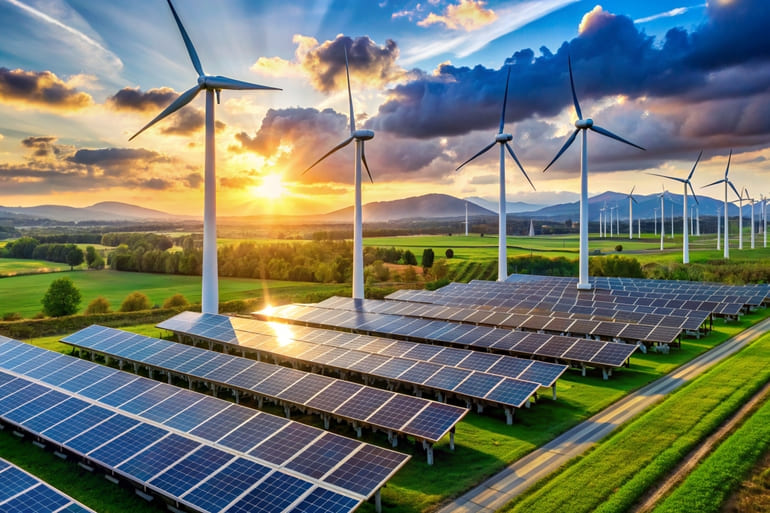
Across India, the signs of energy transition are becoming more visible, though not always immediately noticeable. Solar panels on industrial rooftops, wind turbines along highways, and large solar parks in remote regions are gradually becoming part of the country’s physical and economic landscape. What appears at first as a series of isolated developments is in reality, part of a deeper systemic shift that has been unfolding over more than a decade. This shift has not been driven by a single breakthrough or a sudden change in direction, but by a sequence of decisions that have gradually reshaped how energy is produced, financed, and delivered across the country. The transition is therefore not just about renewable energy capacity, but about how an existing power system adapts to new realities while continuing to support a rapidly growing economy.
What makes this transformation particularly significant is the pace at which it has taken place. Around 2014, India’s renewable energy capacity stood at approximately 76 GW. Within a decade, this number more than doubled, crossing 180 GW, with solar energy contributing the largest share of this growth. This expansion did not happen in isolation. It coincided with rising electricity demand, increasing industrialization, and the need for long term energy security. For businesses and policymakers alike, the transition was not simply about sustainability, but about building a system that could meet future demand in a cost effective and reliable manner.
From Early Hesitation to Strategic Intent
To understand how this journey began, it is important to look back at the early 2010s, when renewable energy in India was still viewed with a degree of caution. Solar power was expensive, with tariffs often exceeding ₹7/unit, and large scale deployment appeared financially challenging. Wind energy had already developed a presence in certain regions such as Tamil Nadu, but its expansion was uneven and dependent on specific geographic conditions. The broader power system was built around conventional sources such as coal, which provided predictable and continuous generation. Renewable energy, by contrast introduced variability and uncertainty, making integration into the existing grid more complex.
The shift in approach began around 2014 and 2015, when renewable energy started to be positioned as a central component of India’s long term energy strategy. The announcement of a target of 175 GW (target announced in 2015) of renewable energy capacity by 2022 marked a clear change in direction. This was not just a policy declaration, but a signal to the market that the government intended to scale the sector in a structured and sustained manner. For investors, this provided much needed visibility. For developers, it created confidence that demand would continue to grow. For the broader ecosystem, it established renewable energy as a serious and investable segment rather than a peripheral initiative.
Building Scale Through Design and Coordination
Once intent was established, the next challenge was execution. Scaling renewable energy in a country as large and diverse as India required more than isolated projects. It required coordinated planning across land, infrastructure, and policy frameworks. One of the most effective solutions that emerged during this period was the development of large solar parks. States such as Rajasthan and Gujarat led the way by creating dedicated zones where land acquisition, grid connectivity, and basic infrastructure were pre arranged.
Projects such as the Bhadla Solar Park, which has a capacity exceeding 2 GW demonstrated how scale could transform the economics of renewable energy. By concentrating development in specific locations, these parks reduced logistical complexity and enabled developers to focus on efficiency and cost optimization. At the same time, transmission planning began to evolve. The introduction of initiatives such as Green Energy Corridors helped strengthen the grid and ensure that power generated in resource rich regions could be transported to demand centres. This alignment between generation and transmission was critical, as it ensured that capacity addition translated into actual power delivery.
Market Mechanisms and the Economics of Change
A defining moment in India’s energy transition came around 2017 with the introduction of competitive bidding for renewable energy projects. This shift fundamentally changed how electricity from renewable sources was priced. Instead of fixed tariffs, developers were required to compete by offering the lowest possible price, which created strong incentives for efficiency across the value chain.
The results were significant. Solar tariffs, which had been above ₹7+/unit in the early part of the decade fell sharply to below ₹3/unit in several cases. This decline was driven not only by global reductions in technology costs, but also by improvements in project execution, financing structures, and operational practices. For industrial consumers and businesses, this marked an important turning point. Renewable energy was no longer seen as a premium option, but as a cost competitive alternative that could support both financial and sustainability objectives.
This phase also attracted global capital into the sector. Institutional investors began to view India’s renewable energy market as transparent, scalable, and predictable. This influx of capital further accelerated growth, creating a reinforcing cycle in which scale led to cost reduction and cost reduction enabled further scale.
Expanding the Ecosystem Beyond Generation
As renewable energy deployment accelerated, attention began to shift towards the broader ecosystem that supports it. One of the key issues that emerged was dependence on imported components, particularly solar modules. This created exposure to global supply chain disruptions and price volatility. In response, India introduced measures to strengthen domestic manufacturing capabilities through incentives and policy support.
This shift was important because it recognized that energy transition is not limited to generation capacity alone. It extends to manufacturing, supply chains, financing, and technology development. For businesses, this opened up new areas of opportunity. Companies could participate not only as power producers, but also as manufacturers, technology providers, and service partners within a growing ecosystem.
At the same time, distributed energy systems began to gain momentum. Rooftop solar installations became more common in commercial and industrial sectors, where companies sought to manage energy costs and improve operational efficiency. This decentralization of energy production marked a subtle but important shift in how energy is consumed and managed.
The Emerging Focus on System Integration
As renewable energy capacity crossed significant levels, the nature of the challenge began to evolve. The focus gradually shifted from adding capacity to integrating it effectively into the grid. Unlike conventional power sources, renewable energy is inherently variable. Solar generation depends on daylight, while wind patterns fluctuate across seasons and regions. Managing this variability requires a more dynamic approach to grid operation.
This has led to growing interest in energy storage systems, hybrid renewable projects, and digital grid management solutions. Battery storage systems offer the ability to store excess energy and release it when demand rises. Hybrid projects that combine solar and wind help create more stable generation profiles. Digital tools enable real-time monitoring and optimization of energy flows across the grid. Together, these developments are shaping the next phase of the transition, where efficiency and reliability become as important as capacity.
Working Within Practical Realities
It is important to recognize that India’s energy transition is taking place within a set of real world constraints. Electricity demand continues to grow, infrastructure development requires time, and financial considerations influence decision making across the sector. Transmission networks must be continuously upgraded to keep pace with renewable capacity additions. Land acquisition remains a complex process in many regions. Distribution companies, which play a critical role in the power ecosystem face financial challenges that affect procurement and payment cycles.
Rather than viewing these as limitations, they can be understood as part of the process of system evolution. Large scale transitions rarely follow a straight path. They involve continuous adjustment, learning, and adaptation. In this context, progress is not defined by perfection, but by the ability to move forward while managing complexity.
A System That Is Evolving Through Adaptation
One of the defining features of India’s energy transition is its adaptive nature. Instead of attempting to replace the existing system entirely, the approach has been to gradually integrate renewable energy into it. This has required coordination across policy, industry, and infrastructure, as well as a willingness to refine strategies over time.
For professionals and business leaders, this creates a landscape that is both dynamic and opportunity rich. The transition is not confined to power generation. It extends to storage technologies, grid infrastructure, digital solutions, and financing models. Each of these areas presents its own set of opportunities for innovation and investment.
What Lies Ahead for the Power Ecosystem
As India moves forward, the focus of the energy transition is likely to shift further towards optimization and system efficiency. Questions around grid stability, storage integration, and long term sustainability will become increasingly important. At the same time, renewable energy will continue to expand as a share of the overall energy mix.
The visible shift in India’s energy landscape is only part of the story. What appears as steady growth in solar and wind capacity is in reality, a much deeper process of system adjustment that is still unfolding. As renewable energy continues to expand, the more important question is not just how much capacity can be added, but how effectively this evolving system can adapt to greater complexity, variability, and scale. This will depend on how well different elements such as grid infrastructure, storage solutions, market mechanisms, and institutional coordination come together over time. The answer to that will not emerge from a single policy or breakthrough, but from a series of incremental decisions that shape the system’s ability to respond and stabilize. In many ways, this next phase will define not just the pace of the transition, but the quality and resilience of the energy system that ultimately takes shape.
