



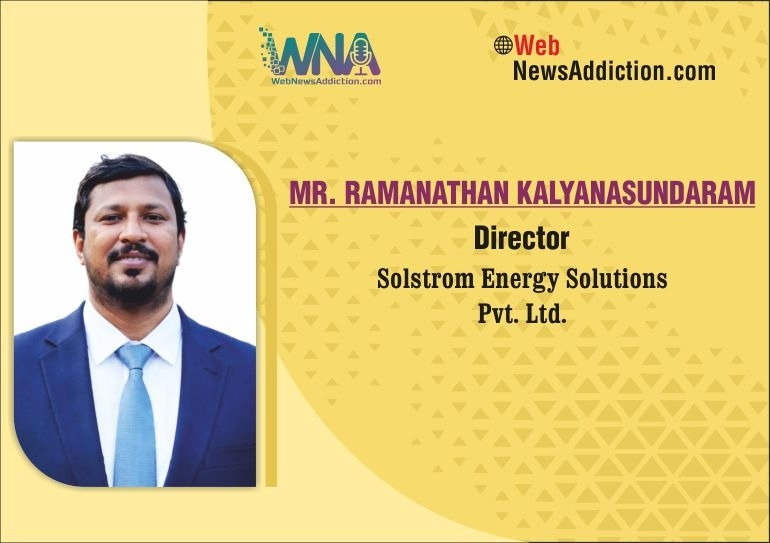
India’s solar story is no longer just about ambition, it’s about execution at scale. As the country accelerates towards its clean energy goals, solar power is emerging as a central pillar. But beneath this rapid growth lies a more complex narrative shaped by infrastructure realities, technological evolution, and the need for long-term thinking. For Mr. Ramanathan Kalyanasundaram, Director of Solstrom Energy Solutions Pvt. Ltd., this evolution is both visible and inevitable.
Driving Forces Behind India’s Solar Momentum
Solar adoption in India is being powered by a convergence of factors rather than a single catalyst. Strong policy backing, including rooftop solar initiatives, production-linked incentives, and ambitious national targets has created a stable foundation for growth. At the same time, falling costs have made solar one of the most competitive energy sources in the country.
“Over the past decade, the cost of solar panels and installation has declined sharply, making solar one of the cheapest sources of electricity in India.” says Mr. Ramanathan Kalyanasundaram.
Rising demand driven by urbanization and increased consumption has further accelerated adoption. At a macro level, solar is also helping India reduce its dependence on imported fuels while aligning with its climate commitments.
Also Read: https://webnewsaddiction.com/panitos-roboware-building-the-intelligence-beneath-indias-ev-future/
The Real Challenges of Scaling Solar
Despite strong momentum, deploying solar at scale presents a unique set of challenges. Land acquisition remains one of the most significant hurdles, particularly for large utility-scale projects that require contiguous parcels. Regulatory complexities and competing land-use priorities often make execution difficult.
“Execution on the ground is where the real complexity lies, especially when it comes to land and approvals,” he notes.
Grid infrastructure is another constraint. In several regions, transmission capacity has not kept pace with renewable energy growth, leading to delays and inefficiencies. Intermittency adds further complexity, as solar generation is limited to daylight hours and cost-effective large-scale storage solutions continue to evolve.
Financial and regulatory factors also play a role. Access to low-cost capital, delayed payments from distribution companies, and policy variations across states can impact project viability. In addition, India is still strengthening its domestic solar manufacturing ecosystem, with reliance on imported components exposing projects to supply chain risks and price volatility.
Execution at scale also depends on a skilled workforce. Gaps in trained personnel for installation, operations, and maintenance can slow deployment, particularly in emerging regions. For distributed solar, adoption barriers persist in the form of limited consumer awareness, financing constraints, rooftop suitability, and regulatory challenges such as net metering policies.
Solstrom’s Approach to a Growing Market
In a landscape filled with both opportunity and complexity, Solstrom Energy Solutions is focusing on integration and execution. The company approaches solar as a full lifecycle solution from design and engineering to installation and long-term maintenance, ensuring efficiency, quality, and reliability.
“We manage the complete solar value chain—from site assessment and design to engineering, procurement, installation, and long-term maintenance.” says Mr. Ramanathan Kalyanasundaram.
A strong emphasis on distributed and rooftop solar allows the company to cater to residential, commercial, and industrial segments. This decentralized approach not only reduces costs for consumers but also contributes to a more resilient energy ecosystem. With in-house capabilities and an engineering-led model, the focus remains on delivering consistent quality while scaling operations across regions.
Why Infrastructure Is the True Backbone
One of the most overlooked aspects of solar projects is infrastructure. While panels often receive the most attention, mounting structures and electrical systems play a critical role in determining efficiency, safety, and longevity.
“Mounting structures and electrical systems are not just supporting elements—they are core to performance, safety, and long-term value, he emphasizes.
The tilt and design of structures directly impact energy generation, while robust electrical systems ensure seamless and safe power transmission. Compromises in these areas can lead to reduced performance, higher maintenance costs, and long-term inefficiencies.
Common Pitfalls in Solar Deployment
As solar adoption increases, certain mistakes continue to surface across projects. A lack of thorough site assessment is one of the most common issues. Skipping detailed analysis such as shadow studies or structural evaluations can lead to suboptimal system performance.
“Short-term thinking is one of the biggest risks in solar,” Mr. Ramanathan Kalyanasundaram points out. “Focusing only on upfront cost often leads to long-term inefficiencies.”
There is also a tendency to underestimate the importance of quality engineering and experienced partners. Another common misconception is that solar systems require minimal attention after installation, whereas consistent monitoring and maintenance are essential for sustained performance.
The Role of Technology in Improving Efficiency
Technology is rapidly transforming how solar projects are designed, managed, and optimized. Modern systems are equipped with real-time monitoring tools that track performance and detect issues instantly.
Solar systems are increasingly becoming data-driven, with advanced monitoring and predictive tools helping identify issues early and optimize performance”, he says.
Smart inverters, advanced analytics, and predictive maintenance tools are improving energy conversion and reducing downtime. The integration of storage solutions and automation is further enhancing reliability, allowing solar energy to be used more effectively beyond daylight hours.
Emerging Trends Shaping the Future
The solar landscape in India is evolving towards a more decentralized and technology-driven model. Rooftop solar adoption is gaining momentum across segments, while microgrids and localized energy systems are creating new opportunities.
“We’re moving towards an ecosystem where solar will not just supplement the grid; it will increasingly become the backbone of India’s clean energy future”, Mr. Ramanathan Kalyanasundaram observes.
At the same time, the push for domestic manufacturing is strengthening supply chains and reducing import dependence. Corporate sustainability goals are also driving demand, with more organizations adopting solar as part of their ESG strategies.
A Long-Term View on Solar Investments
For businesses and developers, solar represents not just an energy solution but a long-term investment. The focus, therefore, needs to shift beyond upfront costs towards overall lifecycle value, where quality components, strong engineering, and reliable infrastructure play a defining role.
Equally important is a thorough understanding of site conditions, energy requirements, and regulatory frameworks. Well-designed systems tailored to specific use cases consistently deliver better performance and returns.
Leveraging government incentives, policy support, and financing mechanisms can significantly improve project viability, while the integration of monitoring systems and smart technologies helps ensure consistent performance and reduced downtime.
Choosing experienced partners with proven execution capabilities remains critical in minimizing risks and ensuring long-term reliability.
“Successful solar investment requires a quality-first, long-term, and technology-driven approach,” says Mr. Ramanathan Kalyanasundaram.
Planning for scalability and future integration, whether through system expansion, storage, or hybrid energy solutions is becoming essential as energy needs continue to evolve.
