



India’s clean energy narrative has for the most part been shaped by scale. Installed capacity continues to rise, ambitious targets are announced with increasing confidence, and electrification statistics suggest a country rapidly closing its energy gaps. On the surface, it is a story of momentum: one that signals intent, investment, and progress. Yet, as with many large-scale transformations, what appears complete at the macro level often reveals inconsistencies when examined up close.
In a recent ground-level perspective on rural clean energy adoption, the focus shifted from ambition to execution. It highlighted a set of realities that are less frequently discussed. Fragmented infrastructure, inconsistencies in supply, and the everyday operational challenges that define how energy is actually experienced in rural settings. These are not peripheral issues; they sit at the very core of whether clean energy delivers on its promise. And it is within this context that a more critical question begins to take shape: if energy systems are expanding, why does meaningful access still remain uneven?
Availability is not the same as access
The answer lies in a distinction that is often overlooked in mainstream discourse. Availability as a concept is relatively easy to establish. It can be mapped, measured, and reported. Access, however is far more complex. It exists not in reports, but in lived experience. It is reflected in whether a household receives power consistently enough to rely on it, whether a small business can operate without disruption, or whether a farmer can depend on energy at moments that are critical to productivity. The difference between the two is subtle in language, but significant in impact.
Why last-mile delivery remains a challenge
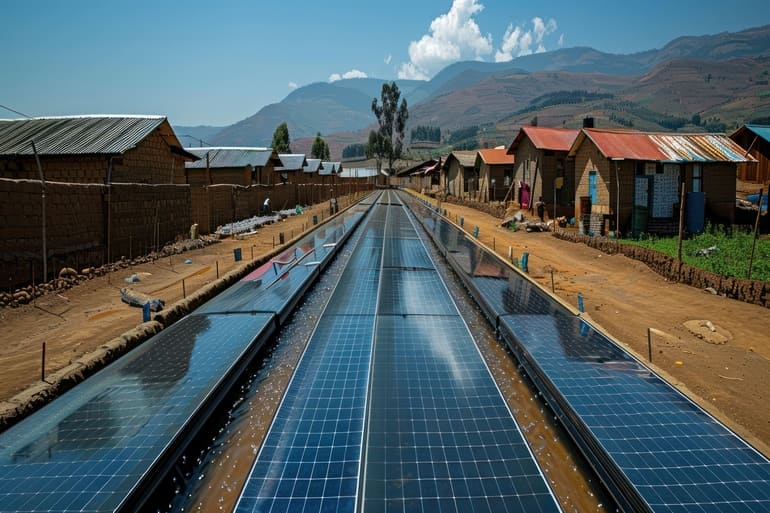
This gap between availability and access is most visible at what is often referred to as the last mile. It is here at the intersection of infrastructure and everyday use that the limitations of a purely capacity-driven approach begin to surface. A grid connection may reach a village, but reliability may fluctuate. A solar installation may be commissioned, but long-term performance may depend on maintenance systems that are not always in place. In such scenarios, the presence of infrastructure creates the appearance of resolution, even as underlying challenges persist.
Structural constraints in rural energy systems
Part of the difficulty lies in the nature of rural energy ecosystems themselves. Unlike urban centres, where demand density supports robust infrastructure and faster service response, rural areas operate under very different conditions. Distances are greater, revenue models are tighter, and the economics of maintenance are more difficult to sustain. As a result, the systems that are deployed often operate under constraints that are not immediately visible at the planning stage. Over time, these constraints shape user behaviour, influence adoption, and ultimately determine whether an energy solution becomes integral to daily life or remains underutilized.
The role of trust, usability, and awareness
There is also a human dimension that tends to receive less attention in technical discussions. Access is not only about physical connectivity: it is also about trust, familiarity, and usability. Communities that have experienced inconsistent supply may be slower to rely on new systems. Technologies that are not supported by local service networks may face challenges in sustained adoption. Even well-intentioned interventions can fall short if they do not align with the rhythms and requirements of the communities they are meant to serve.
Shifting the focus from capacity to impact
This is where the conversation around clean energy needs to evolve. Moving forward, the emphasis cannot remain solely on how much capacity is added, but must increasingly focus on how that capacity is translated into dependable, everyday utility. This requires a shift in how success is defined, not just in terms of expansion but in terms of effectiveness. It calls for a deeper integration of planning, where infrastructure, service ecosystems, financing models, and user behaviour are considered as interconnected elements rather than isolated variables.
Why solutions must be adapted to local contexts
Emerging approaches are beginning to reflect this shift in thinking. There is growing recognition that localized and decentralized models may offer greater flexibility in certain contexts, particularly where traditional grid expansion faces limitations. At the same time, these models bring their own set of challenges from financing structures to long-term maintenance. Their success much like that of centralized systems depends on how well they are adapted to local conditions rather than how widely they are deployed.
What defines success going forward
What becomes increasingly clear is that the journey from availability to access is not a single step, but a layered process. It involves aligning infrastructure with usage, technology with context, and policy with practicality. It requires acknowledging that energy in its most meaningful sense is not just about supply, it is about service. And service, by its nature must be consistent, responsive, and rooted in the realities of those it intends to support.
India’s clean energy transition has already demonstrated its ability to scale. The next phase will test its ability to adapt. Because the true measure of progress will not lie in how extensively systems are rolled out, but in how effectively they become part of everyday life across diverse geographies.
Why this gap needs closer attention
As earlier discussions on rural clean energy realities have shown, the challenge goes beyond infrastructure and lies in how effectively intent is translated into impact on the ground. Understanding this distinction is essential not only for policymakers and industry stakeholders, but for anyone seeking to engage meaningfully with the future of energy in India. Only when availability evolves into genuine access can the larger promise of clean energy begin to fully materialize.
