


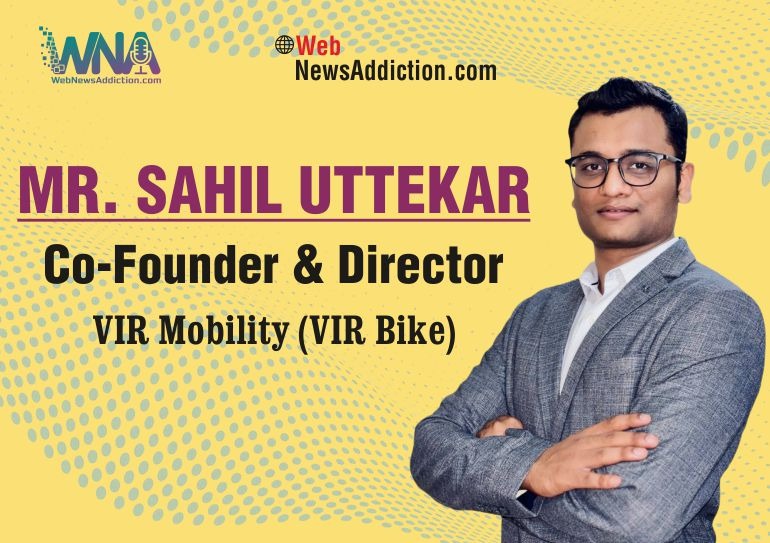
Over the past year, VIR Mobility has undergone a defining shift, one that reflects not just product evolution, but a deeper clarity in vision. For Co-Founder Mr. Sahil Uttekar, the journey has moved beyond simply validating the need for electric cycles to carving out a distinct identity in a rapidly evolving market.
“The most defining shift for us has been moving from validating the problem to establishing clear product differentiation,” says Mr. Uttekar. “We’ve always believed that the transition from traditional cycles to electric cycles is inevitable, much like the evolution from cash to digital payments. But the real inflection point was identifying how VIR would stand apart in this transition.”
That differentiation, he explains, lies in engineering-led choices. “Our focus on aluminum-based, corrosion-resistant frames and long-term durability reflects that clarity,” he adds. “We are building products designed for performance and longevity in Indian conditions.” This shift has also reshaped his priorities as a founder. “It has sharpened my focus toward building long-lasting products and sustaining trust, rather than competing on short-term cost advantages”, he adds.
Also Read: https://webnewsaddiction.com/from-chaos-to-cohesion-indias-urban-mobility-awakening/
This clarity is also evident in VIR’s recent strategic decisions, particularly around pricing. In a market where affordability often comes at the cost of quality, the company has taken a more balanced approach. “A key decision for us was the strategic realignment of pricing,” Mr. Uttekar notes. “By making our products more competitive without compromising on features, we’ve repositioned VIR as a strong value proposition in retail environments.” The impact has been immediate. “It has improved dealer confidence and accelerated our sales momentum in the last quarter.”
Yet, beyond products and pricing, Mr. Uttekar believes the larger EV ecosystem still has gaps that many players overlook. “One of the most underestimated aspects today is enabling infrastructure and behavioral adoption,” he says. While visible momentum exists through government initiatives and events like the Pune Grand Tour, he emphasizes that the real challenge is deeper. “The transformation lies in making cycling a viable, everyday mobility choice. Product innovation alone won’t drive long-term success; ecosystem readiness and user behavior will.”
As VIR Mobility looks ahead to 2026, its growth strategy is notably disciplined. Rather than chasing rapid expansion across multiple fronts, the company is choosing focus. “We are doubling down on distribution strength and product stability,” Mr. Uttekar explains. “Having validated our products in our home market, we’re now expanding into new cities through a growing dealer network.” Just as importantly, there are deliberate decisions on what not to pursue. “We are consciously avoiding rapid SKU expansion. Instead, we’re focusing on streamlined offerings within the right price segments to ensure better inventory movement and stronger market fit.”
This measured approach has been shaped, in part, by recent challenges. Global supply chain fluctuations and currency volatility have tested assumptions, particularly in a price-sensitive market like India. “Frequent price revisions are not always feasible,” Mr. Uttekar says. “So we’ve had to rethink sourcing strategies and operational efficiencies.” At the same time, he points to an encouraging shift in consumer behavior. “Customers today are increasingly aware and receptive to feature-rich electric cycles. That validates our belief in a more evolved consumer base.”
At the core of VIR’s positioning is a clear product philosophy; one that blends engineering precision with user-centric design. “Our differentiation comes from a combination of engineering choices and user-focused design,” he explains. “Lightweight aluminum frames enhance performance while ensuring durability. Advanced connector systems improve reliability and reduce service issues. And by integrating premium components at accessible price points, we’re able to deliver superior value.”
This evolution is also reflected in how the company approaches scaling. A year ago, the focus was on responsiveness by working closely with customers and dealers to refine the product. “We were solving issues quickly, gathering feedback, and building relationships without relying heavily on marketing spend,” Mr. Uttekar recalls. Today, that approach has matured into a more structured system. “We’re now focused on operational discipline, system-driven growth, and minimizing product errors to ensure sustainable expansion.”
Looking ahead, the next 12 to 18 months will be critical in defining VIR Mobility’s place in the EV landscape. But for Mr. Uttekar, success will not be measured by scale alone. “It will be defined by customer experience and brand trust,” he says. “Our goal is that every interaction, whether through a test ride or ownership immediately reflects the product’s value.” Alongside this, the company is investing in the future. “We are strengthening our R&D efforts to introduce more seamless and future-ready technologies across our portfolio.”
Ultimately, VIR Mobility is positioning itself as more than just an electric cycle brand. “We aim to stand out as a company delivering reliable, high-performance mobility solutions driven by innovation and trust,” Mr. Uttekar concludes.
In the end, VIR Mobility’s story is not just about going electric, but about going the distance with engineering, reliability, and value at its core.

1 Comment
Pingback: NORD Unveils Advanced Decentralised Drive Electronics Platform