



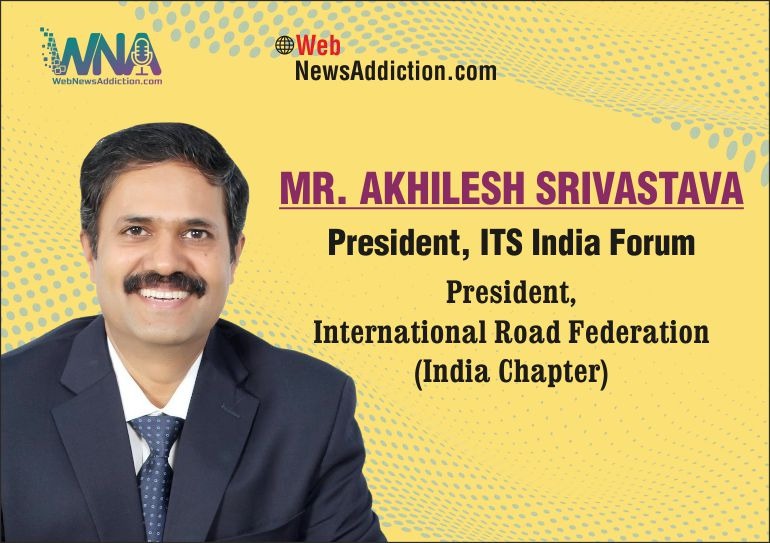
India’s urban mobility narrative is entering a decisive phase, one where the focus is gradually shifting from expanding infrastructure to improving how it functions as a system. While cities continue to invest in metros, highways, and expressways, congestion and road safety challenges remain deeply entrenched. This disconnect points to a larger structural issue: mobility in India has evolved in parts, not as a cohesive whole. As Mr. Akhilesh Srivastava, President – International Road Federation (IRF) India Chapter & ITS India Forum explains, the real transformation will come not from building more roads, but from integrating technology, policy, and planning into a unified, intelligent mobility ecosystem. Unless we move from asset creation to ecosystem design, the problem will persist, making it imperative to prioritize safety, efficiency, and seamless movement as part of a system-wide approach.
India’s urban mobility challenges become clearer when viewed through the lens of data and on-ground realities. Cities like Mumbai, Delhi, and Bengaluru continue to grapple with congestion and safety concerns despite significant infrastructure investments. India accounts for nearly 11% of global road fatalities despite having only about 1% of the world’s vehicles, with over 1.68 lakh deaths annually. High-density mixed traffic, weak enforcement, poor land-use planning, and inadequate last-mile connectivity continue to create inefficiencies across the system. As Mr. Akhilesh Srivastava puts it, “Our roads are not failing due to lack of infrastructure—they are failing due to lack of integration.”
Also Read: https://webnewsaddiction.com/rooftop-revelations-ajit-bahadur-guides-indias-solar-journey/
The Missing Link in India’s Mobility Chain
Last-mile connectivity remains one of the weakest links in urban mobility. Nearly 30-40% of trips in cities are under 5 km, yet these are often the most unsafe and inefficient. Commuters frequently step out of metro systems only to face unreliable or unsafe last-mile options, contributing to congestion, accident risks, and loss of productivity. Strengthening pedestrian infrastructure, enabling micro-mobility solutions such as e-bikes and e-rickshaws, and ensuring seamless multimodal integration could significantly reduce dependence on private vehicles. As emphasized, “If first mile and last mile fail, the entire mobility system fails.”
Despite large investments in metros and expressways, traffic congestion continues to persist. A key reason is that infrastructure has largely been developed in silos rather than as part of an integrated system. Metro networks, buses, and highways often operate independently, without real-time coordination or unified planning. Gaps such as the limited effectiveness of Unified Metropolitan Transport Authorities (UMTA), absence of common ticketing systems, and limited data sharing between agencies further compound the problem. In this context, the issue is less about traffic itself and more about coordination, highlighting the need to move towards integrated, user-centric mobility systems.
As Mr. Akhilesh Srivastava emphasizes, “The future is Mobility as a Service (MaaS).” This approach envisions the integration of metro systems, buses, shared mobility, and micro-mobility into a seamless network supported by unified ticketing and digital platforms. The inclusion of demand-responsive transport systems further enhances flexibility and efficiency. Globally, such integrated systems have demonstrated a 20-30% shift from private to public transport, significantly improving both efficiency and sustainability. For India, this presents an opportunity to leapfrog directly into digitally integrated, user-centric mobility ecosystems. As he points out, “The winner in mobility is not the fastest mode—it is the most seamless journey.”
From Infrastructure to Intelligent Mobility
Technology is increasingly emerging as a key enabler in transforming urban mobility. Artificial intelligence, in particular, is enabling a shift from reactive to predictive systems, helping identify accident-prone zones, optimize traffic signals, and improve enforcement through data-driven approaches. The use of digital twins is also allowing cities to simulate and plan mobility scenarios more effectively.
India has already taken important steps in this direction through initiatives such as the FASTag ecosystem and the evolution of digital mobility platforms. Technology is no longer optional, rather, it is foundational to building efficient transport systems. As Mr. Srivastava notes, “AI will not just make roads smarter—it will make them safer.”
Safety, Citizens, and the Road Ahead
Road safety must be embedded into infrastructure from the design stage itself, rather than being treated as an afterthought. This includes mandatory road safety audits at every stage from DPR and design to post-construction, ensuring that safety is systematically built into projects. The adoption of the Safe System Approach further strengthens this framework by designing transport systems that account for human error and minimize the risk of fatalities. Measures such as AI-based assessment tools and performance-linked systems can help ensure safer outcomes. India loses nearly 3% of its GDP annually due to road accidents, making safety not just a social priority but an economic imperative. As emphasized, “safety by design must replace safety by correction.”
At the same time, citizens play a crucial role in shaping safer mobility ecosystems. Responsible driving behaviour, adoption of technology platforms, and community participation are essential to building a culture of safety. Long-term success depends on moving from enforcement-driven compliance to shared responsibility, reinforcing the idea that “Road safety is not enforced on people—it is built with people.”
Vision for a Seamless Indian City
A truly seamless Indian city will be one that is zero fatality-oriented, aligned with Vision Zero principles, and powered by AI-enabled, data-driven systems. It will function as a fully integrated multimodal ecosystem, while remaining inclusive, ensuring safety and accessibility for pedestrians, cyclists, the elderly, and differently abled citizens and sustainable with a focus on low emissions and high efficiency.
In such a city, travel will be predictable, safe, and efficient, with real-time, data-driven decision-making shaping mobility systems. The shift from ownership to access will redefine how people experience transport, making mobility more flexible and user-centric. This is not a distant vision—it is achievable by Viksit Bharat 2047, provided policy, technology, and governance are aligned effectively. “The goal is not faster travel—the goal is safer, smarter, and seamless mobility.”
India’s Mobility Inflection Point
India stands at a unique inflection point. With the convergence of AI, policy reforms, and digital infrastructure, the country has the opportunity to transform mobility from a persistent challenge into a global benchmark.
The focus must now shift from building roads to building safe, intelligent mobility ecosystems. With the convergence of Artificial Intelligence (AI), digital public infrastructure, and policy leadership, Indian cities are well positioned to emerge as global benchmarks for safe, inclusive, and intelligent mobility in the coming years.
As Mr. Srivastava concludes, “The future of mobility in India will not be defined by the number of roads we build, but by the number of lives we save.”

1 Comment
Pingback: Santanu Mishra on Smile Foundation’s Last-Mile Impact