



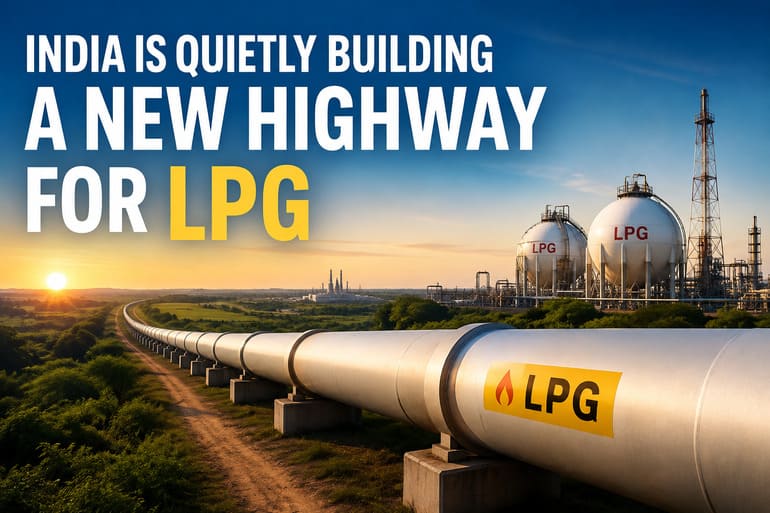
The Petroleum and Natural Gas Regulatory Board (PNGRB) has authorized the development of approximately 1,800 km of new LPG pipeline infrastructure across six states, backed by an estimated investment of about ₹7,000 crore. The expansion is aimed at strengthening LPG supply infrastructure, improving transportation resilience and supporting India’s broader energy security objectives.
The newly authorized network will traverse Telangana, Maharashtra, Uttar Pradesh, Uttarakhand, Karnataka and Goa. The projects will be developed by GAIL (India) Limited and, once completed, will expand the PNGRB-authorized common carrier LPG pipeline network from approximately 7,700 km to nearly 9,500 km. This represents an increase of about 23.5% in the authorized network.
Three LPG Pipeline Projects to Connect Key Markets
The expansion comprises three major projects covering different parts of the country.
The first is the 556-km Cherlapally in Telangana to Nagpur in Maharashtra LPG pipeline. The second is a 611-km pipeline connecting Jhansi in Uttar Pradesh with Sitarganj in Uttarakhand. The third project will cover 633 km, linking Shikrapur in Maharashtra with Goa and Hubli in Karnataka.
Together, the three projects will add approximately 1,800 km to India’s LPG transportation infrastructure and extend pipeline connectivity towards important consumption and distribution centres.
The new authorizations build on PNGRB’s earlier authorization of the approximately 2,757-km Kandla-Gorakhpur LPG Pipeline, which the regulator identifies as the country’s longest LPG pipeline. The latest projects therefore represent another step towards creating a more extensive pipeline-based LPG transportation network.
Also Read: Diamond Power Bags ₹52.86 Crore Order for Hyderabad Data Centre
Moving LPG Beyond Road-Based Transportation
The expansion has significance beyond simply adding pipeline kilometres.
India imports a substantial share of its LPG through coastal locations, creating a logistical requirement to move the fuel from import terminals towards inland markets. A larger pipeline network can provide an alternative to the extensive use of LPG tank trucks for primary transportation.
According to PNGRB, shifting a greater share of LPG movement from roads to pipelines is expected to reduce tanker movements, improve road safety, lower logistics costs and ease traffic congestion. The regulator also expects the modal shift to contribute to lower carbon emissions associated with transportation.
The issue has gained additional importance as PNGRB has been pursuing a reduction in the primary movement of LPG by road to bottling plants following accidents involving LPG tankers. The newly authorized projects could therefore support a gradual shift towards a more centralized and pipeline-led transportation system.
Why the Network Matters for Energy Security
The strategic importance of the projects goes beyond transportation efficiency.
Because a significant portion of India’s LPG supply is imported, the ability to move LPG reliably from coastal entry points to inland consumption centres is an important part of supply-chain resilience. A wider pipeline network can provide additional routes for continuous product movement and reduce dependence on road-based logistics.
PNGRB also highlights the role of pipelines as a form of line-pack storage. LPG held within the pipeline system while remaining part of the flowing network can provide an additional buffer during periods of supply disruption, emergencies or sudden increases in demand.
Also Read: L&T Scores Ultra-Mega Gas Compression Deal in Middle East
With the authorized common carrier LPG pipeline network expected to reach approximately 9,500 km after completion of the new projects, the latest investment marks a significant expansion of India’s LPG infrastructure. It also reinforces the country’s effort to develop a more integrated energy transportation system capable of supporting growing demand while improving the resilience of fuel supply chains.
For GAIL, which has been authorized to develop all three projects, the expansion will further strengthen its role in India’s gas and petroleum product transportation infrastructure.
Also Read: Tata Power Renewables Makes a Powerful Leap in Clean Energy with 190.5 MW Project
The ₹7,000 crore investment and 1,800 km addition represent more than an expansion in physical infrastructure. They point towards a broader shift in how India seeks to move LPG across the country, with pipelines increasingly positioned as a strategic component of energy security, supply reliability and safer fuel logistics.
