



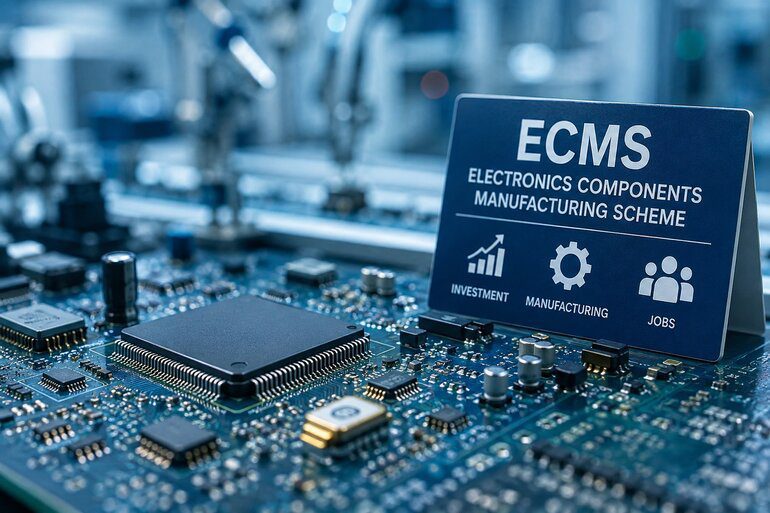
India is accelerating its shift from assembly-led electronics manufacturing to a more integrated, component-focused ecosystem. The Ministry of Electronics and Information Technology (MeitY) has now approved 106 projects under the Electronics Components Manufacturing Scheme (ECMS), with a total expected investment of ₹69,548 crores and projected production of ₹5,34,101 crores.
The latest tranche includes 31 new proposals (plus one expansion by an existing applicant), representing ₹7,877 crores in fresh investment and expected production of ₹82,243 crores. Together, the scheme is expected to generate 74,628 direct jobs and around 2.5 lakh indirect employment opportunities across 15 states.
From Assembly To Components: What ECMS Is Building
ECMS is designed to fill gaps in India’s electronics value chain by supporting domestic production of components, materials, sub-assemblies and capital goods. The 106 approved applications cover around 30 product categories, including:
- Camera modules, display modules and optical transceivers
- Connectors, transducers, speakers, microphones, relays, antennas
- Coils, filters, capacitors, enclosures and metal shielding covers
- Strategic inputs such as anode material for Li-ion cells, rare-earth permanent magnets, acetylene black, electrolyte additives, metallized films for capacitors and hermetic terminals
Several of these represent first-time domestic manufacturing capabilities in India, including filters, coils, speakers, acetylene black and electrolyte additives.
Also Read: BOSGAME Builds India Blueprint with Kaynes Technology Strategic Alliance
Production Is Already Underway
A key signal of momentum is that ECMS is moving beyond approvals into actual output. Of the 106 approved projects, 38 plants have already commenced manufacturing, while another 16 are at advanced stages of construction or machinery installation.
In some segments, approved capacity is expected to meet or exceed domestic demand. Examples highlighted include anode material, Optical Transceiver-SFP modules and relays.
Investment Scale and Job Creation
The scheme has already exceeded its original investment target. Approved ECMS investment now stands at ₹69,548 crore, up from the initially envisaged ₹59,350 crore.
- Total approved projects: 106
- Total expected investment: ₹69,548 crore
- Projected production value: ₹5,34,101 crore
- Expected direct employment: 74,628
- Expected indirect employment: 2.5 lakh
- Plants already manufacturing: 38
- Projects in advanced construction/installation: 16
- States covered: 15
The latest 31 proposals alone are expected to create 9,588 direct jobs.
Geographic Spread: 15 States, 10 In The Latest Round
The 106 approved applications are spread across 15 states, indicating a broad-based push rather than concentration in a single cluster. The most recent approvals cover projects in 10 states: Goa, Gujarat, Haryana, Himachal Pradesh, Karnataka, Maharashtra, Tamil Nadu, Telangana, Uttar Pradesh and Uttarakhand.
This distribution is significant for regional economic impact, as electronics component manufacturing tends to catalyze demand for logistics, tooling, testing, engineering services, packaging and other supporting industries.
Why ECMS matters for India’s electronics ambitions
India has built substantial capacity for assembling finished electronics, but long-term competitiveness depends on reliable access to components, raw materials and specialized equipment. ECMS targets precisely these layers of the supply chain, with a focus on:
- Printed circuit boards and passive components
- Electro-mechanical components and sub-assemblies
- Camera modules and optical transceivers
- Capital goods required for electronics manufacturing
A stronger domestic component ecosystem can deliver multiple benefits: higher value addition within India, more resilient supply chains, reduced import dependence, expanded manufacturing employment and improved export potential.
Also Read: Tata Power Renewables Makes a Powerful Leap in Clean Energy with 190.5 MW Project
What to watch next
With 38 plants already producing and 16 more nearing completion, the next phase will be how quickly these investments translate into:
- Sustained commercial production volumes
- Measurable domestic value addition in end products
- Growth in exports of components and sub-assemblies
- Long-term, stable employment in the electronics sector
For India’s electronics industry, the 106 ECMS projects mark a decisive step towards a more complete, domestically anchored manufacturing ecosystem.
* Source: Press Information Bureau (PIB), Ministry of Electronics and Information Technology

1 Comment
Pingback: Avalon and Zollner Form Electronics Manufacturing JV