



India’s electronics manufacturing landscape is entering a phase where scale alone may no longer be enough. As products become more complex and global companies look for diversified supply chains, capabilities such as system integration, testing, engineering support and lifecycle services are becoming increasingly important.
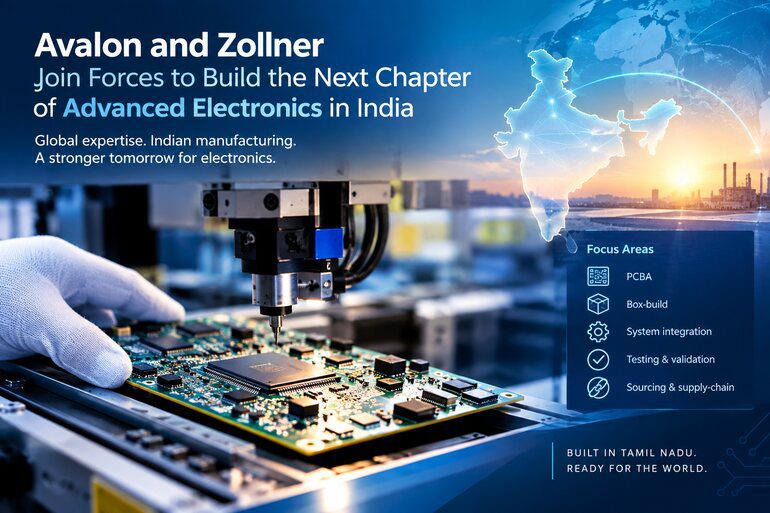
Against this backdrop, Avalon Technologies Limited and Zollner Elektronik AG have entered into a strategic partnership to establish a joint venture focused on advanced electronics manufacturing in India. The proposed venture will manufacture printed circuit board assemblies (PCBA), box-build and system integration products, initially serving the India operations of established customers.
The partnership brings together Avalon’s established manufacturing capabilities and supply-chain relationships in India with Zollner’s global electronics manufacturing and engineering expertise. The companies intend to use these complementary strengths to create a differentiated manufacturing platform that can support customers across India and other markets.
The proposed JV will focus on sectors including Healthcare & Life Sciences, Test & Measurement, Rail and other Industrial verticals, giving Avalon an opportunity to expand into new areas while allowing Zollner to strengthen its manufacturing presence in India.
A Different Structure for a Manufacturing Partnership
Under the proposed arrangement, Zollner will initially hold 51% of the JV, while Avalon will hold 49%. The ownership structure also includes a longer-term pathway for Avalon. Beginning three years after commercial production starts at the JV’s manufacturing facility, Avalon will have an option, subject to certain conditions to acquire an additional 2% stake. If exercised, Avalon’s shareholding would increase to 51%, making it the majority shareholder.
This structure allows Zollner to lead the venture during its initial phase, drawing on its manufacturing and engineering experience, while giving Avalon an opportunity to increase its ownership as the business develops. The proposed partnership is also designed to combine capabilities rather than simply bring together two equity partners.
Avalon will contribute its established Indian manufacturing footprint, supply-chain relationships and operating capabilities, while Zollner brings international customer relationships, engineering expertise and experience across the electronics product lifecycle.
Zollner has more than six decades of experience spanning areas from R&D and advisory services to production, traceability, supply-chain management and after-sales service. Avalon, meanwhile possesses more than 25 years of experience in India’s EMS industry, with capabilities extending across electronics manufacturing and related areas.
From PCBA to System Integration
The proposed JV will manufacture PCBA, box-build and system integration products in India, initially with a focus on the India operations of established customers. However, Avalon’s involvement will extend beyond its equity position. The company will also supply the JV with several of its existing capabilities, including cable wiring and harness, magnetics, plastics, sheet metal and machining. This gives Avalon another opportunity to participate across the value chain as the venture grows, while creating an additional recurring revenue opportunity for the company.
For customers, the partnership is intended to provide access to India-based manufacturing and greater localization support, while bringing production closer to their India operations. For Zollner, the arrangement provides access to an established Indian manufacturing platform and supply chain through Avalon, potentially reducing the time and resources required to develop such capabilities independently.
The partnership also gives Zollner a platform through which it can support the India operations of its global customers.
Avalon Looks Beyond Its Existing Manufacturing Base
The JV extends Avalon’s manufacturing strategy, which is built around high-mix, high-complexity products, long product lifecycles, and long-term customer relationships. The company expects the partnership to provide access to additional customers and new industry verticals, while helping it participate in manufacturing programmes involving greater technical complexity.
Healthcare & Life Sciences and Test & Measurement are particularly notable because they represent new verticals for Avalon under the proposed arrangement. The collaboration could also give Avalon greater exposure to global customers and create opportunities to participate more meaningfully in international supply chains. The combination of Avalon’s local capabilities and Zollner’s global customer relationships is therefore central to the rationale behind the venture.
Zollner Sees India as Part of Global Customer Strategies
The partnership reflects India’s growing importance to Zollner, not only as a manufacturing location but also as an integral part of its customers’ global strategies.
Markus Aschenbrenner, Member of the Managing Board, Zollner Elektronik AG, said: “India is a highly dynamic market, both as a growing technology ecosystem and as an important part of our customers’ global strategies. With the Zollner Avalon JV, we are combining Avalon’s strong local presence and expertise with Zollner’s global capabilities, technological know-how and more than 60 years of experience in EMS. We see the JV as a long-term commitment and look forward to developing the business together.”
The proposed venture is intended to help global customers build more resilient and diversified supply chains while establishing manufacturing capabilities closer to their Indian operations. That approach could become increasingly relevant as companies reassess how and where their electronics products are manufactured and supported.
A Wider Role for India in Global Electronics Manufacturing
The Avalon-Zollner partnership comes at a time when India’s electronics manufacturing ambitions are expanding beyond basic production capacity. The next stage of growth is likely to depend increasingly on the ability to handle complex products, integrate multiple technologies and provide services across longer product lifecycles. That is where the proposed JV’s combination of PCBA, box-build, system integration, testing and supporting manufacturing capabilities becomes significant.
Rather than focusing on a single manufacturing activity, the partnership is designed around a broader set of capabilities that can support products from manufacturing through integration and validation. The partnership also creates a pathway for Avalon to develop new customer relationships and enter additional industry segments, while giving Zollner an established Indian platform to support its global customers operating in the country.
Building a Platform for the Next Phase
Kunhamed Bicha, Chairman and Managing Director, Avalon Technologies Limited, said: “This JV is strategically significant for Avalon. It expands our access to customers, opens new verticals and advances our capabilities in highly complex manufacturing. Just as importantly, it is fully consistent with the strategy that has built Avalon: high-mix, high-complexity products, long product lifecycles, trusted customer relationships and disciplined, profitable growth.
Zollner brings more than six decades of engineering expertise, global customer relationships and full product lifecycle capabilities. Avalon brings an established India manufacturing platform, a strong local supply chain and integrated capabilities across the value chain. Together, we can provide global customers with a faster and more reliable path to manufacturing in India. We see strong long-term potential in this partnership.”
The proposed joint venture therefore represents more than an expansion of manufacturing capacity for either company. It brings together Avalon’s India-focused manufacturing and supply-chain strengths with Zollner’s international engineering, customer and lifecycle capabilities, while creating a platform aimed at more complex electronics applications.
The development further demonstrates how India’s domestic electronics manufacturing capabilities are becoming increasingly integrated with global electronics networks. The bigger opportunity may ultimately lie in what happens beyond the initial JV structure: whether the partnership can scale into new sectors, attract more global programmes and strengthen India’s role in the production of increasingly sophisticated electronic systems.
The next chapter of India’s electronics manufacturing story may not simply be about making more electronics. It could be about taking on more complex products, deeper integration and a larger role in global supply chains.

2 Comments
Pingback: Premier Energies Enters BESS Manufacturing with 12 GWh JV
Pingback: Tungaloy-NTK Merger Set for 2027