



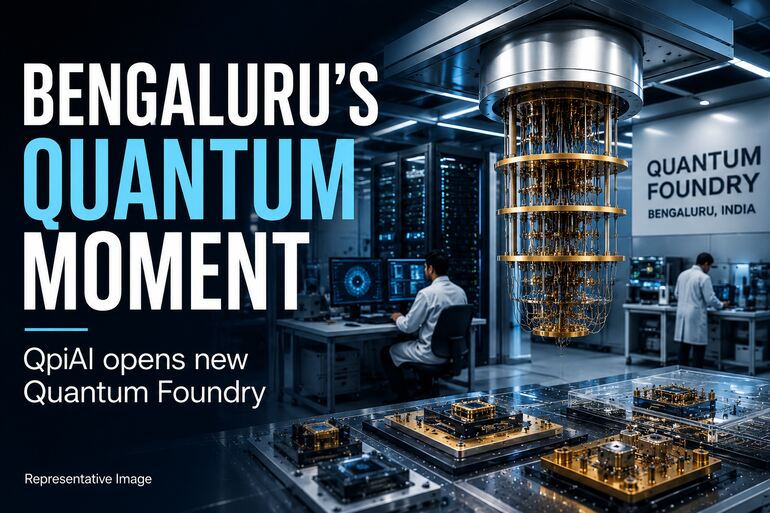
Bengaluru-based quantum computing company QpiAI has inaugurated a Quantum Foundry in the city, marking a new development in India’s efforts to build domestic capabilities for manufacturing quantum computing hardware.
The facility forms part of a 70,000 sq. ft. research and development centre and brings quantum processing unit (QPU) manufacturing, testing and quantum solution development together, QpiAI says the facility is designed to manufacture superconducting qubits, peripheral chips and sensors used in quantum computing systems.
QpiAI Quantum Foundry to Manufacture Superconducting Qubits
According to the company, the facility can fabricate flip-chip-based superconducting quantum processors with up to 128 qubits. QpiAI has outlined a longer-term expansion plan that targets manufacturing capability for quantum processing units containing up to 10,000 physical qubits. The 10,000-qubit figure represents a future target and should not be interpreted as a 10,000-qubit processor already operating at the facility.
QpiAI’s publicly available quantum roadmap currently lists its systems progressing from the 25-qubit Indus platform to the 64-qubit Kaveri, followed by a planned 128-qubit Ganges system and a 1,000-qubit Everest system. The company has also said that its Kaveri 64 processor is based on a fabrication and design approach intended to provide a foundation for scaling toward larger quantum systems.
Also Read: The Next Energy Frontier: Abinash Sahoo on India’s Battery Ambition
What the Quantum Foundry Brings to India
The inauguration comes as countries and technology companies compete to develop larger and more reliable quantum computing systems. Unlike conventional computing, quantum computing depends on highly specialized hardware. Superconducting quantum computers require precisely fabricated qubits, control and readout electronics, specialized packaging and cryogenic systems. Developing domestic fabrication capability could therefore give India a greater role in the quantum hardware supply chain.
QpiAI describes itself as a full-stack quantum-AI company, with its activities spanning quantum computing hardware, control systems and software. Its existing Indus platform is designed around superconducting quantum technology and can be scaled to a 128-qubit system, according to the company’s published specifications.
The company has also said it has developed quantum processors in Bengaluru ranging from 8 to 64 qubits and has established quantum computing installations in Karnataka.
Bengaluru’s Quantum Ecosystem is Expanding
The Quantum Foundry is being established alongside other quantum computing initiatives in Karnataka. In March, QpiAI announced that it had been awarded a contract to install its 25-qubit Indus quantum computing system at the Quantum and AI Computing Centre of Excellence at IIIT-Dharwad, with the system also being made accessible to IIIT-Raichur. The company described it as its second quantum computing installation in Karnataka.
The initiative is intended to support education, research and commercial experimentation, including hands-on training for students and faculty-led research.
Earlier this year, Karnataka had also announced plans to deploy what the state described as India’s first commercial quantum computer at IIIT-Dharwad, further positioning the state as a hub for quantum computing infrastructure. The developments indicate that Karnataka’s quantum strategy is moving beyond research institutions towards physical computing infrastructure, industry deployments and hardware development.
Also Read: India’s Nuclear Opening Enters the Next Stage as SHANTI Rules Take Shape
QpiAI’s Roadmap to Larger Quantum Processors
The headline figure of 10,000 physical qubits is significant, but qubit count alone is not enough to determine the usefulness of a quantum computer. Quantum systems are highly susceptible to errors. Building commercially useful fault-tolerant quantum computers requires advances in qubit fidelity, error correction, connectivity, control systems and the conversion of physical qubits into reliable logical qubits. In other words, a machine with a larger number of physical qubits does not automatically deliver a corresponding increase in useful computational power.
This distinction is becoming increasingly important as quantum companies worldwide publish roadmaps involving thousands or even millions of physical qubits. QpiAI’s own roadmap currently targets a 1,000-qubit NISQ system, while the company has separately described a longer-term vision involving much larger quantum infrastructure.
Quantum Manufacturing becomes the Next Challenge
For India, the importance of QpiAI’s Quantum Foundry may therefore lie less in the immediate qubit count and more in the development of domestic manufacturing infrastructure. The quantum computing industry needs more than a working processor. Scaling requires repeatable fabrication processes, high-quality materials, device testing, packaging, control electronics and specialized engineering expertise.
A local foundry could help connect those capabilities with India’s growing research, software and application ecosystem. QpiAI’s launch also comes as the company expands its quantum computing deployments in Karnataka. Its 25-qubit Indus system is being introduced at academic centres to support both research and commercial experimentation, providing another potential pathway from hardware development to practical applications.
India Looks to Build a Quantum Technology Ecosystem
The development is part of a broader effort to establish India as a participant in the global quantum technology industry. The country’s quantum strategy includes efforts across quantum computing, communications, sensing and materials, with government-backed programmes aimed at supporting research, infrastructure and commercialization. The challenge for Karnataka will be to move from building quantum infrastructure to developing applications, businesses and an ecosystem around the technology.
Quantum computing is being explored for areas including optimization, materials research, pharmaceuticals, financial modelling and artificial intelligence. However, many of these applications remain at the research and development stage, and the commercial value of large-scale quantum computing has yet to be demonstrated across most industries.
Source: Hon’ble IT/BT Minister Shri Priyank Kharge’s official X post and publicly available information from QpiAI.
