



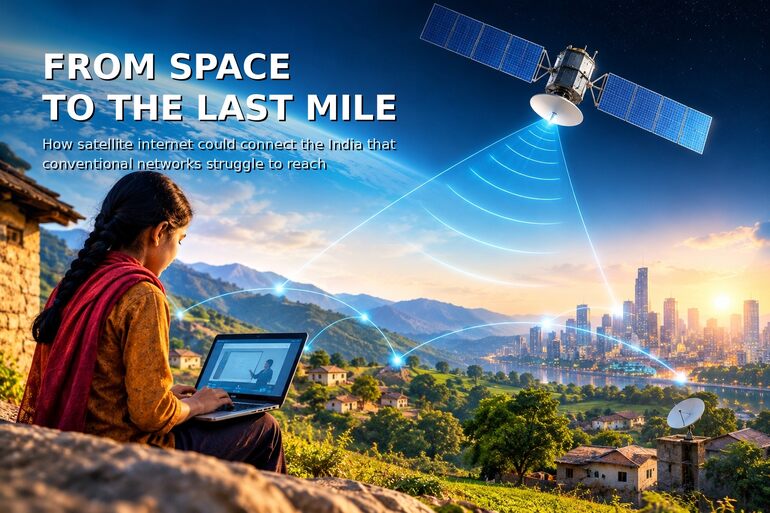
Internet connectivity for most Indians could be something that can be taken for granted. We connect through a mobile tower, fibre cable or Wi-Fi router and rarely think about the infrastructure behind it. But what happens when there is no fibre cable to lay, no convenient location for a mobile tower, or when geography makes conventional connectivity simply too expensive?
This is where satellite internet could change the equation. India has now moved another step closer to commercial satellite broadband services after the Digital Communications Commission (DCC) approved most of the Telecom Regulatory Authority of India’s (TRAI) recommendations on spectrum allocation for satellite-based communication services. The decision could help companies such as Starlink, Eutelsat OneWeb and Jio Satellite move closer to commercial operations in India.
But for the ordinary citizen, the important question is not really about spectrum.
It is:
“What does all this mean for me?”
First, What exactly is Satellite Internet?
In simple terms, satellite internet uses satellites to connect users to the internet instead of relying entirely on terrestrial infrastructure such as fibre cables and mobile towers. This makes the technology particularly interesting for areas that are difficult to reach through conventional networks.
Think of a remote village in the mountains, an island community, a border area or a location where laying hundreds of kilometres of fibre may not make commercial sense. A satellite does not need a road to reach that village. That is the opportunity.
Why is Spectrum so Important?
The term “spectrum” can make this story sound more complicated than it really is.
Wireless communication needs specific radio frequencies to transmit information. Those frequencies are limited and therefore have to be regulated. India’s Telecommunications Act, 2023 provides for administrative assignment of spectrum for specified satellite-based services rather than treating every category in the same way as conventional auctioned spectrum.
TRAI was subsequently asked to recommend the terms and conditions for assigning spectrum for satellite-based commercial communication services. The DCC’s latest decision therefore represents an important regulatory step: India is creating the framework under which satellite operators can obtain spectrum and provide services.
But this does not mean satellite internet will suddenly become available across the country tomorrow. There are still licensing, spectrum assignment, security and other regulatory requirements to complete.
What Has The Government Actually Done?
This distinction is important. A company cannot simply launch satellites and start selling internet services because the spectrum framework has been approved. Satellite operators still have to comply with India’s telecom authorization requirements, obtain spectrum assignment and meet security-related conditions.
Recent reporting indicates that security clearances remain an important requirement before commercial rollout. In other words, the government is trying to create a pathway that allows satellite companies to operate commercially while keeping the service within India’s regulatory and security framework.
For consumers, that should provide an important reassurance: satellite internet operating in India will not exist in a regulatory vacuum.
The Pricing Question Matters
This is perhaps the most interesting part of the debate. TRAI had originally recommended a spectrum charge of 4% of adjusted gross revenue (AGR), along with a minimum annual charge of ₹3,500 per MHz and an additional ₹500 per urban subscriber for certain fixed satellite services.
However, the framework under consideration has since evolved. The government is looking at a 5% AGR-based spectrum charge, with a possible one-percentage-point concession for operators serving government-designated hard-to-connect areas. The emerging framework is also reported to be subject to further government approval and detailed rules.
This matters to an ordinary consumer because the cost of regulation ultimately influences the economics of providing the service. If satellite broadband is too expensive to operate, companies may pass those costs on to consumers. If the framework is designed intelligently, however, it can encourage operators to expand into areas where connectivity is most needed. And that brings us to the bigger opportunity.
The Real Test Should be Rural India
Satellite internet should not be judged only by how many urban households subscribe to it. Its bigger test should be whether it can connect the India that terrestrial networks find difficult to reach. A reliable internet connection in a remote school could support digital education.
A connection in a rural health centre could improve access to telemedicine. A connection in a small village enterprise could open access to digital payments, e-commerce and wider markets. For emergency services and disaster-hit areas, satellite connectivity could also provide an important alternative when terrestrial networks are disrupted.
This is where satellite broadband could become more than another premium internet product. It could become part of India’s digital infrastructure strategy.
But Satellite Internet will not replace Mobile Networks
It is also important not to view this as a battle between satellites and mobile towers. India will need all of them. Fibre will remain critical for high-capacity networks. 4G and 5G will continue to serve the majority of mobile users. Satellite connectivity can fill some of the gaps where terrestrial infrastructure is difficult, expensive or vulnerable.
The future may therefore be less about one technology replacing another and more about different technologies working together to create a more connected India.
The Bigger Question is Affordability
Technology alone does not bridge a digital divide. A satellite can provide coverage over a remote village, but if the equipment and monthly service are unaffordable, coverage does not automatically translate into meaningful access.
That is why India’s satcom policy should ultimately be judged on three things: Coverage, Affordability, Impact. Who gets connected, how much does it cost, and what can people actually do with that connection? Those questions matter more to citizens than the technical details of spectrum allocation.
From Space to the Last Mile
India’s satellite broadband story is therefore about much more than companies competing for spectrum. It is about how the country builds the next layer of its digital infrastructure. The government has an opportunity to use regulation not merely to enable a new industry, but to encourage that industry to solve a genuine national challenge: connecting people whom conventional infrastructure has struggled to reach.
The next internet revolution may indeed come from space. But its real success will not be measured by how advanced the satellites are. It will be measured by whether a child in a remote village, a doctor in an underserved health centre, a small entrepreneur in a distant district or a community on an island can finally say:
“The internet works here too.”

2 Comments
Pingback: Rohde & Schwarz Showcases Test Solutions at EuMW 2026
Pingback: New E-Commerce Rules: What Changes in 2027