



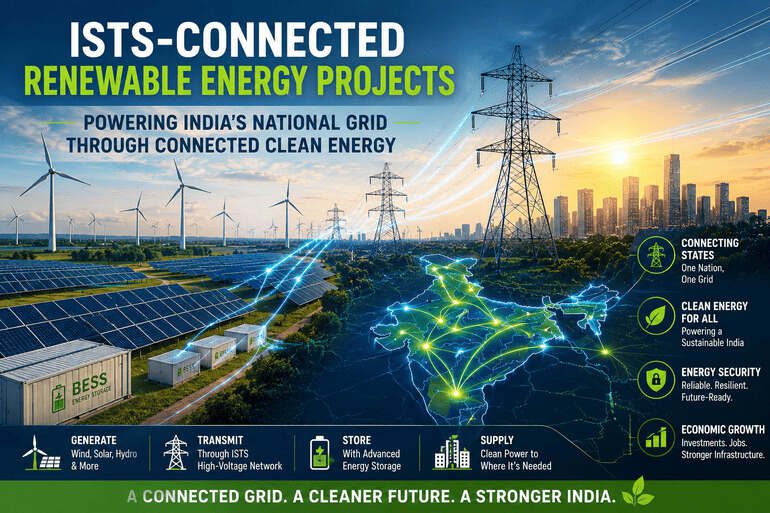
Every time organizations such as the Solar Energy Corporation of India (SECI), NTPC Renewable Energy or other public sector entities issue renewable energy tenders, one acronym quietly appears in the project description. That acronym is ISTS. Most readers skim past it without a second thought. Headlines naturally focus on project capacity, investment value or the successful bidder, whether it is a 500 MW solar park, a 1 GW wind project or a large Battery Energy Storage System (BESS). Yet hidden behind those announcements is one of the most important developments shaping India’s clean energy future.
As India accelerates its transition towards renewable energy, the challenge is no longer limited to generating more electricity. The bigger question is how that electricity reaches homes, industries and businesses spread across a vast country. Solar panels and wind turbines may generate clean power, but without an efficient transmission network, much of that electricity cannot reach the places where it is needed. That is where the Inter-State Transmission System (ISTS) comes in. Although rarely discussed outside the power sector, it has quietly become one of the foundations of India’s renewable energy strategy.
Renewable Energy Is Only Half the Story
When people think about renewable energy, they usually picture endless rows of solar panels or giant wind turbines turning against the skyline. While these projects are undoubtedly important, generating electricity is only one part of the equation. Electricity becomes valuable only when it reaches consumers.
Consider Rajasthan, for example. The state enjoys some of the highest levels of solar radiation in the country and has emerged as one of India’s largest renewable energy hubs. Several utility-scale solar parks generate enormous quantities of electricity every day. However, Rajasthan itself does not always consume all the electricity those projects produce. At the same time, neighbouring states such as Delhi, Haryana and Uttar Pradesh often require significantly more electricity than they can generate from renewable sources.
Without an efficient transmission network, the surplus clean energy produced in Rajasthan would remain largely confined within the state. Meanwhile, another state could continue relying on conventional power generation simply because renewable electricity cannot reach it efficiently. This is why transmission infrastructure has become just as important as renewable energy generation itself.
Think of ISTS as India’s Electricity Highway
The easiest way to understand the Inter-State Transmission System is to compare it with India’s national highway network.
Imagine an automobile manufacturer based in Gujarat. The company does not produce vehicles only for customers living within Gujarat. Instead, those vehicles travel through highways to dealerships in Maharashtra, Delhi, Assam and virtually every other state. Without highways connecting different regions, transporting goods across the country would become slow, expensive and inefficient.
Electricity works in much the same way. Instead of carrying trucks and cargo, the ISTS carries electricity through high-voltage transmission lines that connect multiple states under India’s national grid. Renewable energy generated in one state can therefore be transmitted to another state where electricity demand is higher. In simple terms, ISTS serves as the country’s electricity highway, allowing clean power to travel wherever it is needed.
A Simple Example Explains Why ISTS Matters
Imagine a renewable energy developer builds a 500 MW wind farm in Andhra Pradesh, where wind conditions are particularly favourable. If that project were connected only to the state’s local electricity network, most of the power generated would remain available only within Andhra Pradesh. However, once the wind farm is connected to the Inter-State Transmission System, the electricity becomes part of India’s national grid. Depending on demand, the same electricity could power industries in Maharashtra, commercial establishments in Telangana or residential consumers in Karnataka.
The same principle applies to solar power. Large solar parks in Rajasthan can transmit surplus electricity to northern states experiencing higher electricity demand. Instead of renewable energy remaining confined to the state where it is generated, ISTS enables India to treat clean electricity as a shared national resource. This improves efficiency, reduces wastage and allows renewable energy to be utilized wherever it delivers the greatest value.
Why Does Almost Every SECI Tender Mention ISTS?
Anyone who regularly follows renewable energy tenders will notice that the term “ISTS-connected” appears frequently in projects floated by SECI. The reason is relatively straightforward. SECI is not simply procuring renewable electricity. It is helping create a national renewable energy ecosystem. Rather than asking developers to establish projects only near cities where electricity demand is high, SECI encourages them to build projects in locations where renewable resources are strongest.
For example, Rajasthan offers abundant sunshine, while Andhra Pradesh and Tamil Nadu possess some of India’s most productive wind corridors. Developers can therefore select locations that maximize electricity generation instead of being restricted by local demand. Once connected through the ISTS network, the electricity generated in these regions can be supplied across multiple states.
This approach improves project economics, encourages competition among developers and ensures India makes better use of its renewable energy potential.
How Does Electricity Actually Travel Across States?
For most people, electricity simply appears when a switch is turned on. Few realize the complex journey it takes before reaching homes and businesses. When electricity is generated at a solar park or wind farm, it first passes through a substation, where transformers increase its voltage. Transmitting electricity at very high voltages reduces energy losses over long distances, making the system far more efficient.
From the substation, electricity enters the high-voltage transmission network that forms part of the Inter-State Transmission System. These transmission corridors carry electricity across states until it reaches another substation closer to consumers. There, the voltage is gradually reduced before local distribution companies deliver electricity to homes, factories, hospitals and commercial establishments.
Think of it like air travel. A passenger travelling from Jaipur to Kochi first boards a flight covering the long-distance journey before taking a taxi for the final few kilometres. Similarly, electricity travels through high-voltage transmission lines over long distances before entering local distribution networks that deliver power directly to consumers.
Why Grid Stability Has Become More Important
Another term frequently associated with ISTS projects is grid stability, but what exactly does it mean? Imagine a hot summer afternoon when millions of households across India switch on air conditioners almost simultaneously. Electricity demand rises sharply within a matter of minutes. At the same time, cloud cover may temporarily reduce solar power generation in Rajasthan while strong winds increase wind generation in southern India. Without a connected national transmission system, balancing these sudden changes would become extremely difficult.
The Inter-State Transmission System allows electricity generated in one region to flow quickly towards another region experiencing higher demand. This ability to balance supply and demand across multiple states makes the national grid more stable and reliable. As renewable energy contributes a larger share of India’s electricity generation, maintaining this balance will become increasingly important.
Battery Storage Makes ISTS Even More Powerful
Battery Energy Storage Systems are emerging as another important component of India’s renewable energy transition. The simplest way to understand a utility-scale battery is to think of it as a giant power bank. During sunny afternoons, solar parks often generate more electricity than consumers immediately require. Instead of allowing that excess electricity to go unused, batteries store it for later use. When evening arrives and solar generation stops, the stored electricity can be released back into the grid to meet rising demand.
When combined with ISTS connectivity, battery storage allows renewable electricity to remain available even when weather conditions change, making the electricity system cleaner as well as more reliable.
Also Read: https://webnewsaddiction.com/assam-bess-project-apgcl-consultancy-tender/
The Benefits Go Beyond Renewable Energy
ISTS projects do much more than transport electricity. Every new transmission project creates demand for transmission towers, substations, transformers, conductors, switchgear and sophisticated grid management technologies. It supports engineering companies, construction firms, equipment manufacturers and technology providers involved in building India’s power infrastructure.
Thousands of engineers, technicians and skilled workers are employed during planning, construction, commissioning and maintenance. Manufacturers producing cables, transformers and electrical equipment also benefit as renewable energy deployment accelerates. In many ways, every ISTS-connected project contributes not only to India’s clean energy goals but also to strengthening domestic manufacturing and industrial capabilities.
What Happens as More ISTS Projects Are Built?
As India continues expanding renewable energy capacity, the importance of ISTS infrastructure will only increase. The country has set an ambitious target of achieving 500 GW of non-fossil fuel electricity capacity by 2030. Meeting that objective will require much more than installing additional solar panels and wind turbines. It will demand a modern transmission network capable of integrating renewable energy generated across multiple states while maintaining reliable electricity supply.
Future developments such as hybrid renewable energy parks, offshore wind projects, Battery Energy Storage Systems and even green hydrogen production are all expected to depend heavily on robust transmission infrastructure. The stronger India’s transmission network becomes, the easier it will be to integrate larger volumes of renewable electricity into the national grid.
The Bigger Picture
When a renewable energy tender mentions an ISTS-connected solar project, wind farm or Battery Energy Storage System, it represents much more than another infrastructure project. It signals another step towards building a nationwide electricity network capable of moving clean energy from resource-rich regions to areas where electricity demand continues to grow. Just as highways transformed the movement of people and goods across India, the Inter-State Transmission System is quietly transforming the movement of renewable electricity.
For most consumers, these transmission lines remain invisible. Yet every new ISTS project strengthens the country’s ability to deliver cleaner, more reliable and more affordable electricity. As India advances towards its renewable energy ambitions, ISTS will continue to play a central role not only in connecting power plants to the grid, but in connecting the country’s clean energy future itself.
