



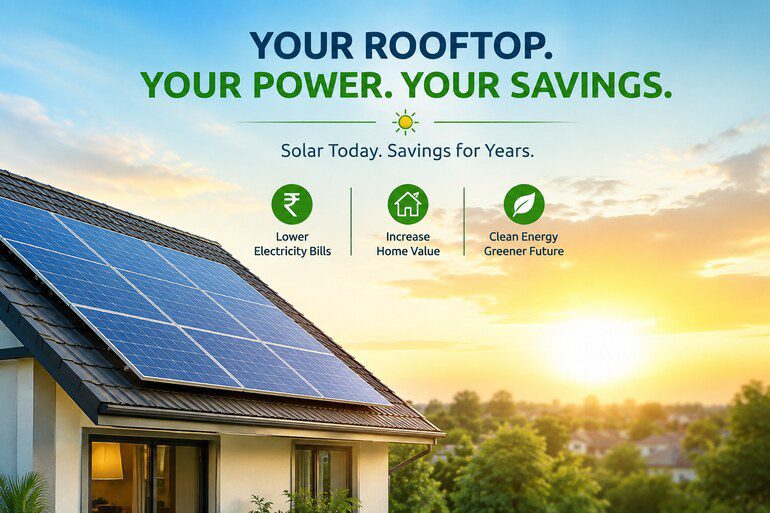
For millions of Indian households, the rooftop has traditionally been little more than unused space exposed to the sun every day. But that is changing. As electricity costs remain an important part of household budgets and the government continues to push distributed renewable energy, the question facing homeowners is no longer simply whether solar panels can be installed on a roof. It is whether that roof can become a meaningful source of electricity savings.
The latest policy movement around rooftop solar has once again brought the issue into focus. The Ministry of New and Renewable Energy has extended the deadline for receiving eligible Central Financial Assistance claims under the earlier Grid Connected Rooftop Solar Phase II programme to November 30, 2026. The amendment covers eligible applications that have reached the redeemed, inspected or installed stage, with the applicable claims continuing to be governed by the Phase II guidelines.
For homeowners, however the bigger story goes beyond a single deadline. India is steadily moving towards a model in which rooftop solar becomes part of the residential electricity equation. The PM Surya Ghar: Muft Bijli Yojana launched in February 202 aims to bring rooftop solar to one crore households. The scheme provides Central Financial Assistance to eligible residential consumers, with the commonly cited maximum support for a residential system reaching ₹78,000.
So, if you are considering solar panels for your home in 2026, what should you actually know before making the decision?
Also Read: Rooftop Solar Deadline Extended: Households Get More Time to Claim ₹78,000 Subsidy
The rooftop is becoming an energy asset
One of the biggest changes in India’s energy landscape is happening away from large power plants and utility-scale solar parks. Solar generation is increasingly moving closer to where electricity is consumed.
A rooftop solar system essentially turns a portion of a home’s unused roof into a small power-generation asset. During daylight hours, the panels generate electricity that can be used by the household. Depending on the system, electricity consumption pattern and applicable state and DISCOM arrangements, surplus generation can also be handled through the relevant grid-connected mechanisms.
This changes the traditional relationship between a household and the electricity grid. Instead of purchasing all of its electricity from the grid, a solar-equipped home can generate part of its daytime requirement itself. Over time, that can reduce dependence on grid electricity and potentially lower electricity expenditure. The economics, however, are not identical for every household.
A home with substantial daytime electricity consumption may extract more immediate value from rooftop solar than a household whose electricity consumption is concentrated late at night. Roof orientation, available space, shading, system size, local electricity tariffs, installation costs and the applicable net-metering or related regulations can all influence the final economics.
That is why the right question is not simply, “How much subsidy can I get?”
The better question is, “How much electricity can my rooftop realistically generate, and how much of that electricity can my household actually use?”
₹78,000 is important, but it is not the whole solar story
The headline subsidy number has naturally attracted attention. Under the PM Surya Ghar framework, residential consumers can receive Central Financial Assistance based on eligible rooftop solar capacity, with support capped at ₹78,000 for systems above 3 kW under the standard residential structure. MNRE material describes the subsidy as ₹30,000 per kW for the first 2 kW and ₹18,000 for the additional capacity up to 3 kW, resulting in the ₹78,000 maximum.
But homeowners should avoid treating the subsidy as though it represents the entire financial benefit of going solar. The system still has an upfront installation cost. There can also be costs and procedural requirements associated with installation, approvals, metering and other components depending on the location and project.
The real financial calculation therefore involves several variables: the cost of the system, applicable subsidy, household electricity consumption, electricity tariff, solar generation, system performance and the time required to recover the remaining investment.
This is also why two neighbouring homes can install similar-looking solar systems and experience different financial outcomes. The solar panels may look identical from the street. The economics underneath them may not be.
Also Read: GK Energy Receives ₹454.5 Crore Rooftop Solar Empanelment for 1 Lakh Households
What should a homeowner check before installing solar?
The first consideration is the roof itself. A suitable rooftop needs adequate usable space and should ideally have good solar exposure. Shadows from neighbouring buildings, trees, water tanks and other structures can affect generation. The structural condition of the roof is another consideration, particularly for older properties.
The second consideration is electricity consumption. A homeowner should look at several recent electricity bills rather than making a decision based on a single month’s consumption. Understanding when electricity is being consumed can be just as important as understanding how much is being consumed.
The third is system sizing. Installing the largest possible system is not automatically the smartest choice. A system should be matched to the household’s requirements, available roof space and applicable scheme and grid rules.
The fourth is the vendor. This is particularly important because the government has been strengthening implementation and monitoring under the rooftop solar ecosystem. Consumers should verify the applicable empanelment and scheme requirements before selecting a vendor rather than choosing an installer solely on the basis of the lowest quoted price.
The fifth is documentation. Rooftop solar is not simply a purchase-and-install transaction. The consumer may have to move through application, installation, inspection, metering and subsidy-related processes. Delays at any one stage can affect the overall timeline. That makes it sensible to start the process well before any applicable deadline.
The deadline matters, but consumers should understand what it actually means
The latest MNRE amendment is particularly relevant because it gives additional time for certain pending claims under the earlier rooftop solar Phase II framework.
According to reports on the August 31, 2026 amendment, eligible Phase II applications that have reached the redeemed, inspected or installed stage can remain eligible for CFA if the claim is received by November 30, 2026. The applicable claims continue to be governed by the respective Phase II guidelines.
This distinction matters. The November 30 date should not simply be interpreted as a universal “install solar by November 30” deadline for every household interested in PM Surya Ghar. Instead, consumers should determine which scheme framework and application status apply to them before assuming that the extension applies to their particular case. For people already moving through the process, that makes checking the status of an application particularly important.
For new consumers, the focus should be on understanding the current PM Surya Ghar process and applicable requirements rather than relying on headlines about the extended Phase II deadline. That is where the distinction between news about a deadline and understanding the solar opportunity becomes important.
Why rooftop solar could become more important for Indian homes
India’s electricity demand is changing alongside the way people live. Air conditioners, refrigerators, water pumps, televisions, computers, electric vehicles and a growing range of connected appliances are increasing household electricity requirements. At the same time, India is expanding its renewable-energy capacity and trying to reduce the carbon intensity of electricity generation.
Rooftop solar sits at the intersection of these trends. It can generate electricity close to the point of consumption, reduce the amount of power a household needs to draw from the grid during suitable hours and potentially reduce long-term electricity expenditure.
MNRE says the PM Surya Ghar scheme is designed to create substantial additional rooftop solar capacity in the residential sector. Government material associated with the programme has projected around 30 GW of additional rooftop solar capacity through the residential segment.
The scale is significant because rooftop solar is not only about individual homes. Multiply one solar-equipped home by thousands, then hundreds of thousands and eventually millions, and the combined effect becomes a distributed energy resource spread across cities, towns and villages. That is a very different energy model from relying exclusively on large centralized generation.
Could solar panels eventually change how households think about electricity?
Perhaps the most interesting aspect of India’s rooftop solar push is psychological. For decades, electricity has largely been something households buy. Solar introduces the possibility of households becoming small-scale electricity producers as well. That does not mean every home will become completely independent of the grid. In fact, grid connectivity remains an important part of the rooftop solar model for many consumers.
But the relationship can change. A household that once looked at the monthly electricity bill simply as an unavoidable expense can begin viewing its roof as an underused energy resource. That shift could be particularly important as India adds more electric vehicles, home appliances and other electricity-consuming technologies.
The roof that once protected a home from the weather could increasingly become part of the home’s energy infrastructure.
The real solar decision is bigger than the subsidy
The extension of the rooftop solar claim deadline is useful news for eligible consumers, but the larger development is the continued push to make distributed solar a mainstream part of India’s energy system.
For a homeowner, the decision should therefore not begin and end with the question of whether a subsidy is available. The more useful questions are whether the roof is suitable, how much electricity the household consumes, when that electricity is consumed, what system size makes sense, what the installation will cost after applicable assistance and what local grid and metering requirements apply.
The subsidy can improve the economics. But the solar system itself has to work for the household. As India moves deeper into its rooftop solar transition, that distinction could become increasingly important.
The November 30, 2026 extension gives eligible consumers under the applicable Phase II framework additional breathing room. More broadly, PM Surya Ghar is helping turn the residential rooftop from an overlooked part of the building into a potential component of India’s clean-energy infrastructure.
And perhaps that is the bigger story. Rooftop solar is moving beyond a government incentive or a household cost-saving measure and emerging as an important part of India’s broader energy transition. What happens on millions of individual rooftops could ultimately shape how the country powers its homes in the years ahead.

2 Comments
Pingback: Delhi Solar Policy 2026: Cabinet Approves Amendment
Pingback: Yash Highvoltage Strengthens US Expansion