



India’s roads tell a story of ambition. Over the past decade, India has witnessed one of the most ambitious infrastructure expansions in its history, as the country has expanded its highway network at one of the fastest rates in the world, with national highway construction increasing from roughly 12 km per day in 2014 to over 30 km per day in recent years. Highways now cut across deserts in Rajasthan, wind through the fragile Himalayan terrain, and connect remote villages to economic hubs. According to government data, the length of national highways in India increased from about 91,000 km in 2014 to over 145,000 km in recent years. This surge reflects a clear economic vision: Better roads drive growth, connectivity, and opportunity.
This rapid growth reflects a clear national priority: Roads are not just transport assets, they are economic enablers. They move goods, connect people, and unlock regional development. But as India builds faster and wider, a critical question is emerging. Are these roads being built for the India of tomorrow, or for the climate of yesterday?
Because while infrastructure has accelerated, climate patterns have shifted even more dramatically. The result is a growing gap between design assumptions and real-world conditions. This is the gap that is already beginning to show in the form of flooded highways, cracked pavements, and repeated repair cycles.
Also Read: https://webnewsaddiction.com/lawyered-legal-tech-that-moves-at-the-speed-of-enforcement/
A Decade of Change: From Predictable Weather to Persistent Extremes
Ten years ago, infrastructure planning in India relied heavily on historical climate data. Engineers designed roads based on expected rainfall averages, known flood levels, and temperature ranges that had remained relatively stable for decades. These assumptions formed the backbone of road engineering standards. But over the last decade, those assumptions have steadily unravelled.
India is now experiencing extreme weather events on a majority of days each year. The India Meteorological Department has reported a significant rise in localized heavy rainfall events, even as the overall number of rainy days has decreased. This means that instead of steady monsoon patterns, cities are now receiving intense bursts of rain, sometimes exceeding 150 to 200 mm in a single day. At the same time, heatwaves have become longer and more intense. In several parts of the country, temperatures now regularly exceed 45°C, with road surface temperatures often crossing 60°C. Coastal regions are seeing more frequent cyclones, while hill states are experiencing increased landslides due to erratic rainfall patterns. This transformation is not gradual, it is structural. And it is forcing infrastructure systems to operate under conditions they were never designed to handle.
The Economic Toll of Flooded Road Networks
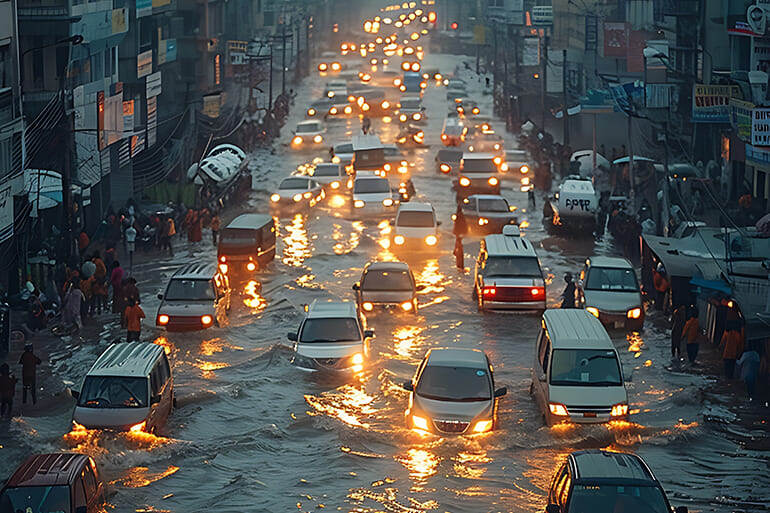
One of the most visible impacts of changing climate patterns is the increasing frequency of road flooding in urban India. Cities like Mumbai, Chennai, and Bengaluru have all experienced repeated episodes where roads become completely unusable after just a few hours of heavy rain. The reasons are layered and interconnected.
First, urbanization has dramatically altered natural drainage systems. Lakes, wetlands, and open spaces that once absorbed excess water have been reduced or built over. Second, stormwater drainage infrastructure has not kept pace with urban expansion. Many systems are designed for rainfall intensities that are now routinely exceeded. As a result, water accumulates rapidly on roads, especially in low-lying areas. Roads, which are often slightly elevated can act as barriers that trap water instead of allowing it to flow naturally. Once submerged, the structural layers beneath the road surface begin to weaken. Repeated exposure to water leads to potholes, cracks, and eventual failure.
The economic cost of this phenomenon is significant. Urban flooding in India is estimated to cause over $4 billion in annual losses. These losses are not limited to infrastructure damage. They include reduced productivity, disrupted logistics, increased fuel consumption, and delays in emergency response. For businesses, a flooded road can mean delayed shipments and broken supply chains. For individuals, it means hours lost in traffic, increased commuting stress, and safety risks. Over time, these seemingly small disruptions accumulate into a substantial economic burden.
What is often overlooked is that a large share of this damage is preventable. A World Bank assessment has indicated that every $1 invested in resilient infrastructure can save up to $4 in avoided losses over time. This raises an important question: Why are Indian cities still spending more on repairing damaged roads than on preventing that damage in the first place?
The answer lies in how roads are planned and managed. Most urban road projects are still designed in isolation, without fully integrating drainage, land use, and climate projections. A shift towards solutions already exists, but implementation remains inconsistent. For instance, cities like Surat have demonstrated that integrated flood management, including improved drainage networks and early warning systems can significantly reduce urban flooding impacts. Similarly, permeable pavements, bio-swales, and restored urban wetlands have proven effective in managing excess water in several global cities.
This is where the conversation needs to move forward. Should road projects in flood-prone cities be approved without climate risk assessments? Can municipal budgets justify repeated repair costs when long-term solutions are known to be more economical? And how can citizens and businesses push for accountability in infrastructure planning?
The challenge is no longer a lack of knowledge, but a gap in prioritization. Flooded roads are not just an inconvenience; they are a signal of deeper planning failures. Addressing them requires not only better engineering, but also better coordination, governance, and public engagement.
Heat: The Invisible Stressor on India’s Roads
While flooding is dramatic and visible, heat is a quieter but equally destructive force. Over the past decade, India has seen a steady increase in heatwave days, with temperatures often crossing 45°C and road surface temperatures exceeding 60°C. Under these conditions, the materials used in road construction begin to weaken. Most Indian roads rely on bitumen, which softens under prolonged heat exposure. This makes road surfaces more vulnerable to deformation under heavy traffic, leading to rutting, cracks, and uneven surfaces. In severe cases, this can reduce safety and increase accident risks, especially on high-speed corridors.
Urban areas face an additional challenge in the form of the urban heat island effect. Dense clusters of asphalt and concrete absorb and retain heat, raising local temperatures significantly. This not only accelerates road damage but also increases energy demand and overall urban discomfort. The result is a repeated cycle of damage and repair. Roads deteriorate faster, require frequent maintenance, and increase long-term costs. In extreme heat conditions, pavement life can reduce significantly, making this not just an engineering issue but an economic one.
If heat damage is now predictable, the key question is why road design has not adapted at the same pace. Should high-temperature zones mandate the use of heat-resistant materials instead of treating them as optional? Can lifecycle costing replace short-term budgeting in infrastructure decisions?
Solutions already exist. Polymer-modified bitumen can withstand higher temperatures, while concrete roads offer greater durability in extreme heat. Reflective or “cool pavement” technologies can reduce heat absorption and increasing urban green cover can lower surrounding temperatures. The real shift lies in moving from reactive repairs to proactive design. Instead of repeatedly fixing damaged roads, the focus must be on building roads that can withstand rising temperatures from the outset.
Lessons from the Ground: Kerala’s Wake-Up Call
If there is one event that clearly illustrates the vulnerability of India’s road infrastructure, it is the Kerala floods of 2018. The scale of the disaster was unprecedented. Over 10,000 km of roads were damaged, along with hundreds of bridges, cutting off entire communities as connectivity collapsed. But beyond the scale of destruction lies a more important question: Could some of this damage have been reduced with better planning?
Many roads in flood-prone areas were not elevated sufficiently and drainage systems were unable to handle the volume of water. Alternative routes were limited, meaning that when primary roads failed, there were few options for movement. This had serious implications for disaster response, delaying relief efforts and restricting access to affected areas.
What this reveals is not just a failure during one extreme event, but a larger gap in how infrastructure is designed. Studies on resilient infrastructure suggest that every $1 invested in disaster-resilient construction can save up to $4 in recovery costs. If that is the case, then why are critical road networks in high-risk zones still being built without redundancy or elevation standards?
This is where the conversation must move forward. Should highways and key district roads in flood-prone areas be mandated to include elevated sections and backup connectivity routes? Can climate risk mapping become a compulsory step before approving major road projects? And how can state governments ensure that vulnerable areas are prioritized for resilient upgrades rather than repeated repairs?
The Kerala floods highlighted a critical point: Roads are not just economic assets, they are lifelines. Their failure during extreme events can amplify the impact of disasters, turning a natural hazard into a humanitarian crisis. The real question is whether infrastructure planning has evolved enough to prevent a repeat of such disruptions.
The Fragility of Hill Roads in a Changing Climate
In India’s hill states, the challenges take a different form. Roads in states like Uttarakhand and Himachal Pradesh are increasingly affected by landslides, many of which are triggered by intense rainfall events. Road construction in these areas often involves cutting into slopes, which can destabilize the natural structure of the terrain. Without adequate slope protection measures, these slopes become highly vulnerable to erosion and collapse.
Over the past decade, the frequency of such incidents has increased. Roads are frequently blocked, sometimes for days, disrupting tourism, local economies, and access to essential services. The cost of maintaining these roads is rising, as repeated repairs are needed to restore connectivity. In some cases, entire sections of roads need to be rebuilt, adding to both financial and environmental costs.
A report by the Geological Survey of India has identified thousands of landslide-prone locations across the Himalayan belt, many of them directly intersecting with road networks. This raises a critical question: Are roads in these areas being designed with long-term slope stability in mind, or are they being rebuilt after each failure?
Solutions are well understood but not consistently applied. Bio-engineering techniques such as vegetation-based slope stabilization, improved drainage systems to reduce water infiltration, and reinforced retaining structures can significantly reduce landslide risks. In addition, detailed geotechnical assessments before construction and continuous monitoring of vulnerable slopes can prevent failures rather than respond to them.
This is where the discussion must shift. Should road approvals in hilly terrain require mandatory slope stability audits? Can infrastructure planning move from repeated reconstruction to long-term risk reduction? And how can authorities ensure that connectivity in these areas is not dependent on a single fragile corridor?
The issue is no longer just about landslides. It is about whether infrastructure in fragile terrains is being built to endure, or simply rebuilt to recover.
A Reactive System in a Proactive World
One of the underlying issues in India’s road infrastructure system is its reactive nature. Roads are often repaired after damage occurs, rather than designed to prevent that damage in the first place. This approach may seem cost-effective in the short term, but it leads to higher long-term expenses. Repeated maintenance cycles increase lifecycle costs, consume more materials, and create ongoing disruptions. Studies suggest that investing in resilient infrastructure upfront can reduce maintenance costs by up to 30-40% over the lifespan of a road. Yet, budget constraints and short-term planning often lead to compromises in design and materials.
At a national level, the scale of the challenge is immense. India is expected to require over $2 trillion in infrastructure investment by 2050, with a significant portion needed to address climate resilience. Without integrating resilience into this investment, the country risks locking in vulnerabilities for decades.
This is where the shift must happen. If lifecycle savings are already proven, why do project approvals still prioritize lowest upfront cost over long-term performance? Should infrastructure tenders begin to mandate lifecycle costing instead of focusing only on initial bids? And can resilience standards be made non-negotiable rather than optional add-ons?
There are clear pathways forward. Governments can adopt performance-based contracts that hold contractors accountable for long-term road quality, not just construction completion. Lifecycle costing models can be integrated into bidding processes to ensure that durability and maintenance savings are factored into decisions. Dedicated funding for climate-resilient infrastructure can also help bridge the gap between higher upfront costs and long-term benefits.
For industry stakeholders, the question is equally important. Are contractors, engineers, and consultants pushing for better materials and designs, or defaulting to conventional practices to meet cost constraints? And for citizens and businesses, the issue is not abstract. Every pothole, delay, and repair bill reflects how infrastructure decisions are being made. The real challenge is not a lack of solutions, but a lack of alignment between knowledge, policy, and execution. Moving from a reactive system to a resilient one will depend on whether decision-makers are willing to prioritize long-term value over short-term savings.
Signs of Progress and the Road Ahead
Despite these challenges, there are signs of progress. Over the past few years, there has been growing recognition of the need for climate-resilient infrastructure. Guidelines have been introduced and some projects are beginning to incorporate improved drainage systems, better materials, and enhanced design standards. Technology is also starting to play a role. Tools such as remote sensing, geographic information systems, and predictive analytics are being used to identify high-risk areas and monitor road conditions. In states like Gujarat and Maharashtra, this has translated into practical, on-ground applications rather than just technical concepts. For instance, data-driven flood mapping works by combining satellite imagery, rainfall data, and elevation models to identify which road stretches are most likely to get flooded during heavy rain. Instead of waiting for roads to fail, authorities can now see patterns, such as recurring water accumulation at specific points and prioritize those stretches for drainage upgrades or elevation.
Similarly, corridor monitoring uses sensors, drones, and historical maintenance data to track the condition of highways over time. If a particular stretch shows repeated damage after every monsoon, it signals a deeper design issue rather than just wear and tear. This allows engineers to intervene early, whether by strengthening the base layers, improving slope drainage, or redesigning that segment entirely. A simple way to understand this is to compare it with weather forecasting. Just as forecasts help cities prepare for heavy rainfall in advance, these tools help infrastructure planners anticipate where roads are likely to fail and act before the damage happens.
This is where the real opportunity lies. If such insights are already available, should road authorities still rely on routine inspections alone? Can predictive data become a standard part of maintenance planning instead of an additional layer? And how can these tools be made accessible across all states, rather than limited to a few early adopters?
The shift is not about replacing traditional engineering, but about strengthening it with better information. The question is whether the system is ready to act on what it already knows.
Shifting from Speed to Strength in Infrastructure
India’s infrastructure journey is at a turning point. The past decade has been defined by expansion, building more roads, faster than ever before. The next decade must be defined by endurance. This means designing roads that can withstand higher temperatures, heavier rainfall, and more frequent extreme events. It means aligning infrastructure with natural systems, rather than working against them. And it means shifting from short-term fixes to long-term resilience.
Because in the end, the true strength of a nation’s infrastructure is not measured by how quickly it can be built, but by how well it can endure the forces it faces.
The perspectives in this piece are informed by inputs from a Transport Infrastructure Professional with over 25 years of experience.

1 Comment
Pingback: EV Policy Trends Driving India’s Delivery Mobility Boom