


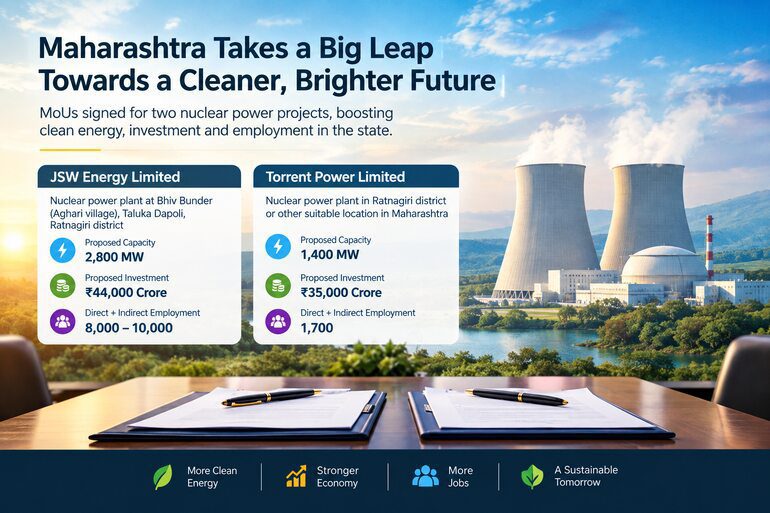
Maharashtra has taken a significant step towards expanding its nuclear power ambitions, with the state government signing MoUs with JSW Energy Limited and Torrent Power Limited for proposed nuclear power projects with a combined capacity of 4,200 MW.
The agreements, signed and exchanged in the presence of Hon’ble Chief Minister of Maharashtra Shri Devendra Fadnavis at Sahyadri Guest House in Mumbai, envisage a combined proposed investment of ₹79,000 crore. The projects are also expected to create thousands of direct and indirect employment opportunities if they progress through the necessary project development and approval stages.
The development adds another dimension to Maharashtra’s efforts to strengthen its long-term power generation capacity while attracting large investments into the state’s energy infrastructure.
Also Read: Aimtron Electronics Enters New Global Engagement with Curtiss-Wright
JSW Energy Proposes 2,800 MW Nuclear Plant in Ratnagiri
Under its MoU with the Maharashtra Energy Department, JSW Energy has proposed the development of a 2,800 MW nuclear power plant at Bhiv Bunder in Aghari village, Dapoli taluka, Ratnagiri district. The proposed project represents an investment of ₹44,000 crores and is expected to generate between 8,000 and 10,000 direct and indirect employment opportunities, according to the state government’s announcement.
The proposed Bhiv Bunder project accounts for the larger share of the combined capacity and investment covered by the two MoUs. Its development would place Ratnagiri at the centre of another major energy investment proposal in Maharashtra.
For JSW Energy, the proposed nuclear project also signals an interest in a generation technology that can provide firm power while complementing the company’s broader presence in India’s evolving energy sector.
Torrent Power Plans 1,400 MW Nuclear Project
Maharashtra has also signed an MoU with Torrent Power Limited for the development of a 1,400 MW nuclear power plant. The proposed project is planned for Ratnagiri district or another suitable location in Maharashtra. It carries a proposed investment of ₹35,000 crores and is expected to create around 1,700 direct and indirect employment opportunities.
Unlike the JSW Energy proposal, the location for the Torrent Power project has not been fixed in the announcement, with Ratnagiri or another suitable site in Maharashtra identified as possibilities. Together, the two proposals would add up to 4,200 MW of proposed nuclear capacity, backed by ₹79,000 crores in proposed investment.
Also Read: Industry Leaders Join WOWSemi to Strengthen India’s Semiconductor Talent Pipeline
What the Two MoUs Mean for Maharashtra’s Nuclear Ambitions
The scale of the proposals is notable not only because of the planned generation capacity, but also because of the investment and employment potential associated with them. The JSW Energy and Torrent Power proposals could collectively generate between 9,700 and 11,700 direct and indirect employment opportunities, based on the figures announced by the state government.
However, the MoUs represent an early stage in the development process. The proposed projects would still need to progress through the applicable technical, regulatory, environmental, nuclear safety and other statutory processes before construction and commercial generation can take place. This distinction is important as the signing of an MoU signals an investment and development intention rather than confirming that a project is ready for construction.
Ratnagiri Emerges as a Key Location
Ratnagiri features prominently in both proposals. JSW Energy has identified Bhiv Bunder in Dapoli taluka for its proposed 2,800 MW plant, while Torrent Power has identified Ratnagiri district or another suitable location in the state for its 1,400 MW project. The concentration of proposed nuclear investments in the region could bring greater attention to local infrastructure, industrial services, skilled manpower, logistics and other supporting requirements if the projects advance.
At the same time, large nuclear projects involve detailed site assessments and multiple layers of regulatory scrutiny. The progression from an MoU to an operating nuclear facility is therefore expected to involve several stages of evaluation and approval.
Also Read: Premier Energies Powers Into India’s BESS Boom with 12 GWh JV
A Larger Role for Nuclear Power in India’s Energy Mix?
The Maharashtra developments come at a time when nuclear power is receiving renewed attention in India’s long-term energy strategy. Unlike variable renewable sources, nuclear generation is designed to provide firm electricity supply, making it potentially complementary to solar and wind generation as power systems incorporate larger shares of renewable energy.
For Maharashtra, the proposed projects could therefore become part of a broader effort to build a more diversified electricity portfolio capable of supporting industrial growth and rising power demand. The immediate significance of the two MoUs, however, lies in the scale of the proposals: 4,200 MW of potential nuclear capacity and ₹79,000 crore of proposed investment from JSW Energy and Torrent Power.
The next question will be how these proposals progress through site evaluation, approvals and project development. If they move forward successfully, the two projects could give Maharashtra a much larger role in India’s emerging nuclear power expansion.

1 Comment
Pingback: Eplan Platform 2027 Brings AI to Engineering