



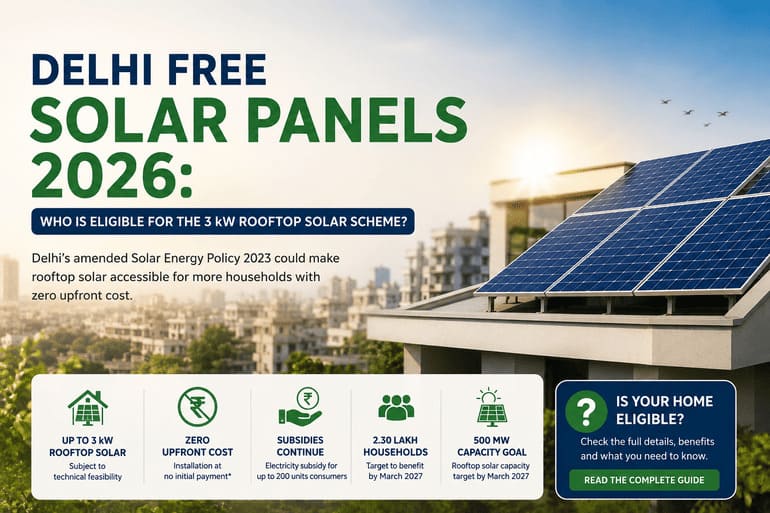
Delhi households looking to switch to rooftop solar are set to get a major boost under the amended Delhi Solar Energy Policy 2023. The Delhi Cabinet has approved the second amendment to the policy, under which eligible domestic consumers can have rooftop solar systems of up to 3 kW installed at zero upfront cost, subject to technical feasibility.
The initiative is aimed at households with average monthly electricity consumption of up to 400 units in FY 2025-26. The Delhi government has set a target of covering around 2.30 lakh households and adding about 500 MW of rooftop solar capacity across the capital by March 2027.
Also Read: Delhi Cabinet Approves Second Amendment for Zero-Cost Rooftop Solar Systems
Who Is Eligible for Rooftop Solar in Delhi?
Under the amended policy, domestic electricity consumers with an average monthly consumption of up to 400 units in FY 2025-26 are eligible for rooftop solar systems of up to 3 kW.
However, eligibility is also subject to technical feasibility. This means a household meeting the electricity-consumption criterion would still need to meet the applicable requirements for installing a rooftop solar system.
The 400-unit threshold is therefore an important point for Delhi residents considering the scheme.
How Much Rooftop Solar Can Eligible Households Get?
Eligible households can receive rooftop solar systems of up to 3 kW, subject to technical feasibility. The size of the system that is ultimately installed may depend on the household’s electricity consumption, available rooftop space and other technical considerations.
A 3 kW rooftop solar system can generate a significant amount of electricity for a typical household, although actual generation varies depending on factors such as sunlight, roof orientation, shading, system performance and weather conditions.
What Does Zero Upfront Cost Mean?
One of the biggest changes under the amended Delhi Solar Policy is the effort to remove the initial financial barrier to rooftop solar adoption. Under the revized arrangement, eligible households do not have to make the upfront payment for the installation, subject to the applicable policy conditions and technical feasibility.
The financial support is linked to central and Delhi government subsidies and an additional government top-up intended to cover the difference between the available subsidy and the tendered cost of the system. This approach is designed to make rooftop solar accessible to households that may otherwise find the initial installation cost difficult to afford.
Will Households Continue to Receive Electricity Subsidies?
The Delhi government’s revized solar policy has been presented alongside the continuation of existing electricity subsidy benefits for eligible consumers.
For households consuming up to 200 units a month, the existing electricity subsidy is expected to continue after installation of the rooftop solar system, according to the government’s announcement. This means eligible households could benefit from both rooftop solar generation and applicable electricity subsidy provisions, subject to the rules governing each benefit.
Delhi Solar Scheme: How Many Homes Will Benefit?
The Delhi government has set an ambitious target of installing rooftop solar systems across approximately 2.30 lakh households by March 2027.
The programme is also expected to add around 500 MW of rooftop solar capacity across Delhi. The large-scale target reflects the government’s effort to move rooftop solar beyond government and institutional buildings and increase adoption among residential consumers.
Why Is Delhi Promoting Rooftop Solar?
The high initial cost of installing solar systems has been one of the barriers to wider residential adoption. The revized Delhi Solar Policy seeks to address that problem by reducing or removing the upfront financial burden for eligible households.
The policy is also intended to increase renewable energy generation, encourage households to become electricity producers and reduce dependence on conventional power sources. Delhi’s initiative is also aligned with the broader national push for residential rooftop solar under the PM Surya Ghar initiative.
What Happens After Installation?
The rooftop solar system is expected to help households generate electricity for their own consumption. Depending on the applicable arrangements, excess electricity generated by a system may also be dealt with under the relevant grid-connected rooftop-solar provisions.
The actual savings and electricity generation will vary from household to household. Factors such as system capacity, electricity consumption, sunlight availability and rooftop conditions can affect the benefits.
Households should therefore check the latest official guidelines and application requirements before proceeding.
When Will the Delhi Solar Scheme Be Implemented?
The state government has set March 2027 as the target for installing rooftop solar systems across approximately 2.30 lakh households and adding around 500 MW of capacity.
Further implementation details, including the application process, vendor arrangements and technical requirements, will determine how quickly individual households can access the programme. Residents should rely on official Delhi government and Delhi Solar Portal updates for the latest application and eligibility information.
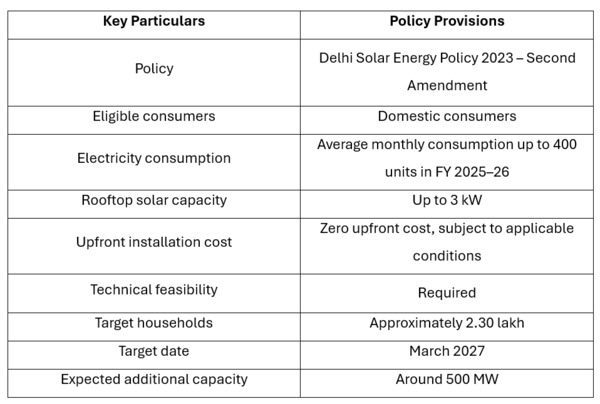
Delhi Solar 2026: Key Details at a Glance
What Should Residents Do Now?
Households interested in the scheme should first check their average electricity consumption and ensure that their rooftop is suitable for a solar installation. Residents should also keep an eye on official announcements by the state government and the Delhi Solar Portal for details about registration, approved vendors, documentation and installation procedures as the programme is rolled out.
The revized policy could significantly expand residential rooftop solar adoption in Delhi by addressing one of the biggest obstacles faced by households: the upfront cost of installation.

2 Comments
Pingback: Torrent Completes 322 MWp MSKVY Solar Projects
Pingback: GK Energy Wins 150 MW / 300 MWh BESS Award