



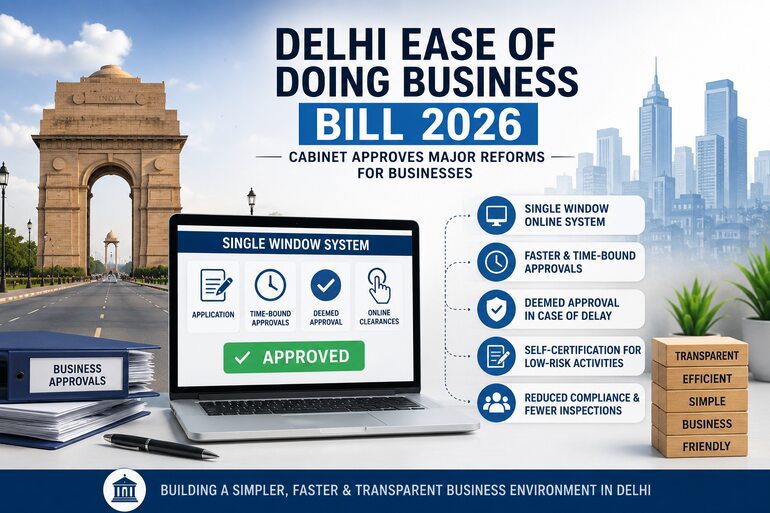
The Delhi Cabinet has approved the Delhi Ease of Doing Business Bill (EODB), 2026, proposing a major overhaul of the way businesses obtain approvals, registrations, licences and other clearances in the national capital. The proposed legislation aims to make business-related government processes faster, simpler, more transparent and technology-driven, with a strong focus on reducing regulatory delays and repeated compliance requirements.
The Bill was approved at a Cabinet meeting chaired by Hon’ble Chief Minister of Delhi Smt. Rekha Gupta. It proposes a single-window online system through which businesses can apply for a range of approvals, registrations, No Objection Certificates (NOCs), licences and other clearances.
The proposed system is expected to reduce the need for businesses to approach multiple government departments separately.
Single-Window System for Business Approvals
One of the central features of the proposed Delhi EoDB Bill is the creation of a single-window mechanism for business-related approvals. The system is proposed to cover requirements such as building plan approvals, fire-related clearances, water and sewer connections, electricity connections and other permissions required for setting up and operating an enterprise.
The Delhi State Industrial and Infrastructure Development Corporation (DSIIDC) is proposed to function as the nodal agency for the business approval system. The move is intended to provide businesses with a more streamlined route from application to final clearance.
Faster approvals and deemed approval provision
The Bill also seeks to address delays in government approvals by introducing prescribed timelines.
For activities covered under specified categories, approvals, permissions or licences could be granted immediately after submission of the required application, subject to the conditions laid down in the proposed legislation. For activities outside those categories, applications would be processed within the timelines prescribed under the Right to Timely and Easy Delivery of Services to Citizens Act, 2026.
A significant provision is the proposal for deemed approval. Where a competent authority fails to take a decision within the prescribed timeframe, approval could be treated as granted in cases covered by the proposed framework. This mechanism could reduce uncertainty for businesses waiting for regulatory clearances.
Self-certification for eligible low-risk businesses
The proposed Bill also introduces a trust-based approach for specified low-risk activities. Eligible enterprises would be permitted to use self-declaration or self-certification in specified cases, subject to the conditions and limits prescribed under the proposed law.
Reported examples of low-risk activities include certain non-polluting commercial, assembly and service operations. The approach is designed to allow eligible businesses to begin operations without going through lengthy approval procedures for every low-risk activity.
Fewer duplicate registrations
Another important proposal is the reduction of duplicate registrations. Businesses that are already registered under frameworks such as GST, the Food Safety and Standards Authority of India, the Micro, Small and Medium Enterprises Development framework or applicable labour codes may not have to obtain separate registrations for certain additional requirements, subject to the provisions of the proposed legislation.
The objective is to reduce repetitive paperwork and the compliance burden on enterprises. The Bill also proposes that businesses should not be repeatedly asked by different departments to submit information that is already available with another Delhi Government authority.
In effect, applicants would provide information to the government once rather than repeatedly submitting the same documents to different offices.
Three-year relief from routine inspections
The proposed legislation also contains a trust-based inspection framework. Eligible newly registered enterprises would generally not face routine inspections for the first three years after registration, although inspections could still be carried out in cases involving serious complaints or other circumstances covered by the proposed rules.
This provision is aimed at reducing unnecessary regulatory interruptions while retaining safeguards for serious violations and complaints.
Negative-list approach proposed
The Bill further proposes a negative-list-based system. Under this approach, enterprises could carry out activities at locations unless those activities fall within categories specifically prohibited or restricted under the relevant schedule of the proposed legislation. The proposed framework is intended to provide businesses with greater clarity about activities that are permitted while reducing unnecessary restrictions.
What the Delhi EoDB Bill could mean for businesses
If implemented in the proposed form, the reforms could significantly change how businesses interact with government departments in Delhi. Instead of navigating several departments independently, businesses could have access to a more integrated digital approval process.
The combination of online applications, fixed timelines, deemed approvals, self-certification and fewer duplicate registrations could potentially reduce the time, cost and uncertainty associated with starting and operating a business. For entrepreneurs, startups, MSMEs and investors, the proposed system could also provide greater predictability when planning new projects and expansions.
What happens next?
The Cabinet approval is an important step, but the Bill should not yet be treated as an enacted law. Following the Cabinet’s approval, the proposed legislation is being sent to the Ministry of Home Affairs for further action. The final implementation of the proposed reforms will therefore depend on the subsequent legislative and approval process.
Bottom line
The Delhi EODB Bill 2026 represents a proposed shift towards a more digital, time-bound and trust-based system for business approvals. Its key proposals, including a single-window system, deemed approvals, self-certification for eligible low-risk activities, fewer duplicate registrations and reduced routine inspections could make it easier for businesses to navigate Delhi’s regulatory framework if the measures are ultimately implemented.
