



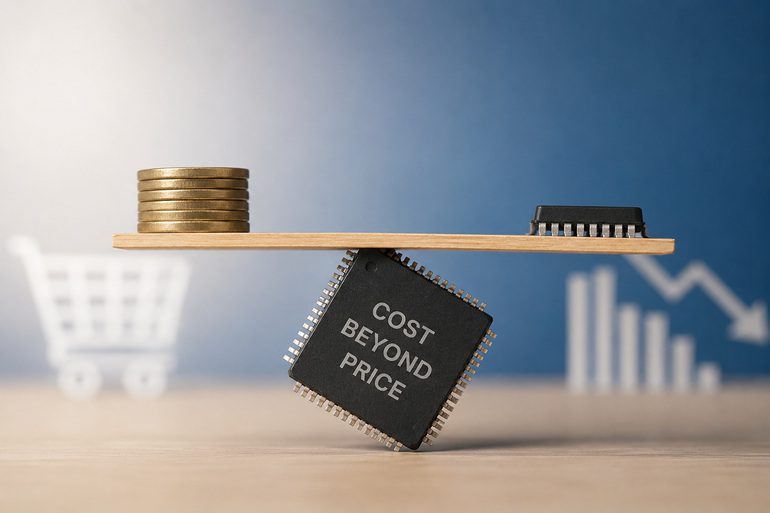
In electronics manufacturing, the lowest component price can sometimes be the most expensive decision.
For procurement teams under constant pressure to reduce costs, negotiating a lower price may seem like the obvious answer. But the real cost of sourcing an electronic component extends far beyond the figure on a supplier’s quotation. Shipping, inventory, quality issues, lead times and supply disruptions can all turn an apparent saving into an unexpected expense.
The challenge, therefore, is not simply to buy components cheaper. It is to make procurement smarter, more resilient and more cost-efficient without compromising quality.
A component that costs less to purchase can end up costing significantly more to the business once shipping, duties, inventory, quality failures, delays and production disruptions are taken into account. In an industry where a component shortage can hold up an entire production line, focusing too heavily on unit price can create savings on paper while increasing costs elsewhere.
The better question is not How cheaply can we buy this component? It is How efficiently can we procure it without compromising quality, reliability or supply continuity?
That shift in thinking is becoming increasingly important for electronics manufacturers.
Also Read: The Next AI Boom May Be Happening Inside India’s Telecom Networks
The Lowest Price Is Not Always the Lowest Cost
The quoted price of an electronic component represents only one element of procurement cost. Shipping and logistics, import duties, minimum order quantities, inventory carrying costs, quality rejection, warranty claims and emergency purchases can all add to the final bill. Even lead time has a financial impact. If a low-cost component takes significantly longer to arrive, manufacturers may need to carry additional inventory or expedite shipments to prevent production delays.
This is why the supplier offering the lowest unit price should not automatically be considered the most cost-effective supplier. Procurement decisions need to look at the total cost of acquiring and managing a component, rather than treating the purchase price as the entire equation.
Sometimes the Best Cost Saving Starts With the BOM
There is also a strong case for looking upstream. Instead of immediately negotiating with suppliers, manufacturers can examine whether every component in the Bill of Materials (BOM) is actually necessary at its current specification and cost. Engineers may find components that are significantly over-specified for their application, multiple parts performing similar functions or an unnecessarily large number of part-number variations.
Standardizing components where practical can simplify procurement and inventory management. Similarly, identifying technically equivalent alternatives can create greater purchasing flexibility and reduce dependence on a single manufacturer. Of course, this is not an argument for simply replacing components with cheaper versions. Any BOM change needs to be evaluated from an engineering and quality perspective.
The real opportunity lies in removing unnecessary cost, not necessary performance.
Also Read: Yamaha Prepares India Business for Next-Generation Mobility With YEIN Integration
Alternative Components Can Improve Resilience as Well as Cost
Component substitution is often viewed primarily as a cost-saving exercise. It can be much more valuable than that. A qualified second-source component can give manufacturers an alternative when prices rise, lead times stretch or a preferred component becomes unavailable. Local suppliers and alternative manufacturers may also provide options that were not considered during the original product design.
But price should never be the only qualification criterion. Electrical and mechanical specifications, thermal characteristics, reliability, certifications, lifecycle status and application requirements all need to be considered. A substitution that saves a few percentage points on component cost but introduces reliability problems is not a successful procurement strategy. The best alternatives are those that provide commercial flexibility without creating technical risk.
Total Cost of Ownership Should Matter More Than Unit Price
Consider two suppliers. One offers a lower component price but requires a large MOQ has a longer lead time and has experienced inconsistent quality. Another charges slightly more per unit but provides shorter lead times, more consistent quality and greater flexibility in order quantities.
The first supplier may win a conventional price comparison. The second may win when the entire procurement equation is considered. Lower inventory requirements can reduce working capital. Better quality can reduce rejection and warranty costs. Shorter lead times can reduce the need for expensive expediting. More reliable supply can reduce the risk of production interruptions.
This is why Total Cost of Ownership (TCO) deserves greater attention in electronics procurement. The cheapest invoice is not necessarily the cheapest supply relationship.
Negotiation Should Go Beyond Price
There is also more to supplier negotiation than asking for a lower per-unit price. Procurement teams can negotiate volume-based pricing, payment terms, MOQ, lead times, shipping arrangements and longer-term agreements. Forecast-based procurement can help suppliers plan production, while arrangements such as consignment inventory may help manufacturers manage working capital and availability.
Price-lock agreements can also provide greater cost predictability in markets where component prices fluctuate. The point is to negotiate the entire commercial relationship, rather than focusing on one number in a quotation. A supplier that cannot reduce the unit price may still be able to offer better payment terms, shorter lead times or greater inventory flexibility, all of which can affect the actual cost to the manufacturer.
Inventory Is a Cost Too
Another area that deserves greater attention is excess inventory. In electronics, holding large quantities of components may seem like a sensible way to protect against shortages. But components can become obsolete, demand can change and product designs can evolve.
The result can be slow-moving or unusable stock that ties up capital. At the other extreme, insufficient inventory can lead to emergency purchases, expensive freight and production delays.
The objective therefore should not be to minimize inventory at any cost. It should be to find the right balance between availability and inventory exposure. Better forecasting, supplier collaboration and visibility into component demand can help manufacturers achieve that balance.
One Supplier May Be Convenient. Two May Be Safer
The same principle applies to supplier concentration. Relying heavily on one supplier can simplify procurement, but it also creates vulnerability. A capacity issue, geopolitical disruption, logistics problem or component shortage at that supplier can quickly become a manufacturing problem.
A qualified dual-source or multi-source strategy can provide an important layer of protection. This does not mean every component needs multiple suppliers. Qualification itself requires time and resources. Instead, manufacturers can identify strategically important or high-risk components and develop alternative sources where the potential disruption justifies the investment.
Supplier diversification is therefore not simply a procurement tactic. It is increasingly part of supply-chain risk management.
Is Local Sourcing Really Cheaper?
For manufacturers in India, the local-versus-global sourcing debate adds another dimension. Local sourcing can offer shorter logistics chains, potentially faster delivery, easier communication and reduced exposure to some international supply-chain disruptions.
Global suppliers, meanwhile, may offer broader component availability, established manufacturing ecosystems and economies of scale. Neither approach is automatically cheaper. A global supplier may offer an attractive factory price but incur additional freight, duties and longer lead times. A local supplier may have a higher unit price but provide faster replenishment and lower logistical complexity.
The right comparison is therefore not local price versus global price. It is local total cost versus global total cost.
Cost Reduction Should Never Mean Lowering the Quality Bar
Perhaps the biggest danger in procurement-led cost reduction is treating quality as an area where compromises can be made. Removing necessary testing, accepting unqualified substitutes, overlooking certifications or selecting components solely because they are cheaper may reduce immediate costs. But the consequences can appear later in the form of field failures, warranty claims, customer dissatisfaction or reputational damage.
Quality requirements should be established before suppliers are compared. Once technical suitability, reliability and qualification criteria are defined, procurement teams can focus on finding the most competitive option within those boundaries. That is a much more sustainable approach than lowering the boundaries themselves.
The Procurement Question Needs to Change
Electronics manufacturers are operating in an environment where component availability, pricing and supply-chain conditions can change quickly. In that environment, procurement cannot be viewed simply as a function responsible for getting the lowest possible price. It needs to become a strategic exercise in balancing cost, quality, availability and risk.
Also Read: Food-Safe Drives from NORD Offer a Lightweight Alternative to Stainless Steel
Before selecting a supplier, procurement and engineering teams should ask:
- Is the component technically suitable?
- Is there a qualified second source?
- What is the total landed cost?
- What are the MOQ and actual lead time?
- What quality certifications are available?
- Can the supplier meet future production requirements?
- How does the supplier manage quality failures?
- What are the risks of relying on this supplier?
- What happens if the component becomes unavailable?
These questions may not produce the lowest price on every purchase. They can, however, produce something more valuable: a lower and more predictable total procurement cost without sacrificing the reliability of the final product.
For electronics manufacturers, that should be the real definition of cost optimization.
