



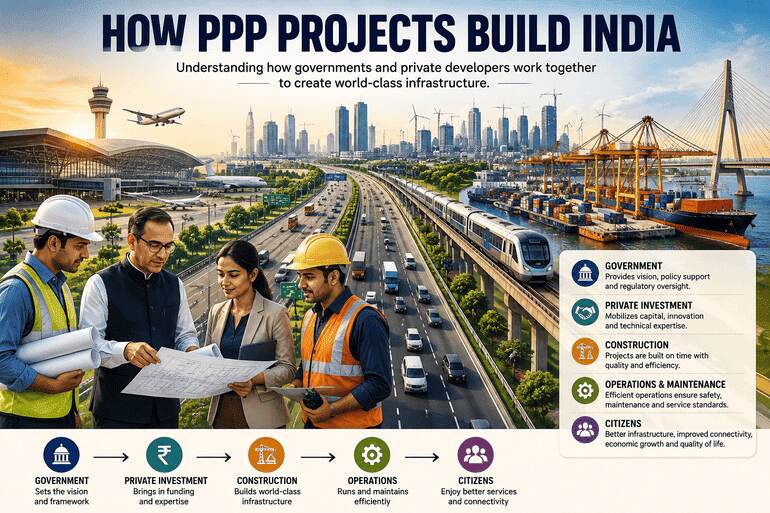
“If airports are earning from hotels, shopping malls, restaurants and advertisements, why am I still paying airport charges?” It is a question that almost every frequent flyer has asked at some point.
Walk through Delhi’s Indira Gandhi International Airport today and you will notice that it is much more than a place where aircraft take off and land. It is an entire commercial ecosystem. There are luxury hotels, premium lounges, international retail brands, food courts, cafes, office spaces, parking facilities, duty-free outlets and advertising displays that generate significant revenue every single day.
To an ordinary passenger, the obvious question is: If the airport is already earning from so many businesses, why does it still collect User Development Fees (UDF), Airport Development Fees (ADF) and other passenger charges?
The same question often extends beyond airports.
Why do we continue paying tolls on highways years after they have been built?
Why are metro fares revized periodically even though commercial spaces inside stations are leased out?
If private companies are making money from infrastructure projects, shouldn’t the public benefit through lower user charges?
Questions such as these have become increasingly common as India witnesses one of the fastest infrastructure transformations in its history. Over the last two decades, the country has invested heavily in expanding airports, expressways, metro rail networks, ports and logistics corridors. While these projects have significantly improved connectivity and boosted economic activity, they have also sparked an important debate among citizens: if private companies are involved in building and operating public infrastructure, why do users continue to pay tolls, airport charges and other service fees?
The answer lies in understanding the economics behind Public-Private Partnership (PPP) projects. Infrastructure development is not limited to constructing roads, airports or metro systems. It also involves arranging long-term financing, managing operational risks, maintaining assets for decades and ensuring that both public interest and private investment remain balanced. Every infrastructure project represents a carefully structured financial model rather than a simple construction contract.
Unfortunately, much of this financial framework remains outside public discussion. Conversations often focus on the charges paid by commuters or passengers, while the complex mechanisms governing investment, revenue sharing, maintenance obligations and regulatory oversight receive far less attention. As a result, PPP projects are frequently viewed only through the lens of user charges rather than the broader economic model that makes such large-scale infrastructure development possible.
Understanding how this ecosystem works offers a more balanced perspective on India’s infrastructure journey. It explains why governments increasingly collaborate with private developers, how commercial revenues are distributed, why user charges continue to exist even after projects become operational, and how these partnerships are designed to create infrastructure that serves the nation while remaining financially sustainable over the long term.
Also Read: POM Power and BEL Join Hands to Develop a Clean Energy Hub
India Needs Infrastructure Faster Than Public Money Can Build It
Imagine that a family wants to build its dream home costing ₹2 crores. The family has savings of only ₹50 lakhs. Waiting until they save the remaining amount could take another 15 or 20 years. Instead, they approach a bank, contribute their savings as equity and borrow the remaining amount through a home loan. They move into the house immediately while gradually repaying the loan over the next two decades.
Now replace the family with the Government of India. Instead of one house, imagine thousands of kilometres of highways, dozens of airports, dedicated freight corridors, ports, metro rail networks, tunnels, bridges and logistics parks, all requiring investment simultaneously. India cannot afford to wait 20 years to build one highway before starting another. The country’s economic growth depends on creating infrastructure continuously. However, governments have another responsibility. They also have to spend on healthcare, education, defence, rural development, agriculture, drinking water, pensions and social welfare schemes.
Every rupee spent on building an airport is a rupee that cannot simultaneously be spent on building a hospital or improving public schools. This is precisely why governments across the world increasingly rely on Public-Private Partnerships, commonly known as PPPs. Rather than funding every project entirely through taxpayers’ money, governments invite private companies to invest their own capital, build the infrastructure, operate it efficiently and recover their investment over a defined period. The government gets modern infrastructure without bearing the entire financial burden upfront, while private developers receive an opportunity to earn a reasonable return on the enormous investments they make.
PPP Is Not the Same as Privatization
Perhaps the biggest misunderstanding surrounding PPP projects is the belief that the government has “sold” public assets to private companies. That is rarely true. Consider a simple example.
Suppose you own a commercial building but lease it to a company for twenty years. During those twenty years, the company operates the building, collects rent from tenants, maintains the premises and earns income from it.
Have you sold your building? Of course not. You continue to own the property. You have merely granted someone the right to operate it under agreed conditions. The same principle applies to most airport, highway and port PPP projects.
The government continues to own the underlying asset. The private company receives the right to design, finance, build, operate and maintain the infrastructure for a fixed concession period, which may extend to twenty, thirty or even forty years depending on the project. Once the concession period ends, the asset remains with or returns to the government under the terms of the agreement. In other words, PPP is better understood as a long-term partnership rather than a sale of public property.
Also Read: Nordex Expands Chennai Manufacturing Base, to Create 1,000 New Jobs
Why Would Any Private Company Invest Thousands of Crores?
Let’s look at this from another perspective. Suppose a person approaches you with a proposal.
“I want you to invest ₹15,000 crores in building an airport. Construction will take around 6-8 years. You’ll borrow heavily from banks, pay interest every month, employ thousands of engineers and workers, maintain the airport for the next thirty years and comply with strict safety regulations. But you won’t be allowed to earn a reasonable return.”
Would you invest? Probably not. Infrastructure is among the most capital-intensive businesses in the world.
Building an airport is not like opening a restaurant or launching an online business. Before the first passenger even enters the terminal, thousands of crores have already been invested in land development, runways, taxiways, terminal buildings, baggage handling systems, airfield lighting, navigation equipment, fire stations, security infrastructure, utilities and digital systems.
Much of this money comes from bank loans. Banks do not lend money because they are optimistic; they lend because they expect repayment with interest. Similarly, investors commit equity because they expect a reasonable return over time.
A fundamental principle behind most Public-Private Partnership (PPP) projects is that private developers should have an opportunity to earn a reasonable return on the capital they invest. This is not about guaranteeing excessive profits; it is about ensuring that large infrastructure projects remain financially viable for companies willing to commit substantial long-term investments.
Consider what it takes to develop a modern airport, expressway or metro network. The developer typically invests thousands of crores, raises debt from banks and financial institutions, navigates regulatory approvals, manages construction risks and takes responsibility for operating and maintaining the asset for decades. Such investments are often recovered over a period of 20 to 40 years, depending on the concession agreement and the nature of the project.
For any investor, the decision to commit capital depends on one basic question: Will the project generate a reasonable return after accounting for the risks involved? If the answer is consistently negative, private investment is unlikely to flow into infrastructure, regardless of how important the project may be for the country’s development. This is precisely why PPP frameworks are structured to balance public interest with commercial viability. The objective is not to maximize profits for developers but to create an environment where private capital is willing to participate in building infrastructure that governments alone may struggle to finance at the required scale.
Finding this balance is one of the biggest challenges in designing PPP projects. Returns must be attractive enough to encourage investment, while regulatory oversight ensures that users continue to receive quality infrastructure at fair and reasonable prices. Achieving that equilibrium is what ultimately determines whether a PPP project succeeds in delivering long-term value for both the nation and its citizens.
Also Read: Cosmic PV’s 1.10 GW Solar Cell Project Secures CTE Approval
But If Airports Earn So Much Money, Why Do Passengers Still Pay?
This is perhaps the most common question raised whenever airport user charges come up for discussion. Modern airports are no longer just transit hubs where passengers check in, board a flight and leave. Over the past two decades, airports have evolved into thriving commercial destinations. A traveller walking through a large airport such as Delhi, Mumbai or Bengaluru is likely to pass luxury retail stores, coffee chains, restaurants, duty-free shops, business lounges, premium parking facilities, hotels and large digital advertising displays before even reaching the boarding gate. To many passengers, it naturally appears that airports must already be earning substantial revenues from these commercial activities. If that’s the case, why should passengers continue paying airport development fees or user charges?
The answer lies in understanding that earning revenue is not the same as earning profit. A useful analogy is that of a modern shopping mall. A mall owner may collect rent from hundreds of retail outlets, lease space for advertising, earn from parking facilities and even host promotional events throughout the year. From the outside, it may seem like the mall is generating income from every corner of the property. Yet those revenues are only one side of the equation. The mall must continuously spend on electricity, air-conditioning, housekeeping, security, fire safety systems, elevators, landscaping, structural maintenance, property taxes, insurance and periodic renovations to remain attractive to both retailers and customers. Having multiple revenue streams does not eliminate the equally significant cost of operating and maintaining a large commercial asset.
Airports operate on a similar principle, although on a much larger and far more complex scale. Beyond the visible commercial establishments, airport operators are responsible for maintaining runways, taxiways, baggage handling systems, passenger terminals, airfield lighting, navigation equipment, security infrastructure, firefighting services, digital systems and countless other facilities that operate round the clock. They must also invest regularly in technology upgrades, safety enhancements, capacity expansion and regulatory compliance, all while ensuring that airport operations remain uninterrupted. These are recurring costs that continue long after the airport has been built.
Also Read: India’s ₹5,070 Crore Floating Solar Push Aims to Add 5 GW Capacity
Another aspect that is often overlooked is that not every rupee generated from commercial activities is freely available to the airport operator. The financial structure of every airport depends on the concession agreement signed with the government and the regulatory framework under which it operates. This determines how different streams of revenue are treated, how airport charges are calculated and, in many cases, how much of the income generated by the airport is shared with the government. Consequently, the operator cannot simply offset all passenger charges against commercial earnings because the contractual framework governing the project may require revenues to be allocated in specific ways.
This is where concepts such as aeronautical revenue, non-aeronautical revenue, Single Till, Double Till and revenue-sharing mechanisms become central to understanding airport economics. These may sound like technical terms, but they directly influence how airport charges are determined and how the financial interests of passengers, private developers and the government are balanced. They are also the reason why two airports of similar size may have different charging structures despite both earning significant commercial revenues.
Therefore, while it is easy to assume that restaurants, retail stores and hotels inside airports generate enough income to eliminate passenger charges, the reality is far more complex. Airport economics is built around a carefully structured financial model that must recover substantial long-term investments, fund continuous maintenance and technological upgrades, support future expansion, and provide a reasonable return to investors who have committed significant capital to the project. At the same time, the entire framework operates within a regulatory environment designed to protect public interest and ensure accountability.
Understanding these financial principles helps explain why commercial revenues alone cannot always replace passenger-related charges. The overall financial sustainability of an airport depends on how different revenue streams are structured, regulated and shared under the applicable concession agreement. Appreciating this broader economic framework offers a more informed perspective on why user charges remain an integral part of many modern airport PPP projects.
However, airport economics extends beyond simply earning revenues from airlines, retail outlets or commercial developments. Equally important is understanding how these revenues are classified, how they are shared between private operators and the government, and how regulatory frameworks influence the charges ultimately paid by passengers. It is this financial architecture that forms the foundation of every airport PPP project and determines whether the interests of investors, operators, governments and the travelling public remain appropriately balanced.
* This opinion piece is based on publicly available information, established industry practices and editorial research. The views and analysis presented are intended to provide an independent perspective on the functioning of Public-Private Partnership (PPP) projects and infrastructure financing in India.
