



Tau, a leader in advanced electrification, introduced Ion, its breakthrough software-defined power electronics platform, at CES 2026. Engineered for scalability and cross-industry adoption, the Tau Ion platform supports high-performance power conversion across mobility, energy, industrial, and grid applications, powering everything from charging systems and motor drives to data centers and distributed energy networks.
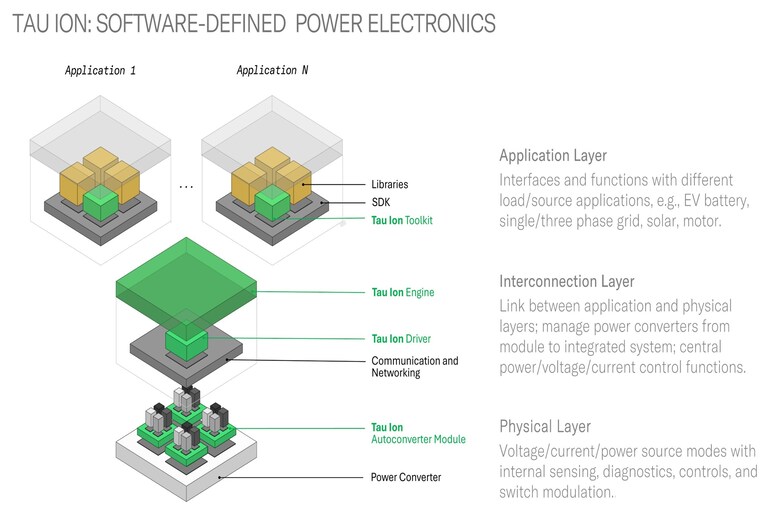
At its core, Tau Ion features a modular, multi-layer architecture that seamlessly combines advanced hardware, intelligent firmware, and scalable software libraries. This integrated design enables developers and partners to build and deploy flexible, high-efficiency power converters while reducing system costs, improving performance, and accelerating time to market compared to conventional, application-specific solutions.
“Power converters are fundamental to how energy moves around the world, and Ion reinvents how they are built and deployed,” said Wesley Pennington, Founder and CEO of Tau. “Developing conventional power electronics requires significant capital investment and highly specialized expertise, while off-the-shelf solutions force compromises in efficiency, cost, and packaging. Ion delivers a modular, software-defined alternative that enables rapid, cost-effective deployment of highly efficient power systems—accelerating electrification and the deployment of new energy resources across industries.”
Tau has demonstrated that Ion-based converters achieve efficiencies exceeding 99%, delivering significant system-level performance gains while reducing overall converter size and cost. These advancements stem from Tau Ion’s ability to address critical power electronics challenges through standardized, modular building blocks that streamline design and enhance scalability.
“Each Ion module abstracts the underlying power electronics hardware, integrating optimized circuitry, low-level controls, filtering, protection, and waveform generation through tightly coupled hardware and firmware,” said Matthias Preindl, Chief Scientist of Tau. “Modules are networked, or interconnected, via a real-time communications layer that enables coordinated control, protection, and diagnostics across the system. At the highest level, applications are defined through software control sets and common libraries, requiring only application-specific functionality to be added and validated, significantly reduces development time, cost, and risk.”
Unveiled publicly at CES 2026, Tau Ion systems feature dynamic reconfiguration capabilities, allowing individual modules to be brought on- or off-line to form adaptable, shared power resources. This flexibility enables a wide range of applications, from N-in-1 architectures for automotive platforms to reconfigurable, self-healing microgrids designed for smart energy and infrastructure systems.
Today, Tau is collaborating with partners across industries to develop and deploy solutions on the Ion platform, accelerating the global shift toward electrification and the integration of next-generation energy technologies.
Key Advantages of the Tau Ion Platform
- Cross-Industry Versatility
The Tau Ion platform supports diverse power conversion needs across mobility, energy, industrial, and grid sectors—powering everything from EV charging and motor drives to solar, data centers, and distributed energy systems. - Software-Defined Power Architecture
By decoupling software from hardware, Tau Ion allows new power converter applications to be created, updated, and deployed through software, eliminating the need for costly hardware redesigns. - Modular and Scalable Design
Its standardized modules can be combined or reconfigured on demand, enabling developers to scale systems seamlessly for varying power levels and architectural requirements. - Industry-Leading Efficiency
With demonstrated efficiencies above 98-99%, Ion minimizes power loss, enhances thermal management, and reduces operational costs even under partial loads. - Reduced System Costs
The platform addresses critical power electronics challenges at the module level, cutting bill-of-material complexity, engineering effort, and validation expenses across entire systems. - Superior System Performance
Advanced waveform generation technology lowers electromagnetic interference (EMI) and significantly reduces high-frequency switching losses, improving overall system reliability and motor control efficiency. - Accelerated Time to Market
Shared hardware and software libraries simplify application-specific development and validation, allowing faster rollout across programs and industries. - Intelligent, Resilient Operation
Built-in networking, coordinated control, and real-time diagnostics provide fault tolerance, predictive protection, and self-healing capabilities for complex power systems.
