



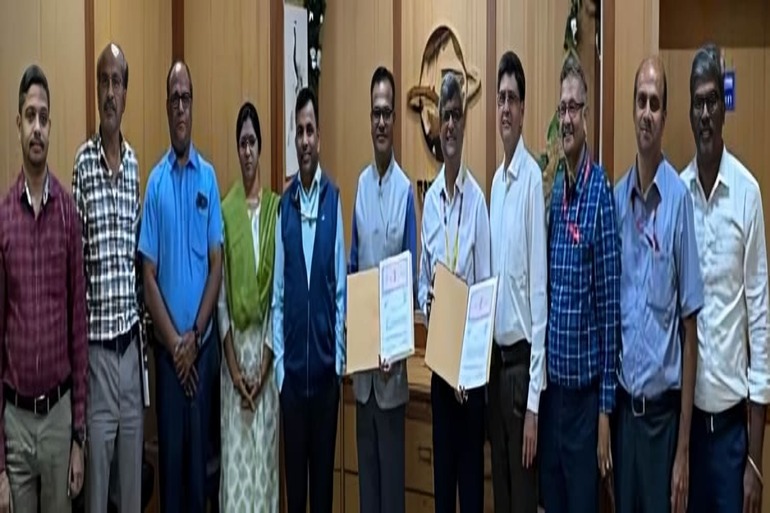
A new step toward developing affordable, homegrown battery technology has been taken with the signing of a Memorandum of Understanding (MoU) between the International Advanced Research Centre for Powder Metallurgy and New Materials (ARCI) and Voltasun Technologies Pvt. Ltd. The agreement focuses on validating and potentially commercializing sodium-ion battery technology based on Sodium Vanadium Phosphate (NVP) cathode material, a promising alternative to lithium-ion batteries.
The MoU, signed on December 15, 2025, enables ARCI to develop and supply 80 pouch cells, each with a capacity of 5Ah, to Voltasun for industrial-scale performance evaluation. If successful, this validation could pave the way for cost-effective, safer, and more sustainable sodium-ion batteries suitable for electric vehicles, portable electronics, and renewable energy storage systems.
ARCI, an autonomous R&D center under the Department of Science and Technology (DST), has already demonstrated strong lab-scale performance for its NVP-based sodium-ion cells under the ANRF MAHA EV project. The collaboration with Voltasun will now extend this validation to real-world industrial conditions.
Voltasun Technologies, a materials-to-cells startup specializes in active battery materials, cell manufacturing, and scale-up consultancy. Its established customer network will help assess the broader commercial potential of ARCI’s sodium-ion technology, particularly in stationary energy storage applications.
The partnership will unfold in two stages: the first phase includes supplying 80 cells and collecting performance feedback; the second phase will involve two more batches of 80 cells each under a separate agreement.
This initiative highlights ARCI’s ongoing efforts to bring Indian R&D to the industrial forefront and to strengthen the nation’s pursuit of self-reliance in advanced energy storage systems.
*”This article is based on a press release from the Press Information Bureau (PIB), Government of India. Content reproduced free of charge with source acknowledgment as per PIB policy.”

1 Comment
Pingback: LONGi Back Contact Modules Power Major Hungarian Solar Park